

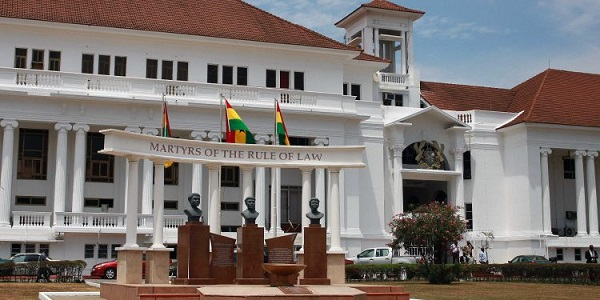
When Justice Bows to Power—A Dangerous Descent into Legal Nihilism.
By Ricky Ryan
The article under reference attempts to interrogate the compatibility of the 25 February 2026 decision of the Supreme Court of Ghana with constitutional and international human rights standards. Yet, beyond its legal technicalities lies a far more troubling reality: the creeping normalization of judicial conduct that appears increasingly aligned with political expediency rather than principled justice.
- When Courts Drift from Justice to Expediency:
A judiciary derives its legitimacy not from authority alone, but from fidelity to justice. The Constitution of Ghana itself affirms that justice “emanates from the people” and must be administered independently.
However, when courts selectively interpret rights or appear to sidestep binding international obligations, they risk descending into what can only be described as institutionalized arbitrariness—a condition indistinguishable from the caricature of “kangaroo justice” often associated with fragile states.
This is not a rhetorical exaggeration. The ECOWAS Court of Justice has already found Ghana responsible for arbitrary detention and violations of fundamental rights of Western Togoland activists.
Yet, the persistent gap between such rulings and domestic judicial or executive compliance raises a critical question:
What becomes of justice when binding regional decisions are treated as optional?
- The Criminalization of Self-Determination:
The people of Western Togoland have, for decades, pursued claims rooted in historical grievances and the internationally recognized principle of self-determination.
Instead of addressing these claims through lawful dialogue, the response has too often been criminalization, arbitrary arrests, and suppression of peaceful advocacy.
Such an approach does not resolve conflict—it radicalizes it.
When peaceful avenues are systematically closed, those who feel “their backs are pinned to the wall” may conclude—rightly or wrongly—that law itself has failed them. History shows where such trajectories lead.
- The Dangerous Precedent: From Legal Failure to Violent Escalation.
The world does not need another reminder of how unresolved grievances metastasize into protracted conflict. The tragedy between Palestinians and Israelis stands as a stark illustration of what happens when:
*International law is inconsistently applied
*Judicial remedies are perceived as compromised
*Political actors prioritize expediency over justice
When institutions fail, anger fills the vacuum.
It is therefore dangerously naïve to dismiss the grievances in Western Togoland as mere “security concerns.”
They are, fundamentally, justice concerns.
- The Silence—and Negligence—of the United Nations System:
Equally troubling is the muted posture of the United Nations.
Western Togoland’s historical roots trace back to a UN Trusteeship arrangement whose resolution remains contested in the eyes of many. Yet, there has been no robust, sustained UN-led mechanism to:
*Review the legitimacy of the 1956 plebiscite process
*Facilitate dialogue between parties
*Ensure enforcement of human rights obligations
This vacuum of international accountability emboldens domestic inertia. Silence, in this context, is not neutrality—it is complicity through neglect.
- A Direct Appeal to Conscience
To political actors who look the other way while innocents suffer:
History is unforgiving.
Judges, legislators, and executives who rationalize injustice for short-term stability often become architects of long-term instability. The erosion of justice does not remain confined to one region—it spreads, undermining the legitimacy of the entire state. - Practical Solutions: A Path Forward
The situation is not irredeemable—but it demands courage and integrity from duty bearers:
A. Immediate Compliance with Regional Judgments:
Ghana must fully implement rulings of the ECOWAS Court, including reparations and cessation of arbitrary detentions.
B. Internationally Supervised Dialogue
The United Nations and African Union should jointly facilitate structured negotiations between Ghana and Western Togoland representatives.
C. Independent Historical and Legal Review
Establish a neutral international commission to examine:
*The legality of the 1956 plebiscite
*Subsequent governance arrangements
D. Democratic Expression of Will
If warranted, organize a credible, internationally supervised referendum, ensuring:
*Inclusivity
*Transparency
*Security
E. Judicial Reform and Accountability
Strengthen safeguards to ensure that domestic courts remain independent not only in theory, but in practice, and aligned with international human rights standards.
- Final Word: Justice Is Not Optional
A judiciary that trades justice for political convenience does not preserve the state—it imperils it.
A government that ignores lawful grievances does not secure peace—it postpones conflict.
And an international community that looks away does not maintain neutrality—it enables injustice.
The choice before Ghana—and the world—is clear:
Either restore faith in justice now, or confront the consequences of its collapse later.
Readers might recall how the same Apex Court in Ghana in their attempt to please politicians, made the most ridiculously illogical ruling that birth certificates are invalid for proving citizenship. Yet they themselves obtained their passports with the very birth certificates and used the very passports to prove their Ghanaian citizenships!
Ricky Ryan
African Diasporan