

By Leo Nelson
A coalition of fourteen civil society organizations has formally applied to join the ongoing Supreme Court case challenging the prosecutorial powers of Ghana’s Office of the Special Prosecutor, marking a significant escalation in the national debate over the future of the country’s anti-corruption architecture.
The groups filed an application on May 5, 2026, seeking leave to participate in the constitutional suit as amici curiae, or friends of the court, in the case of Adamtey v Attorney General [Suit No. J1/3/2026].
The constitutional action questions the legality of key provisions within the Office of the Special Prosecutor Act, 2017 (Act 959), particularly those relating to the prosecutorial authority of the Office of the Special Prosecutor.
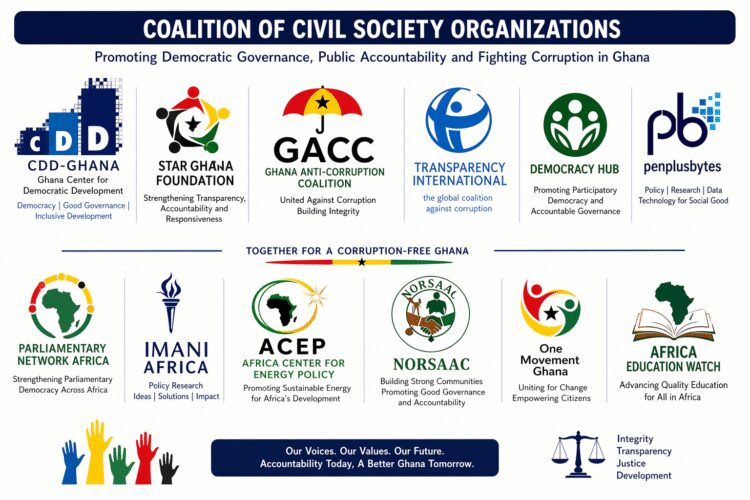
The coalition includes some of Ghana’s most prominent governance, accountability, and policy advocacy institutions, including the Ghana Center for Democratic Development (CDD-Ghana), Transparency International Ghana, the Ghana Anti-Corruption Coalition (GACC), Democracy Hub LBG, and STAR-Ghana Foundation.
Others include NORSAAC, Penplusbytes, the Africa Center for Energy Policy (ACEP), Odekro Parliamentary Monitoring Organization, A Rocha Ghana, Parliamentary Network Africa (PN Africa), IMANI-Africa, the One Ghana Movement, and Africa Education Watch.
In a joint statement issued on Wednesday, May 6, 2026, the organizations explained that their intervention is intended to support the Supreme Court with institutional, constitutional, and public interest perspectives relevant to the case.
Constitutional Questions at the Centre
The case before the Supreme Court has emerged as one of the most consequential legal battles surrounding Ghana’s anti corruption framework since the establishment of the Office of the Special Prosecutor in 2017.
The plaintiff in the suit is challenging the constitutionality of aspects of the OSP Act, raising questions over whether Parliament can grant prosecutorial authority to the Special Prosecutor independent of the Attorney General.
The matter has gained national attention following recent High Court rulings that questioned the prosecutorial authority of lawyers acting on behalf of the Office of the Special Prosecutor and other state investigative bodies without express authorization from the Attorney General.
These legal disputes have already resulted in adjournments and procedural interruptions in several ongoing corruption-related cases, fueling broader concerns about the operational future of the anti-corruption institution.
The civil society organizations described the case as one involving “questions of profound constitutional importance.” They noted that the Supreme Court’s eventual interpretation would have major implications for accountable governance, institutional independence, and Ghana’s anti-corruption fight.
CSOs Cite Historical Involvement in OSP Creation
The coalition emphasized that several of the applicant organizations were directly involved in the advocacy, drafting, and parliamentary process that led to the creation of the Office of the Special Prosecutor nearly a decade ago.
According to the statement, the Ghana Anti-Corruption Coalition, CDD-Ghana, and Transparency International Ghana jointly submitted one of the most extensive civil society memoranda to Parliament’s Constitutional, Legal and Parliamentary Affairs Committee during deliberations on the OSP Bill in 2017.
The groups argue that this historical involvement gives them important institutional memory that could assist the Supreme Court in understanding the legislative intent behind the establishment of the anti corruption office.
“The Applicants take this opportunity to emphasize that their intervention is not partisan, adversarial, or personal to any party before the Court.
“It is motivated solely by a shared commitment to constitutionalism, accountable governance, anti-corruption, institutional integrity, and the preservation of independent public institutions established to serve the Republic.”
Supreme Court’s Growing Openness to Amicus Participation
The coalition also commended the Supreme Court for what it described as an increasing openness to amicus curiae participation in major constitutional matters.
According to the organizations, allowing structured civil society engagement in constitutional adjudication has enriched judicial deliberations in cases that carry substantial public interest implications.
The statement described the trend as evidence of the “maturing of constitutional practice in Ghana.” Legal analysts say the involvement of civil society groups as amici curiae could broaden the legal and policy dimensions considered by the Court, particularly in cases involving constitutional interpretation and public accountability.
Amicus curiae applications are often used to provide courts with expert perspectives, comparative international experience, and broader societal considerations beyond the immediate arguments of the principal parties in a case.
Broader Stakes for Ghana’s Anti Corruption Fight
The constitutional challenge arrives at a sensitive moment for Ghana’s anti corruption institutions. Recent judicial rulings demanding proof of prosecutorial authorization from the Attorney General have generated uncertainty over the operational independence of the Office of the Special Prosecutor and agencies such as the Economic and Organised Crime Office.
Several governance experts and policy advocates have warned that prolonged legal uncertainty could weaken public confidence in anti corruption enforcement and disrupt ongoing prosecutions.
The latest intervention by civil society organizations reflects growing concern among governance actors that the outcome of the Supreme Court case could significantly reshape Ghana’s accountability architecture.
The coalition is being represented by a legal team that includes Kizito Beyuo Esq, Oliver Barker Vormawor Esq, Samson Lardy Anyenini Esq, and Clement Kojo Akapame Esq.
The Supreme Court is expected to determine whether the organizations will be granted leave to participate in proceedings as the constitutional battle over the powers of the Office of the Special Prosecutor continues.