

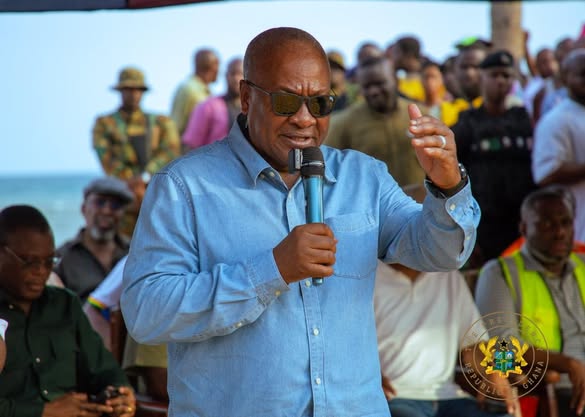
-Mahama cites quorum doubts, Bagbin blindsided by ‘surprise’ passage assent still far off
The Human Sexual Rights and Family Values Bill, 2025 better known as the anti-LGBTQ+ legislation that has divided Ghanaian society for half a decade has entered a new phase of uncertainty.
President John Dramani Mahama told an audience at Chatham House on Monday that the bill “still has quite a while to go” before becoming law, while Speaker Alban Bagbin disclosed he was shocked that Parliament passed the measure in his absence and has summoned leadership to review what he called “procedural irregularities”.
The twin disclosures suggest that what proponents hoped would be a swift journey to presidential assent is instead mired in constitutional and parliamentary scrutiny – raising the real possibility of further delay or even a return to the legislature for reconsideration.
Speaking at the London think‑tank on 1 June, Mahama laid out the obstacles with unusual frankness. “There have been a few issues raised,” he said. “One, that there wasn’t quorum when it was passed, and two, there were some procedural lapses.”
The President confirmed that the Speaker is now addressing these concerns to “ensure the integrity of the legislative process”.
Once the bill is formally transmitted to the Presidency a step that has not yet occurred it will be subjected to detailed scrutiny by the Attorney General and legal advisers. Because the bill originated as a private member’s motion, rather than a government‑sponsored one, that scrutiny is expected to be particularly exacting.
Mahama outlined his constitutional options: he may refer the bill to the Council of State for advice, or return it to Parliament for reconsideration if significant issues are identified. “So there’s still quite a while to go before that bill becomes law,” he concluded a statement that will disappoint the bill’s ardent supporters and offer temporary relief to its critics.
The Speaker’s own account, delivered on the same day, only deepened the sense of procedural fog. Alban Bagbin told reporters that he had left instructions for Parliament to begin consideration of the bill on Friday, 29 May not to complete all stages and pass it.
“I knew that they were going to start the consideration of the bill, and that was the instructions I left before I went to attend to other meetings,” he said, adding that he was “taken aback” when he later learned that the bill had been fully passed in his absence.
He had expected deliberations to extend beyond a single sitting, given the complexity of the legislation.
Bagbin has now summoned parliamentary leadership for an emergency meeting to review the circumstances and “chart a way forward”. “This is such a critical bill that will require consensus,” he stressed a pointed remark given the manner of its passage.
The bill, formally titled the Promotion of Proper Human Sexual Rights and Ghanaian Family Values Bill, was first introduced in June 2021 by a bipartisan group led by Sam Nartey George, MP for Ningo‑Prampram.
It seeks to criminalise same‑sex relations, advocacy, funding and related activities. Supporters say it protects Ghanaian cultural and religious values; critics argue it violates constitutional rights and international human rights obligations.
The Eighth Parliament actually passed the bill in February 2024, but it lapsed after legal challenges at the Supreme Court and the dissolution of Parliament before presidential assent could be obtained.
The current Ninth Parliament reintroduced it as a private member’s bill, and it was again referred to the Constitutional, Legal and Parliamentary Affairs Committee before being returned for final consideration which, unexpectedly, happened on 29 May.
Mahama used his Chatham House platform not only to discuss the bill but also to outline a more pragmatic foreign policy direction. In a fragmented global order, he argued, countries that “build bridges across geopolitical divides will be more strategically relevant”. Ghana will strengthen ties with traditional allies while expanding cooperation with emerging economies guided by national interest, not ideology.
That pragmatic tone may also inform his handling of the anti‑LGBTQ+ bill. Western governments and development partners have repeatedly warned that such legislation would harm Ghana’s international standing and access to financing. By emphasising constitutional process and procedural legality, Mahama may be buying time and space to navigate between domestic conservative pressures and external expectations.
For now, the bill sits in a constitutional limbo. The Speaker’s review of quorum and procedural lapses could yet lead to a re‑examination of the vote. Even if transmitted, the Presidency’s legal scrutiny may recommend a return to Parliament. And if Mahama refers the bill to the Council of State, further weeks or months of deliberation are likely.
Proponents who celebrated the 29 May passage as a victory may find that the legislative battle is far from over. Opponents, who feared imminent criminalisation, have been granted a reprieve but not a guarantee.
What is clear is that Ghana’s anti‑LGBTQ+ bill, already five years in the making, will not reach the statute books swiftly. In Accra’s political circles, the word is no longer “when will the President sign?” but “will it survive the scrutiny?”
By Prince Ahenkorah