

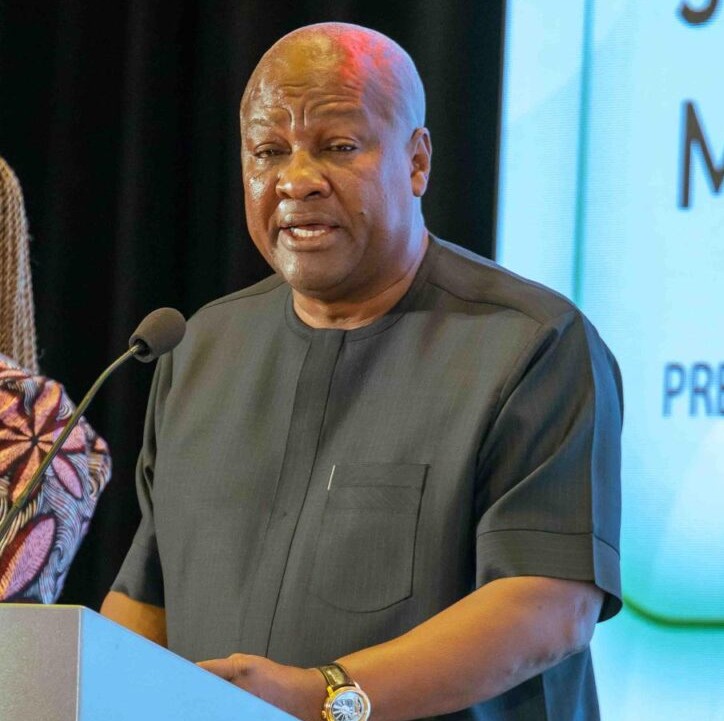
– But Constitution Closes Door on Third Term
By Leo Nelson
President John Dramani Mahama has never been this popular. A new national tracking poll by Global InfoAnalytics puts his job approval at a record 71 percent the highest for any president in the firm’s regular tracking series since 2020.
Sixty-six percent of Ghanaians believe the country is moving in the right direction. Fifty-seven percent report their living standards have improved over the past year.
Yet for Mahama, this political triumph is shadowed by a constitutional reality he cannot alter: he is serving his second and final term. Article 66(2) of the 1992 Constitution is unambiguous “A person shall not be elected to hold office as President of Ghana for more than two terms”.
The framers deliberately excluded the qualifier “consecutive,” foreclosing any creative reinterpretation. As constitutional scholar Professor H. Kwasi Prempeh has put it: “Two terms means two terms. Period”.
And while a quiet chorus of his most fervent followers, some close family members, and even a few grudging admirers among his critics secretly wish he could run again perhaps arguing that his two terms were non-consecutive the President has drawn a clear line.
A few weeks ago, during a closed-door meeting with the Council of Elders of the National Democratic Congress (NDC) at Flagstaff House, President Mahama stated flatly that he has no interest in seeking the presidency after he completes his current term.
The message, delivered in his characteristic calm but firm tone, was meant to settle any speculative murmurs within the party. Sources present at the meeting told The New Republic that some elders were visibly disheartened, but the President insisted that the Constitution must be respected and that the party must prepare for a new generation.
This was not his first such declaration. During a state visit to Singapore last year, Mahama had already set the record straight: “I will not be a candidate in the next elections, and therefore I can hold the line when it comes to fiscal discipline”.
The NDC leadership has since repeatedly reinforced that position. National Chairman Johnson Asiedu Nketiah issued a categorical statement in December 2025: “The NDC will not sponsor, support, entertain, or tolerate any move to amend the presidential term limits for any individual, including H.E. John Dramani Mahama”.
Yet the preparation for a post-Mahama future has already begun. Behind the scenes, jostling for the President’s position is well underway and it is turning fractious. Senior NDC figures, regional power brokers, and ambitious ministers are quietly testing alliances, building war chests, and positioning themselves for what promises to be a bruising succession battle.
The frontrunners are a who’s who of the NDC establishment. According to Pollstar, Mussah Dankwa, Finance Minister Dr. Cassiel Ato Forson currently leads in voter preference polls, with 32 percent of respondents favouring him as Mahama’s successor, followed by National Chairman Johnson Asiedu Nketiah at 25 percent, and Education Minister Haruna Iddrisu at 23 percent. Chief of Staff Julius Debrah, a Mahama loyalist with deep grassroots connections, is also emerging as a serious contender, with organised youth groups and civil society organisations already rallying behind him.
But the competition is already causing tensions. The Council of Elders has ordered an immediate halt to all premature campaign activities, warning that unauthorised tours and media polls are distracting from governance.
Asiedu Nketiah himself has cautioned that early jockeying for power, just months into Mahama’s term, undermines the administration: “Whoever succeeds President Mahama will ride on the achievements of the current government”.
The irony is inescapable. At the very moment Mahama’s approval rating soars, buoyed by falling inflation, a stable cedi, and renewed investor confidence he is constitutionally barred from converting that popularity into another term.
Polling shows that 57 percent of Ghanaians now prefer the country to be led by younger people going forward. But the succession debate also reflects deeper anxieties: unemployment tops public concerns at 44 percent, followed by the general economy at 32 percent, and persistent power outages (“dumsor”) at 29 percent.
For Mahama, the 71 percent figure is both a vindication and a farewell wave. He has navigated a rocky economic recovery, steadied the ship, and pushed through reforms that are only now bearing fruit. But his own words to the NDC elders have closed the door on any draft movement. “He is not a man who speaks carelessly,” a close aide said. “When he says he is done, he means it.”
The question now is not whether Mahama will run he will not. It is whether the NDC can manage the succession without fracturing, and whether the President’s soaring popularity can be transferred to a successor. For Ghanaians who have warmed to his leadership, the 71 percent figure is a snapshot of the present. For the party, it is a ticking clock.
As one veteran NDC insider put it, speaking on condition of anonymity: “Mahama is the glue holding this coalition together. When he leaves, everyone will scramble. The question is whether the party will still be standing when they’re done.”