

By Lawrence Odoom
President John Dramani Mahama has issued a stern admonition to Ghanaians to desist from treating the country’s drainage systems as refuse sites, cautioning that such reckless habits are exacerbating flood vulnerabilities and eroding state-led efforts to safeguard communities.
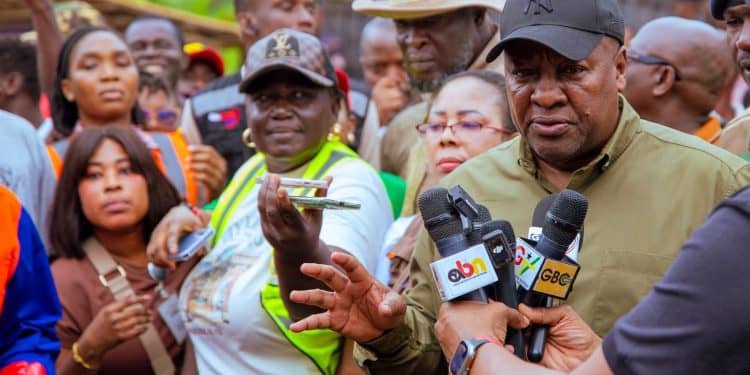
Addressing the media during an inspection of the Alajo Drains as part of the ongoing National Clean-Up Exercise, the President said the devastating floods of June 29 must serve as an inflection point for a collective recalibration of civic behavior and environmental stewardship.
According to President Mahama, the Alajo drain was overwhelmed by a confluence of silt, plastic debris, and domestic waste, which collectively obstructed the free flow of water.
“We have to clear the drains. We just worked on this Alajo drain. It’s part of the outdoor stream. And there are two problems in it. There’s silt, and then there’s also plastics and household waste,” he stated.
He lamented the sheer disregard evident in what was retrieved from the channel, noting that the items discarded reflected a profound lapse in public sanitation ethics.
“You find in a drain like this, there are Indian blocks. People discard an Indian block and throw it in the drain. Old furniture, dining tables, everything you can find in that drain,” he said.
The President underscored a fundamental principle: drainage infrastructure was engineered for hydrology, not refuse management.
“The drains are not garbage instruments. If you want to dispose of something, you know how to dispose of it,” he declared.
President Mahama urged residents to utilize designated waste disposal infrastructure, including skip containers strategically deployed across Accra, rather than consigning refuse to waterways.
“We have skip trucks that leave containers all over the city. Just go and throw your garbage into the skip, and the truck will come and pick it and take it where it has to take it,” he said.
He further posited that the erosion of communal hygiene norms is a byproduct of urban anonymity, and called for a restoration of traditional values of collective upkeep.
“We are taught to keep a clean environment. But when we all leave our hometowns and we come, because of the anonymity of urbanization, we think that nobody watches us. So we dump those values, and we live in filth. We must change that attitude,” he asserted.
Commending security personnel, traditional authorities, and volunteers for their participation, President Mahama characterized the post-flood response as a testament to national fortitude.
“The floods have been devastating, but we must show that we are a resilient nation and we can bounce back even better,” he said.
He reaffirmed the government’s commitment to long-term drainage remediation beyond the two-day exercise, announcing plans to procure additional equipment to ensure that dredged silt and waste are not reintroduced into watercourses.
“Otherwise, if we don’t do that, what we would have done would be in vain, because when the rains come, it will just wash all those silt and garbage back into the drain,” he warned.