

Government freezes GH¢6.9m and $440,000, 217 arrested, 165 prosecutions initiated
The government has intensified its crackdown on illicit drug trafficking, freezing about GH¢6.9 million and US$440,000 in cash linked to suspected drug-related activities.
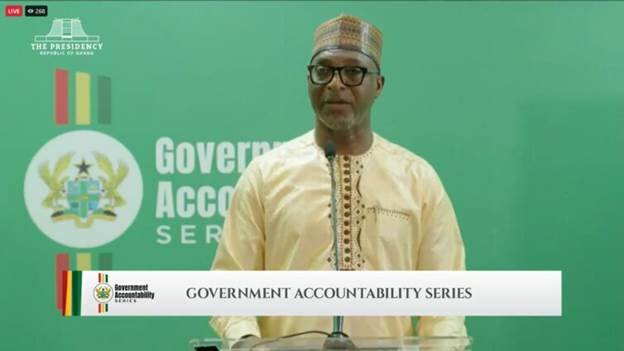
The Interior Minister, Mohammed Muntaka-Mubarak, disclosed this on Monday, August 24, 2026, during the Government Accountability Series.
He said the government’s strategy was moving beyond the arrest of drug users and street-level distributors to targeting the traffickers, financial networks and assets believed to be sustaining the illicit drug trade.
“Our campaign is not just (targeted) at the users, but those who are bringing it,” the Minister said.
According to Mr Muntaka, security agencies had traced 73 assets allegedly connected to suspected drug-related activities during the period under review.
He added that about 19 kilogrammes of gold had also been seized in cases involving suspected money laundering linked to the illicit drug trade.
The Minister said cash associated with suspected drug trafficking activities had been restrained, including approximately GH¢6.9 million and US$440,000.
“When we get them, we seize their assets, or we taint their assets, freezing them while the prosecution is going on,” he stated.
The financial crackdown forms part of a broader intelligence-led operation against drug trafficking and abuse.
Mr Muntaka disclosed that between January 2025 and July 2026, security agencies seized more than 8,500 kilogrammes of narcotic drugs.
They also intercepted approximately 45.4 million tramadol tablets during the period.
A total of 217 suspects were arrested, while 165 prosecutions has been initiated.
The Minister commended the Director-General of the Narcotics Control Commission (NACOC) and his team for what he described as a bold and decisive approach to tackling the country’s illicit drug problem.
He said the operations were being conducted in collaboration with the Ghana Police Service and other security agencies.
“One of the major challenges that confronts us continues to be the illicit drug fight,” Mr Muntaka said.
He expressed particular concern about the growing use of synthetic drugs, citing the huge quantity of tramadol intercepted by security agencies.
“One of the biggest challenges now is the use of these synthetic drugs, and Narcotics Control has intensified its effort,” he said.
“Imagine, in less than two years, over 45 million tablets of tramadol were seized or intercepted.”
Mr Muntaka said the government’s approach was designed to disrupt the financial infrastructure that enables the illicit drug trade to thrive.
He explained that intelligence-led investigations were being used to identify suspected traffickers, trace their assets and freeze property and funds believed to have been acquired through drug proceeds.
The Minister said the strategy was intended to ensure that law enforcement agencies did not only arrest individuals but also weaken the financial networks supporting drug trafficking.
He assured that security agencies would continue to pursue suspected traffickers and take action against assets linked to illicit drug proceeds as prosecutions progressed.
Beyond enforcement, the government is also focusing on education and prevention.
Mr Muntaka disclosed that NACOC had conducted more than 2,000 educational programmes across the country to raise awareness about the dangers and consequences of drug abuse.
The programmes targeted 1,153 first-cycle schools, 185 second-cycle schools and 41 tertiary institutions.
Education and sensitisation activities were also conducted in 187 faith-based institutions, 147 communities and 235 workplaces.
“We have intensified education to try to let people understand the effect and how this thing can be devastating,” the Minister said.
He explained that prevention remained critical, particularly among young people and other vulnerable groups who could be exposed to drug use and trafficking.
Despite the gains recorded in arrests, seizures and public education, Mr Muntaka identified rehabilitation as a major challenge in Ghana’s fight against drug abuse.
He noted that Ghana currently does not have a dedicated national rehabilitation centre capable of adequately supporting people struggling with drug dependence.