

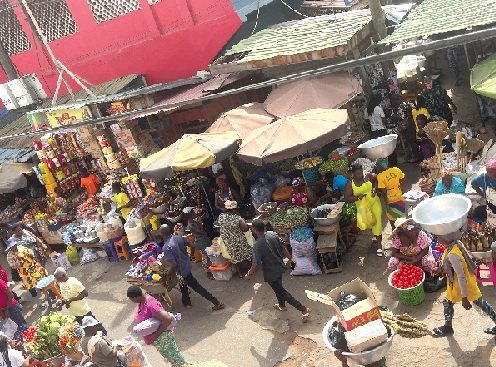
Traders see demolition as land grab, not modernisation, as MCE struggles with compensation and relocation
By Gifty Boateng
The battle lines are drawn in Nungua, a coastal suburb of Accra, where 250 shop owners are resisting President John Mahama’s signature 24-Hour Economy policy – at least in its local manifestation. The Krowor Municipal Assembly wants to demolish their 3-acre market and replace it with a modern, round-the-clock trading hub. The traders say no.
What should be a straightforward infrastructure upgrade has become a litmus test for the Mahama administration’s ability to deliver on its flagship campaign promise without alienating its own urban base. The Nungua Market Shop Owners Association, clad in red and speaking with a single voice, has rejected the proposal outright. Their argument: the land and shops were privately purchased through an AMA-facilitated scheme years ago. “They sold us the shops; they cannot now demolish them,” said Linda Owusu, a member.
Pensions, loans and investments at risk
For these traders many of them pensioners, widows, single mothers and retirees who have sunk their life savings, bank loans and pensions into their businesses the 18-month construction period is a non-starter. They point to the Kejetia Market redevelopment in Kumasi as a cautionary tale: after demolition, they allege, shops were allocated to party loyalists and relatives, not the original owners.
The traders also accuse the Nungua Traditional Council of collecting ground rent since 2021 without carrying out any maintenance. But their main grievance is the absence of a credible relocation plan. The Municipal Chief Executive, Ing. Paul Afotey Quaye, admitted at a stakeholder meeting on 1 September that finding temporary land has proved “very difficult” talks with landowners near the Commercial Bank and Titanic Beach have gone nowhere.
MCE: manifesto endorsement trumps objections
Quaye, who initially tried to bar journalists from the meeting, insisted the project is not an imposition but conceded that “if ultimately the idea cannot be realised, then we can find alternatives.” Yet he also argued that the project enjoyed popular legitimacy because it featured prominently in the NDC’s manifesto, and the President’s electoral victory was “an endorsement that they want the project.”
The MCE disclosed that the Ministry of Local Government has already appointed a contractor and consultant, with funds sitting in the Assembly’s account. What remains, he said, is “final round of engagement” though he could not answer the two questions the traders pose: how will they be compensated, and where will they trade during construction?
Quaye admitted that the issue of income during construction is “perhaps one of the most difficult issues to address in all sincerity.” He offered only vague assurances that “as we engage around the issues we may be able to find a solution.”
The traders are not convinced. They want a written undertaking that they will get their shops back, and they want the Assembly to renovate rather than demolish. The MCE said the Assembly is ready to document the allocation process if that provides reassurance but on relocation, he had no answers.
With the 2028 elections not far off, the NDC cannot afford to alienate a well-organised trading bloc in a key constituency. The Nungua traders are politically conscious; they voted for Mahama, but they are now demanding that their livelihoods be protected. The MCE’s careful balancing act promising engagement while pressing ahead with procurement suggests the Assembly is gambling that the traders will eventually cave.
For now, the traders are holding firm. They have demanded that the project be either renovated on the same site or relocated entirely. The MCE, for his part, has left the door open to abandoning the project if consensus cannot be reached. But with funds already committed and contractors waiting, the pressure is on both sides to find a way out of this standoff.
The Nungua standoff exposes a deeper tension in the 24-Hour Economy vision: how to reconcile grand modernisation with the messy reality of local property rights and informal livelihoods. The Mahama administration’s willingness to bend – or break – will be watched closely across Ghana’s urban markets.