

How GH¢196,000 Was Shared Among Police Officers
TNR Files
A forensic analysis of mobile money transactions has exposed the inner workings of an alleged institutionalised bribery scheme within the Volta Regional Motor Traffic and Transport Department (MTTD), revealing how nearly GH¢200,000 was systematically collected and distributed among officers over just nine months.
At the centre of the alleged operation is Chief Superintendent Benedicta Akpene Ansah, the Ho MTTD Unit Commander, who investigations show was one of the principal beneficiaries of the scheme.
The forensic report, obtained by The New Republic, reveals that GH¢79,410.46 was withdrawn from the mobile money wallet officially designated as a “welfare” account during the first nine months of its operation. Of this amount, Chief Superintendent Ansah personally received GH¢6,185.00.
An additional GH¢5,848.00 was paid to Benedictas Collections and Business Center, the mobile money business she allegedly established to receive deposits into the wallet. Combined, the Commander and her business received GH¢12,033.00 making her the single largest beneficiary identified in the report.
The second-largest beneficiary was Wontumi Ntaki Enterprise, which received GH¢7,182.00.
In all, the forensic report identifies 21 beneficiaries of withdrawals from the wallet, including Pearl Korantemaa, Sampson Ayire, Collins Gyekye and Sewornu Prince Tsatsu.
According to multiple sources familiar with the alleged arrangement, officers deployed at checkpoints across the Volta Region were expected to collect money from motorists and transfer the proceeds into the designated mobile money number 0540751376 internally referred to as the department’s “welfare” account.
Rather than isolated incidents of extortion, sources describe the arrangement as an organised revenue collection system operating within the command under an internal nickname: “Wobedibi” a Twi expression meaning “you will eat some.”
Officers worked in teams of between five and twelve personnel, with funds allegedly shared according to rank senior officers receiving larger allocations while junior personnel received comparatively smaller amounts.
Investigators say officers assigned to various road corridors were expected to meet weekly collection targets based on the earning potential of their duty stations.
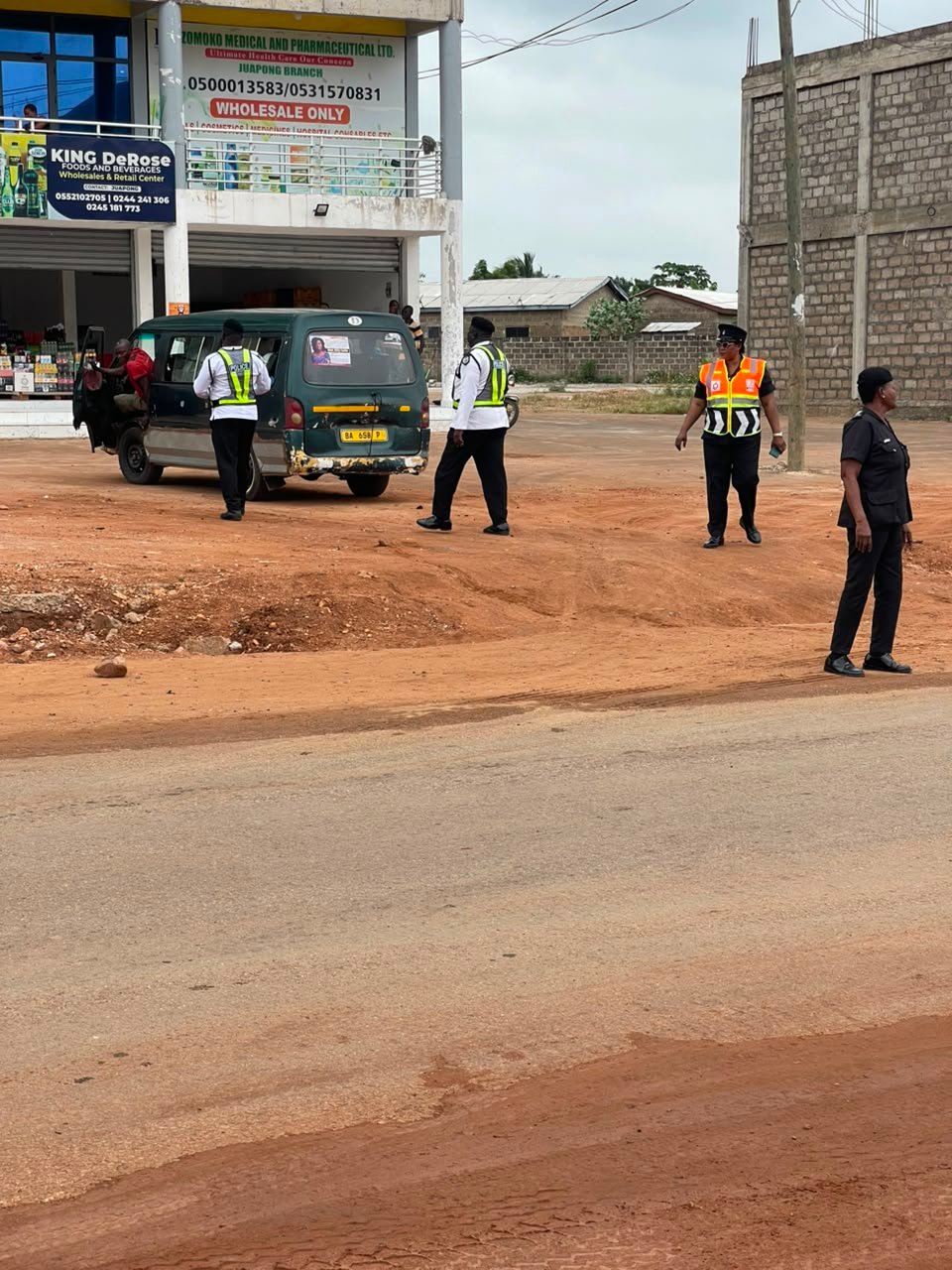
· Sogakope and Juapong (busiest corridors): GH¢3,500 – GH¢4,000 weekly targets
· Less busy locations: Approximately GH¢400 weekly targets
Sources further allege that access to the wallet was centrally controlled through the command structure using the account’s security PIN, enabling senior officers to supervise both the movement and distribution of funds. After weekly distributions to participating officers, the remaining balance was retained as a reserve for welfare activities.
The investigation also raises questions about the unusually high concentration of police checkpoints along the Accra-Aflao Highway. According to sources, the financial incentives encouraged the establishment of numerous checkpoints, with motorists sometimes encountering as many as eighteen between Accra and Aflao.
Those same sources allege that many of these checkpoints disappear whenever senior government officials particularly the President travel through the Volta Region.
The investigation further suggests that the emphasis on revenue generation may have weakened traffic law enforcement, with some motorists allegedly allowed to avoid formal sanctions after making unofficial payments.
“Officers who refused to participate were marginalised,” sources told The New Republic. Such officers were reportedly excluded from deployment rosters covering the most lucrative checkpoints.
Sources further allege that duty rosters were personally supervised by Chief Superintendent Ansah herself, giving her significant influence over which officers were assigned to high-revenue locations.
The New Republic states that on 8 July 2026 it wrote to Chief Superintendent Ansah, presenting the findings of its investigation and inviting her to respond to a detailed questionnaire. Repeated follow-up telephone calls and text messages also went unanswered.
As of publication, Chief Superintendent Ansah had not responded to the allegations or to questions concerning the financial records obtained during the investigation.
The newspaper says it remains willing to publish any response from the officer and that its investigation into the alleged institutionalised bribery scheme is continuing.
Editorial Note
The New Republic has a proud tradition of holding public officials accountable. The paper has previously exposed police extortion schemes in other regions and continues to push the agenda for transparency within law enforcement institutions.
This newspaper does not offer these findings as a determination of guilt or innocence, but as a matter of public interest and accountability. Chief Superintendent Ansah has been given the opportunity to respond, and her answers should she choose to provide them will be published in full.
Your support helps The New Republic continue delivering independent, credible, and impactful journalism. Every contribution strengthens our ability to investigate, inform, and hold power accountable.
VOLTA MTTD BRIBE SCANDAL:
0Related Posts
Add A Comment
© 2026 THE NEW REPUBLIC GH.
About | Contact | Privacy Policy