

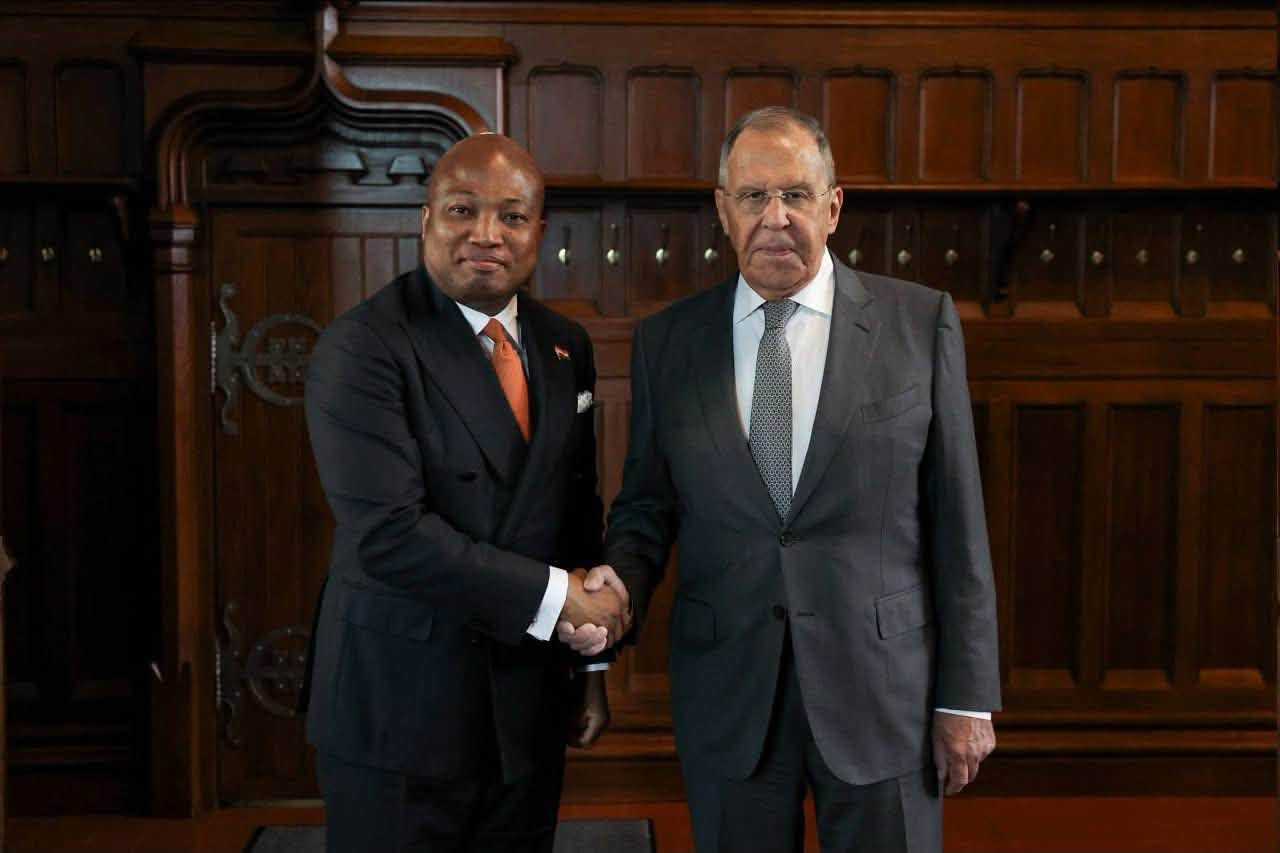
Lavrov to Lobby Founding Members
By Stanley Assor
Russia has thrown its weight behind Ghana’s bid to join BRICS as a partner country, with Russian Foreign Minister Sergey Lavrov pledging to rally the grouping’s founding members to secure consensus support for the West African nation’s application.
Foreign Affairs Minister, Samuel Okudzeto Ablakwa, announced the development in a Facebook post following a breakfast meeting between Mr Lavrov and African foreign ministers at the ongoing Russia-Africa Summit.
“Russian Foreign Minister, His Excellency Sergey Lavrov has announced at a breakfast meeting with African Foreign Ministers today that Russia strongly supports Ghana’s application to join BRICS as a partner country,” Mr Ablakwa wrote.
“Lavrov further pledged to rally all founding BRICS members to ensure consensus support for Ghana.”
The Ghanaian minister said he conveyed the country’s appreciation to his Russian counterpart, whom he described as a “revered colleague and great friend”.
“The Mahama Administration will continue to uphold Ghana’s longstanding foreign policy of non-alignment and friends of all, enemies to none as we pursue diversified development options in our national interest,” he added.
Russia’s endorsement represents an important diplomatic opening for Ghana, but it does not automatically secure admission. The application still requires the necessary agreement among BRICS members.
President John Dramani Mahama’s Cabinet has approved Ghana’s intention to apply to join the grouping as part of a broader strategy to diversify the country’s international partnerships and support its economic transformation agenda.
The government is seeking partner-country status rather than full membership, which would provide a formal channel for engagement with BRICS without making Ghana a full member.
Ghana’s interest in BRICS centres on the prospect of expanding trade, attracting investment, accessing technology and securing development partnerships with major emerging economies.
The grouping began as BRIC, comprising Brazil, Russia, India and China, before South Africa joined in 2011. It has since expanded to include countries such as Egypt, Ethiopia, Iran, the United Arab Emirates and Indonesia, alongside its partner-country arrangements.
For Ghana, closer engagement could create opportunities to expand export markets, attract investment into domestic production and reduce dependence on exporting unprocessed commodities.
China’s manufacturing and infrastructure capabilities, India’s pharmaceutical and technology industries, Brazil’s expertise in commercial agriculture and Russia’s experience in energy and mining could offer potential areas of cooperation.
Ghana could pursue partnerships in agro-processing, pharmaceutical manufacturing, agricultural mechanisation, fertiliser production, renewable energy, railway development and digital infrastructure.
The country’s gold, cocoa, cashew, shea and bauxite resources could also feature in commercial arrangements aimed at promoting local processing and manufacturing rather than simply increasing exports of raw materials.
Such partnerships could support job creation, strengthen local supply chains and reduce dependence on imported finished products. However, the benefits would depend on the terms negotiated, the willingness of investors to establish domestic production facilities and the competitiveness of Ghanaian businesses.
Partner-country status would not automatically guarantee preferential access to BRICS markets. Trade agreements, tariffs, product standards and other commercial conditions would continue to determine the opportunities available to Ghana.
The possibility of accessing alternative development financing is another attraction.
The New Development Bank, established by BRICS founding members in 2014, finances infrastructure and sustainable development projects, including transport, clean energy, water and sanitation.
For Ghana, potential areas of interest include power infrastructure, renewable energy, transport networks, water systems and industrial facilities.
A broader range of financing partners could give the government more options when negotiating loan costs, repayment periods, currencies and other conditions.
However, partner-country status does not automatically make Ghana a member of the New Development Bank or guarantee access to its loans. The bank has separate membership and financing procedures, and Ghana would need to meet the relevant requirements and present viable projects.
Any new borrowing would also have to be assessed against the country’s debt sustainability and its capacity to generate adequate economic returns from financed projects.
The challenge for Accra will be to translate diplomatic goodwill into concrete agreements that deliver measurable benefits to businesses, workers and the wider economy.
The Mahama administration has presented its BRICS initiative as an extension of Ghana’s longstanding non-alignment policy rather than a departure from its traditional Western partners.
The government’s stated position is that Ghana can strengthen relations with Russia, China, India and Brazil while maintaining established ties with the United States, the European Union, international financial institutions and other development partners.
BRICS is not a unified political or financial system. Its members have different strategic priorities and relationships with Western countries, while the grouping has not established a common currency capable of replacing the US dollar in international commerce.
Ghana would therefore continue to need access to foreign exchange, international capital markets and established financial institutions even if its application succeeds.
Closer engagement would also require careful management of transactions involving entities subject to international sanctions. Such risks would depend on the parties and transactions involved; partner-country status alone would not automatically expose Ghana to sanctions.
The government would need to preserve its independence on international security, trade and other diplomatic questions while ensuring that new commercial arrangements are transparent and serve the national interest.
The approach echoes the tradition of diplomatic independence associated with Ghana’s first President, Kwame Nkrumah, who advocated African unity and non-alignment during the Cold War.
The principle is to broaden international cooperation without requiring exclusive allegiance to competing geopolitical blocs.
Mr Lavrov’s pledge to rally the founding BRICS members gives Ghana an important diplomatic opening, but the wider consensus required for its admission remains to be secured.
The next stage will determine whether Russia’s endorsement translates into broader support and whether Ghana can complete the process for partner-country participation.
For the Mahama administration, the ultimate test will not be the diplomatic prominence of the initiative but the economic returns it produces.
The government will need to negotiate arrangements that attract productive investment, expand exports, strengthen local industries, create sustainable jobs and improve access to technology and development financing without exposing the country to unfavourable financial or strategic commitments.
Russia has offered its support. Ghana must now secure the wider backing required for its application and demonstrate that closer engagement with BRICS can deliver tangible gains for the national economy.