

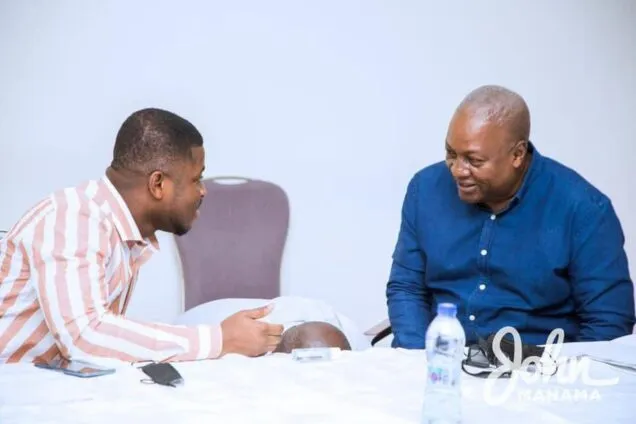
President John Dramani Mahama has come to the defence of GoldBod Chief Executive Officer Sammy Gyamfi, saying relentless attacks on him by the Minority in Parliament are driven by politics — and by the remarkable success of the gold sector under the Ghana Gold Board.
Addressing members of the Ghanaian community in Russia on the sidelines of the Africa Summit, where he is leading Ghana’s delegation this week, the President said the mining sector — and gold in particular — has proved transformational for the economy, making it a natural target of political scrutiny.
“But one sector that has proved transformational to our economy is the mining sector, and especially the gold sector. And so naturally, that is where everybody’s attention is.
And so poor Sammy Gyamfi has been the focus of attacks, especially by the minority, because of our politics,” President Mahama said.
“But you must go into this business with a tough skin. I’m not going to mention the kind of animal skin that you need, but everybody should know what skin is toughest to go into the kind of profession in which we are,” he added to laughter.
A long-held vision
The President traced the Gold Board’s origins to the National Democratic Congress (NDC)’s 2020 manifesto, explaining that although the concept was only hinted at then, the party went back to the drawing board after losing that election.
“He who fights and runs away lives to fight another day. So we constructed the concept even more before 2024, and again mentioned it in our manifesto. So as soon as we hit the ground, we knew exactly what we wanted to do — we had the legislation ready,” he said.
That preparation paid off: by April 2025, Parliament had passed the Ghana Gold Board Act, which restricted the export of gold and imposed strict penalties — including imprisonment — for anyone found carrying gold out of the country without authorisation.
Previously, President Mahama explained, buyers could enter Ghana, purchase gold and export it, with the foreign exchange often never returning to the country. Gold is produced in 10 of Ghana’s 16 regions, and a central goal of the GoldBod was to formalise the artisanal and small-scale mining sector and account for every gram of gold it produces.
The results
The numbers, according to the President, speak for themselves. In 2024, Ghana exported 64 tonnes of small-scale gold, fetching $4.6 billion. In 2025, after GoldBod became operational, exports surged to 104 tonnes, with foreign exchange inflows of $10.8 billion.
“That has helped to stabilise the Cedi because there’s availability of forex, and aside from that, it has helped us to increase our foreign reserves,” he said.
Bauxite talks with Rusal
Beyond gold, the President disclosed that while in Russia, he and officials of the Ghana Integrated Aluminium Development Corporation (GADEC) held talks with Russian aluminum giant Rusal over the country’s integrated bauxite and aluminium project.
“They have expressed an interest in investing in the refining of bauxite — that is one of the missing links in our whole bauxite-to-aluminum value chain. We export the raw bauxite, then we import alumina for VALCO, which produces aluminum and exports it. So there’s a missing link there,” President Mahama explained.
He stressed that the engagement with Rusal was not exclusive, noting that government has held discussions with several potential partners as it seeks to build a domestic bauxite refining industry.
Want me to adjust the tone (e.g., more formal/op-ed style), shorten it into a brief, or reframe it from a pro-government angle to a more neutral or critical one?
By Gifty Boateng