

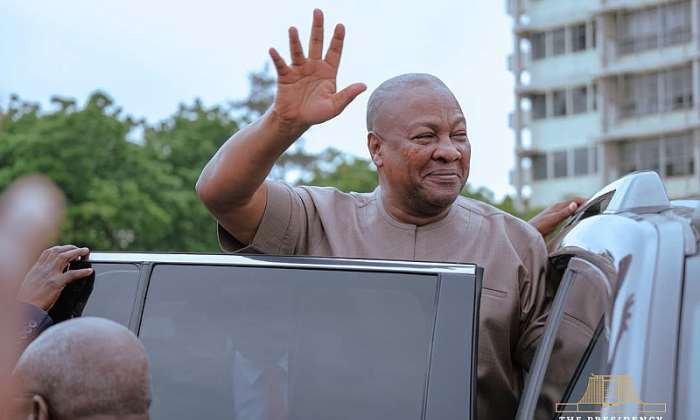
NPP races to Court over Mahama’s political Afterlife
By Stanley Asor
The opposition New Patriotic Party (NPP) appears very haunted by self-imposed fear that President John Mahama can still run for re-election in 2028, thus beating a jittery path to the Supreme Court to make sure double sure that Mahama does not run for office again.
Despite Mahama’s clear declaration that he will not contest another presidential election, the NPP has initiated legal proceedings seeking a definitive interpretation of the constitutional provisions governing how many times a person may be elected President of Ghana.
The action raises questions as to why the opposition party is pursuing a constitutional clarification now, when the President has publicly stated that he does not intend to return to the ballot in 2028.
The NPP’s suit, filed on July 28, 2026, seeks to establish that the constitutional limit of two presidential terms applies irrespective of whether the terms are consecutive or separated by a period out of office.
On Wednesday, October 28, 2026, the party took its fears to the Supreme Court, seeking a definitive interpretation of the 1992 Constitution on whether a President who has served one term can return to office after an electoral defeat and serve two additional terms.
The move places the constitutional rules governing presidential tenure at the centre of the political debate ahead of the 2028 general election, with implications for President John Dramani Mahama’s political future, even though he has stated that he will not seek another term.
THE LEGAL ACTION
In a writ of summons and statement of case dated July 28, 2026, the NPP, through its solicitor, Godfred Yeboah Dame of Dame & Partners, has asked the Supreme Court to clarify the meaning and scope of the constitutional provisions governing presidential term limits. The Attorney-General has been named as the defendant.
At the heart of the action is the question of whether the constitutional restriction to two presidential terms means two terms in total or two consecutive terms, potentially allowing a former President who has served one term to return after an interval and seek two more terms.
The NPP wants the court to settle the question before it becomes a source of further political and constitutional controversy.
The party is seeking declarations on Articles 58(2) and 66(1), (2) and (3)(a) of the 1992 Constitution, arguing that the presidential term limit must be understood as a lifetime maximum of two terms, irrespective of whether they are served consecutively.
RELIEFS SOUGHT
Among the reliefs sought, the NPP wants the court to affirm that no person may be elected President more than twice or occupy the presidency for more than two four-year terms, amounting to eight years.
The party is also asking the court to determine the eligibility of a Vice-President who assumes the presidency for more than half of a predecessor’s unexpired term, seeking a declaration that such a person would be eligible to contest a presidential election for only one term.
It further wants the court to clarify that anyone who has already served one presidential term may serve only one additional term, whether or not the two periods in office are consecutive.
Although framed as a constitutional interpretation case, the timing and subject matter place the suit within the broader political calculations surrounding the 2028 elections and the possibility of Mahama’s name continuing to dominate the succession debate.
The President has indicated that he does not intend to seek another term. The NPP’s legal action, however, raises questions about why the party considers it necessary to seek a definitive ruling on the limits of presidential eligibility at this stage.
The filing itself does not establish that Mahama intends to contest the 2028 election, nor does it prove that the NPP’s action is motivated exclusively by concerns about his candidacy. But it places the constitutional question of a former President’s return to office squarely before the country’s highest court.
NPP’S ARGUMENT
In its statement of case, the NPP takes issue with an interpretation under which the constitutional restriction could be understood as applying only to two consecutive terms.
Under that reading, a person who served one term, failed to secure immediate re-election and subsequently returned to the presidency could potentially claim eligibility for two further terms.
The party argues that such an interpretation would undermine the constitutional restriction on presidential tenure.
“Plaintiff considers this proposition not only absurd but dangerous for the democracy, peace and stability of the nation,” the statement of case reads.
The NPP maintains that the Constitution should not be interpreted in a manner that effectively inserts words into its provisions that the framers did not include.
“Acceding to this interpretation will condone and sanction manipulation of clear provisions in the Constitution as it involves inserting words into the constitutional text it will involve amending the Constitution through judicial fiat,” the party states.
The argument is that the Supreme Court must interpret the existing constitutional text rather than introduce, through its judgment, a distinction between consecutive and non-consecutive terms that the party says is not expressly provided for.
Whether the court accepts that interpretation remains to be determined.
To support its position, the NPP draws on international constitutional practice, including the 22nd Amendment to the United States Constitution, which restricts the number of times a person may be elected President.
The party also refers to constitutional developments in other African countries, arguing that efforts to alter presidential term limits have contributed to political instability in some jurisdictions.
Its legal arguments further invoke the 2011 report of Ghana’s Constitution Review Commission, which recommended an amendment to clarify that a person who had served two presidential terms would not qualify to stand for re-election.
The party relies on these examples to reinforce its argument that presidential term limits are an important safeguard against excessive concentration of executive power.
However, the legal question before the Supreme Court is ultimately one of interpreting Ghana’s own Constitution, including the precise language and relationship of the provisions cited in the suit.
The case comes as political attention increasingly turns to the next general election and the question of who will lead the major parties into the contest.
For the NPP, the suit offers an opportunity to obtain judicial clarity on a constitutional issue that could affect future presidential candidacies. For the broader political system, the proceedings could establish an authoritative interpretation of how Ghana’s presidential term limits apply when a former President returns to office after a break.
But it is well-known that Mahama’s stated position is that he will not run again, making the NPP’s jittery action rather unnecessarily panicky.
Still, since the opposition party has decided on this course, the Supreme Court’s eventual interpretation will have consequences well beyond the immediate electoral cycle, potentially settling a question that future presidential candidates and political parties may otherwise continue to contest.