

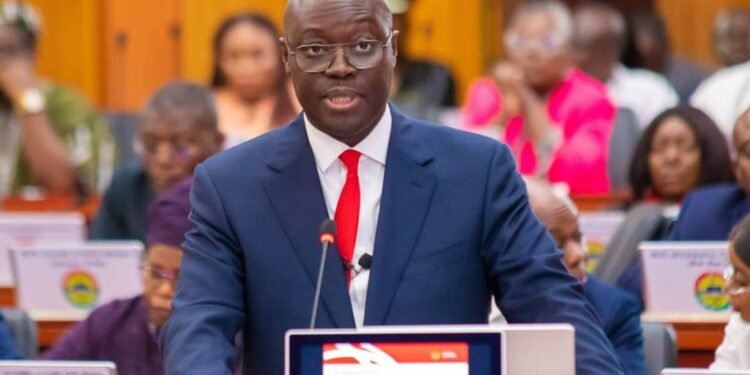
Finance Minister reports economy grew 6.2% in H1 2026, well ahead of target, as government moves to clear over GH¢36bn of debt ahead of schedule
Minister for Finance Dr. Cassiel Ato Baah Forson on Thursday announced an early redemption offer for GH¢29 billion of DDEP bonds falling due in February 2027, telling bondholders bluntly: “Your cash is ready — come for your money.”
Presenting the 2027 Budget Statement to Parliament, Dr. Forson also declared that Ghana “will not default again on the watch of President John Dramani Mahama,” accusing the previous government of deliberately postponing the domestic debt repayment burden and leaving a wall of obligations to fall due in 2027 and 2028 that would, in his assessment, have set the country up for another default.
An economy beating its targets
The minister reported strong performance against the targets reaffirmed in the mid-year fiscal policy review. Real GDP grew by 6.2 per cent in the first half of 2026, against a target of 4.8 per cent, while non-oil GDP grew 5.9 per cent against 4.9 per cent.
Gross international reserves reached US$12.7 billion at end-September, equivalent to 4.5 months of import cover, and headline inflation stood at 5.5 per cent in October 2026, with the policy rate falling from 21.5 per cent in September 2025 to 14 per cent in September 2026.
“The cost of fuel has come down substantially, bringing relief to businesses and households alike,” he said.
Stability is now showing up in credit costs. The Ghana Reference Rate has fallen by 1,971 basis points, from 29.72 per cent in January 2025 to 10.01 per cent by October 2026, and average commercial bank lending rates dropped from 22.2 per cent in October 2025 to 15.94 per cent in October 2026.
Treasury bill rates have tumbled across the board — the 91-day rate down 653 basis points to 4.56 per cent, the 182-day down 632 points to 6.20 per cent, and the 364-day down 346 points to 9.48 per cent — while credit to the private sector grew 35.5 per cent between August 2025 and August 2026.
“Cheaper credit is now passing on the gains of stability to households and businesses,” Dr. Forson said.
Fiscal discipline — without new taxes
Provisional data for January to October 2026 showed a primary surplus of 1.4 per cent of GDP on commitment basis, on course for the full-year target of 1.5 per cent, and an overall deficit of 1.0 per cent of GDP against a target of 3.0 per cent. On cash basis, the primary surplus was 0.1 per cent of GDP against a programmed deficit of 1.3 per cent, with the overall deficit at 2.3 per cent against a target of 4.5 per cent.
Total revenue reached GH¢219.3 billion — 13.7 per cent of GDP and 3.5 per cent above target — with domestic revenue at GH¢218.2 billion, exceeding its target by 4.9 per cent. “These gains were achieved without new taxes or increases in tax rates,” the minister stressed.
Total expenditure of GH¢239.6 billion (15.0 per cent of GDP) came in 7.6 per cent below target, while interest payments fell from 25.6 per cent to 17.8 per cent of domestic revenue, “releasing resources for roads, energy and other essential public goods.” Government transferred GH¢53.7 billion to statutory and earmarked funds — “paying every cedi due in full and on time” — and cleared GH¢20.8 billion in legacy arrears.
Debt: paying early, never again
Provisional public debt stood at GH¢759.3 billion at end-October 2026, or 47.5 per cent of GDP, with 56.4 per cent now held domestically — a deliberate strategy, the minister said, so that “movement in the exchange rate will do less damage to our total debt.”
Since 2025, government has paid GH¢41.36 billion to DDEP bondholders, including GH¢10.6 billion in August 2026, and US$2.1 billion to Eurobond holders, including US$700 million in July 2026. Every obligation to bondholders who did not join the debt exchange has also been met.
With GH¢40.1 billion of DDEP bonds (GH¢29 billion principal and GH¢11.1 billion interest) due on February 16, 2027, and a further GH¢12.5 billion in August, some GH¢53 billion falls due next year — on top of US$590 million and US$580 million in Eurobond maturities in January and July 2027. Dr. Forson said the cedi sinking fund already held GH¢29 billion as of November 11 — enough to cover the entire February principal — while the dollar sinking fund stood at about US$480 million, rising to some US$600 million by December.
Government intends to pay off both the January Eurobond and the February DDEP bonds before December 31, 2026.
“That is more than GH¢36 billion paid back early, and more than GH¢36 billion less debt by December 2026. That is what discipline delivers. This is what discipline delivers,” he said, repeating the offer for emphasis: “To every DDEP bondholder whose bonds fall due in February 2027, hear me clearly — your cash is ready, come for your money.
And to every other DDEP bondholder, every cedi owed to you, principal and interest, will be paid in full and on time.” To Eurobond holders, he added: “Every dollar owed to you, principal and coupon, will be paid in full and on time. Without sweat.”
“The debt restructuring came at a painful cost to our people. We owe them the discipline to borrow responsibly and plan for repayment,” Dr. Forson said, linking the promise to financing and borrowing reforms contained in the budget.
“The Ghanaian people have sacrificed too much to be taken through the pain again. We will protect their sacrifice, honour our commitments and safeguard Ghana’s restored credibility.”
By Gifty Boateng