

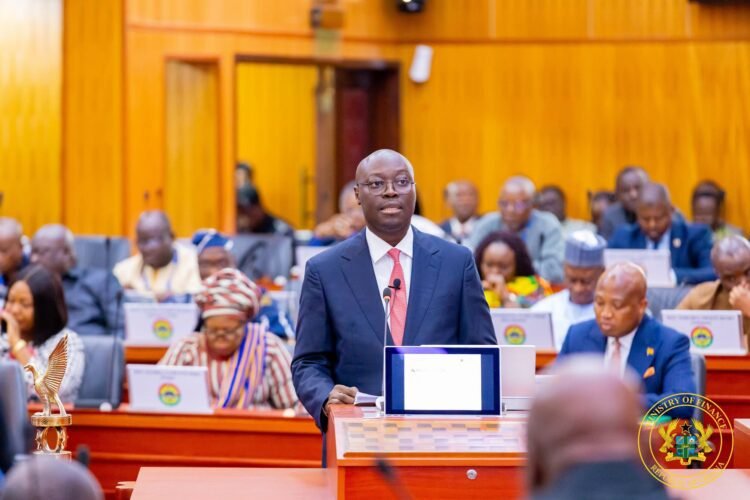
Finance Minister Dr. Cassiel Ato Baah Forson has unveiled the government’s flagship “New Economy” programme — a four-year, $10 billion plan to restructure Ghana’s economy, timed to the country’s 70th independence anniversary in 2027.
The New Economy, which runs from 2027 to 2030, is designed to confront what Dr. Forson described as Ghana’s long-standing structural weaknesses: an overreliance on raw material exports, too little value addition at home, and too few productive jobs for the country’s young population.
“Seventy years after independence, the economic transformation envisaged by Osagyefo Dr. Kwame Nkrumah has not been realized,” the Finance Minister told Parliament. “Our 70th anniversary must mark a decisive turning point.”
An economy worthy of the freedom we inherited
Dr. Forson said the programme aims to expand production, process more of Ghana’s resources at home, and convert the nation’s wealth into “decent jobs, high incomes, and lasting prosperity.”
“As Ghana turns 70, we build the next generation — an economy worthy of the freedom we inherited and the sacrifice our people have made,” he said. “As we begin the next 70 years of our national journey, let us resolve to build a fully developed, First World Ghana. This demands a fundamental shift in our thinking, our priorities, and our action.”
Over the four-year period, government will spend the equivalent of 10 billion United States dollars to create what the Minister called “a modern Ghanaian economy for jobs and prosperity.”
Eight pillars, one productive system
The programme is built on eight connected pillars:
Macroeconomic stability and affordable finance
Commercial agriculture
Energy infrastructure
Critical minerals value addition
Tourism, culture and creative arts
Textiles and garments
Pharmaceuticals and biomanufacturing
The technology economy
Dr. Forson stressed that the pillars form “one productive system”: affordable finance must reach farmers, manufacturers and exporters; agriculture must supply food and industrial raw materials; reliable energy must underpin the 24-hour economy; minerals and cocoa must gain value in Ghana before export; tourism and the creative arts must turn heritage into businesses, jobs and foreign exchange; textiles and garments must link Ghanaian skills to global fashion markets; pharmaceuticals must produce more medicines and vaccines locally while supplying African markets; and technology — anchored by rural connectivity — must widen the sources of jobs and foreign exchange, allowing talent in every region to participate.
Under the programme, government will preserve stability, provide strategic infrastructure, prepare bankable projects and create predictable conditions for enterprise, while the private sector carries the principal responsibility for investment, innovation, production and employment. Government support, the Minister pledged, will be “transparent, time-bound, and linked to verifiable results.”
A defining national choice
Dr. Forson framed the programme as a choice between repeating history and breaking from it.
“We can spend the recovery as though history has taught us nothing, or invest in a productive base strong enough to carry the next generation,” he said. “We choose production. We choose jobs with dignity. And we choose a national purpose that can survive electoral cycles and outlast governments.”
The New Economy, he said, “begins with a solemn pledge: the suffering caused by recurring crises must end; the fiscal space bought by the sacrifice of the people must be used solely for the benefit of the people; and Ghana’s resources must build Ghanaian jobs and prosperity.”
Pillar One: Stability and affordable finance
Turning to the first pillar, Dr. Forson said government will protect the recent macroeconomic gains and put them to work for ordinary Ghanaians. From 2027, government will maintain a positive primary surplus of at least 0.5% of GDP, keep public debt at around 45% of GDP, and preserve single-digit inflation.
By 2030, the government is targeting real GDP growth of about 8%, unemployment below 8%, and a credible path to an investment-grade sovereign credit rating.
“An investment-grade sovereign rating cannot be conferred in a speech. It must be earned through sustained performance,” Dr. Forson said, announcing that government will publish an annual investment readiness report covering fiscal performance, debt affordability, reserves accumulation, monetary credibility, financial sector strength, institutional quality and economic diversification.
On affordable finance, the Minister promised that lower interest rates will translate into credit that businesses “can access, afford, and repay” — from the market woman seeking working capital to the manufacturer investing in new machinery. Government will work through Development Bank Ghana, Ghana EXIM Bank and participating financial institutions to expand financing to productive businesses, deploying credit guarantees, equipment leasing and export finance.
“Our ambition is to bring the cost of capital into single digits and make finance more widely available,” he said, adding that patient capital will give farmers and industrialists time to invest, produce and earn before repayment falls due.
Discipline beyond the election cycle
Dr. Forson assured that fiscal discipline will hold “through the election cycle,” with the room it creates channelled purposefully into irrigation, energy, transport, industrial infrastructure, technology, skills and the productive sectors set out in the programme.
“The purpose of stability is productive confidence,” he said. “A farmer will be able to plan the next season without fearing an inflation shock. A manufacturer will be able to price and order without gambling on the exchange rate. An investor will be able to commit capital beyond one political cycle. And a young Ghanaian will see economic growth reflected in jobs, wages, and opportunities.”
Growth, he said, will be judged “by the jobs it creates, the income it raises, and the productive capacity it leaves behind. Commodity windfalls and debt-financed consumption will no longer define our progress. Ghana’s next phase of growth must be investment-led, export-capable, and job-intensive.”
A few notes: I cleaned up some transcription slips from the raw text (e.g., “corporate-owned markets” → corporate bond markets, “community windfalls” → commodity windfalls, “political third” → political cycle).
Want me to merge this with the earlier section into one complete, full-length feature on the budget speech? I can also do a shorter version for radio/social media, or abullet-pointed “key takeaways” version.
By Gifty Boateng