

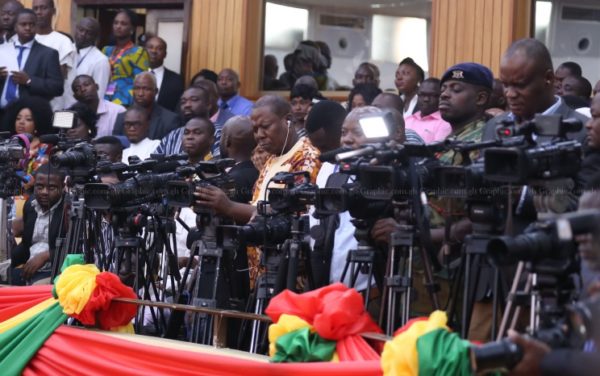
– Journalist Slams Media Coverage of Grief.
Veteran journalist Abdul Hayi Moomen is calling on media practitioners to exercise restraint, empathy, and compassion in their reporting of national tragedies, warning that journalism devoid of sensitivity risks inflicting more pain than it informs.
In a stirring and pointed critique of the media’s coverage of disasters in Ghana, Moomen drew attention to what he described as the growing insensitivity with which reporters and news outlets handle grief-stricken individuals and families, often in the heat of breaking news events.
“There is a kind of silence that should never be interrupted, the silence of grief. It is sacred. It is heavy. It speaks louder than any headline or breaking news banner. And yet, time and again, we see it being trampled upon by the very people society entrusts with telling its most important stories: journalists.
The seasoned broadcaster did not mince words in describing the media’s conduct in the immediate aftermath of national tragedies. “They become invasive spectators in the house of mourning,” he observed, criticizing the practice of reporters thrusting cameras and microphones at bereaved families, often moments after their worst fears have been confirmed.
He was particularly appalled by what he called the “tactless” questions some reporters ask of mourners, including the ubiquitous and painfully tone-deaf: “How do you feel about your loss?”
According to Moomen, such questioning reveals a profound disconnect between journalistic duty and human decency. “As if they expect the bereaved to respond with, ‘Oh, I’m quite alright. I’m glad my husband is dead,’ he remarked bitterly.
Worrying Pattern:
Moomen recounted several instances in Ghana’s recent history where, in his view, the media crossed the line between responsible reporting and voyeurism, recalling the tragic May 9 stadium disaster of 2001, which claimed the lives of over 120 people.
In the rush to document the nation’s grief, he said, the media turned the tragedy into a spectacle—cameras fixated on lifeless bodies, grieving families, and bloodstained grounds, all aired during prime-time news.
He also referenced the June 3, 2015, flood-and-fire disaster that devastated Accra and claimed more than 150 lives.
“The close-up shots of charred bodies, aired and circulated without restraint, did nothing to inform or educate. They only reopened fresh wounds for families. They turned unspeakable pain into a public slideshow.”
Most recently, he pointed to the aftermath of the helicopter crash that claimed eight lives. According to him, journalists were again quick to invade the privacy of mourning families—before many had even come to terms with the tragedy.
“Children have yet to come to terms with the news. Spouses are still in shock. But the cameras are already there, too close, too unkind, zooming in on tear-streaked cheeks, capturing every sob, every tremble, every fall to the ground. All for a few extra clicks, for the exclusive angle, for a headline that screams louder than decency.”
Moomen challenged media practitioners to reflect critically on what they deem newsworthy during such times. “What is the value in showing a child crumbling in tears? What do we gain from filming a mother collapsing by the coffin of her dead son? How do close-up shots of burnt bodies add depth to a story?” he asked. “They don’t!”
Instead of adding meaning or context, Moomen argued, these images inflict “more pain to the already suffering. More trauma to the already broken. More insensitivity to a profession that should know bette.”
Call for Compassionate Journalism:
His central appeal was clear: journalism must not become voyeurism. Rather, it must strive to be “a craft rooted in truth, but also in compassion.”
While acknowledging the public’s right to be informed, he stressed that “the grieving have a right to mourn in peace.” That right, he suggested, ought to guide editorial decisions in newsrooms and the conduct of field reporters.
“Let’s watch how we report tragedy,” Moomen advised his fellow journalists. “Let’s watch how we approach those in pain. Let’s watch what we show to the world, and how we show it.”
He concluded with a profound reminder that speaks to the heart of ethical journalism: “Sometimes, the most powerful story is not in what we capture, but in what we choose not to show.”
As Ghana continues to grapple with incidents of public loss and national grief, Moomen’s plea stands as a timely call for introspection within the media fraternity—urging a return to a journalism that not only informs but also heals, respects, and preserves the dignity of those it covers.
By Leo Nelson