

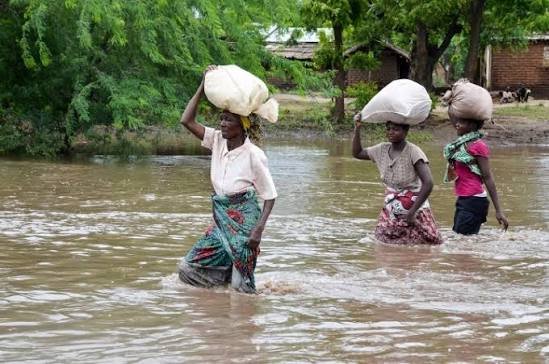
A worsening climate crisis has affected at least 13 million people and claimed more than 3,000 lives across Africa in 2025, as extreme weather events ranging from deadly floods to prolonged droughts intensified across the continent, according to a new report by the World Meteorological Organization (WMO).
The findings paint a sobering picture of a continent increasingly vulnerable to climate shocks as rising temperatures, devastating floods, prolonged droughts and accelerating sea-level rise place growing pressure on economies, ecosystems and communities.
While Africa contributes only a small fraction of global greenhouse gas emissions, it continues to bear a disproportionate share of the consequences of climate change, with millions of people facing heightened risks to their livelihoods, food security and health.
According to WMO’s latest State of the Climate in Africa report Africa is now warming faster than the global average, with the pace of temperature increase since 1991 significantly exceeding that recorded during any previous 30-year period. The continent’s average land surface temperature in 2025 ranked between the third and seventh warmest ever recorded, depending on the dataset used.
According to WMO Secretary-General Celeste Saulo, the report highlights both the scope of the crisis and the significance of resilience building.
“The signs of a changing climate are clear across Africa from increasing temperatures and rising seas to damaging floods and drought.
“This report shows not only the scale of the risks, but also the growing importance of early warnings, climate services and coordinated action to protect lives and livelihood.”
Scientists warn that the accelerated warming trend is increasing the frequency and severity of extreme weather events, exposing vulnerable populations to greater risk.
Flooding became the most prevalent climate-related disaster across the continent this year, accounting for more than half of all reported weather occurrences. Severe floods in Nigeria killed over 200 people in May, and flooding in the Democratic Republic of the Congo killed over 160 people in April. Communities in numerous regions were devastated, with homes, roads, agricultural land, and key infrastructure all destroyed.
At the same time, drought conditions persisted across much of East Africa, affecting more than 8.5 million people. Water scarcity, crop failures, and livestock losses exacerbated humanitarian issues in places already dealing with food insecurity and economic hardship.
The South Indian Ocean also experienced an unusually active tropical cyclone season during 2024 and 2025, bringing destructive winds, heavy rainfall and coastal flooding to several countries.
Beyond these immediate disasters, the report identifies longer-term environmental changes that are reshaping the continent’s future.
Africa’s glaciers, once prominent features of several mountain regions, are disappearing at an alarming rate. Scientists estimate that glaciers across the continent have lost more than 90 percent of their total area since the late nineteenth century. Mount Kilimanjaro, Africa’s highest peak, provides one of the clearest examples of this transformation. Its glacier coverage has shrunk from approximately 11.4 square kilometres in 1900 to less than one square kilometre in recent years.
The rapid retreat of glaciers serves as a visible indicator of broader climate shifts and has implications for water resources, ecosystems and tourism.
Meanwhile, the continent’s oceans continue to absorb vast amounts of excess heat generated by global warming. Although ocean temperatures in 2025 were slightly below the record-breaking levels observed in 2023 and 2024, they remained among the highest recorded over the past decade.
According to World Meteorological Organization (WMO), the persistent marine heatwaves and rising ocean temperatures are disrupting marine ecosystems and threatening the livelihoods of millions of people who depend on fishing and coastal resources.
Early Warning Systems Seen as Key to Africa’s Climate Resilience
Despite the mounting climate challenges confronting the continent, the report highlights encouraging progress in efforts to improve preparedness and disaster response.
One of the most significant developments has been growing cooperation between meteorological agencies, disaster management institutions and local authorities. Advances in climate forecasting, seasonal prediction systems and early warning services are helping communities anticipate extreme weather events and take protective measures before disasters strike.
However, major gaps remain. According to the WMO, only 40 percent of African countries currently have operational multi-hazard early warning systems capable of providing timely alerts for a range of climate and weather-related threats. These systems are widely regarded as one of the most effective tools for reducing disaster-related deaths and economic losses.
The lack of comprehensive warning systems leaves many communities vulnerable to sudden floods, storms, droughts and other climate hazards.
Moreover, sea-level rise is another increasing problem raised in the paper.
Measurements taken between 1999 and 2025 suggest that certain African coastal regions are experiencing sea-level rise rates that are higher than the global average of 3.6 mm annually.
Sea levels along the Atlantic coast are rising at a rate of about 4.2 mm per year. The Indian Ocean shoreline is increasing at a pace of about 5.2 millimetres per year, whereas the Red Sea region has seen rates of up to 5.6 millimetres per year.
These developments pose significant hazards to coastal settlements, infrastructure, freshwater supplies, and economic activity, particularly in low-lying metropolitan areas where population growth is accelerating.
For many countries, the challenge is no longer simply preventing climate change but adapting to impacts that are already unfolding.