

–Five lecturers with NPP ties release a damning scorecard, yet their own credibility is under fire as independent polls tell a different story.
By Gifty Boateng
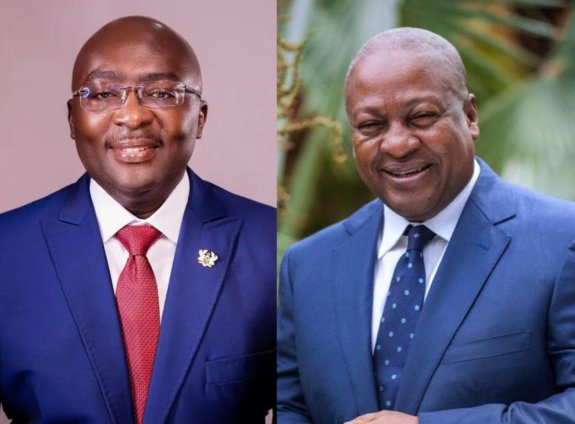
The Institute of Economic Research and Public Policy (IERPP) has handed President John Mahama a first-year score of 4.9 out of 10 a verdict that would be unremarkable if its authors were not so plainly aligned with the opposition New Patriotic Party.
The group, composed of five senior lecturers from the University of Ghana, GIMPA, and UPS-A, has been dubbed the “Bawumia hit squad” by critics, and its latest report has done little to dispel that label.
The IERPP’s Performance Tracker cites weaknesses in energy, infrastructure, manufacturing, governance, policy implementation, and social delivery as the main drags on the administration’s score. Infrastructure, in particular, is singled out for failing to spend on capital projects a criticism that may resonate with Ghanaians frustrated by potholed roads and stalled works.
Executive Director Professor Isaac Boadi noted that capital expenditure execution stood at just 0.9% in 2025, a statistic that deserves scrutiny, regardless of its source.
But the report’s methodology is where the trouble begins. The IERPP has not disclosed its full assessment criteria, weighting, or data sources. It presents itself as an independent think tank, yet its fellows have a paper trail of partisan activity that makes objectivity a stretch.
Dr. Joshua Zaato is a known NPP member who contested a parliamentary seat in the Sissala constituency. Prof Boadi has been photographed in ‘Free SHS’ campaign gear, actively stumping for the NPP. Dr. George Domfe has publicly clashed with Prof Ransford Gyampoh a known NDC sympathiser in a televised debate that revealed more heat than light.
Then there is Dr. Kwasi Nyame-Baafi, a GIMPA lecturer who doubles as the NPP’s National Deputy Director for Research and a technical advisor to Dr. Bawumia himself. His presence at IERPP’s press events suggests the line between academic analysis and party propaganda is entirely blurred.
The IERPP’s pessimistic rating stands in sharp contrast to independent polls released in recent months. The Institute for Economic Affairs (IEA), a well-regarded policy think tank, found in May 2026 that 58.9% of Ghanaians approve of Mahama’s performance down from 68% in December 2025 but still overwhelmingly positive.
The economy was cited as the top driver of support, with 73.5% of approvers pointing to macroeconomic management. Energy and electricity, curiously, accounted for only 2.7% of positive responses a finding that undercuts the IERPP’s emphasis on energy as a weakness.
Global InfoAnalytics went further, reporting in its May 2026 tracking poll that 74% of Ghanaians approve of Mahama’s handling of the economy, 67% support his job creation efforts, and 65% are satisfied with his approach to illegal mining. These are not marginal numbers; they suggest a president who, while not without critics, retains significant public goodwill.
The IERPP report lands at a delicate moment. The NPP is in opposition, still licking its wounds from the 2024 defeat, and looking for any ammunition to weaken the Mahama administration. A low score from an ostensibly academic source provides useful cover for attacks on the government’s competence. But the report’s partisan fingerprints are too visible to be ignored. The group’s members are not neutral observers; they are operatives with a stake in the NPP’s revival.
The public reaction has been predictably sceptical. Journalist Richard Nii Abbey, now based in the US, captured the mood perfectly: “Can anyone tell me those behind IERPP? I want to know whether to take the rating seriously or just a case of the hen dancing for the hawk.” That metaphor a hen dancing for the hawk is a Ghanaian expression for a performance that serves the predator, not the truth.
Even if one discounts the IERPP’s political bias, its specific criticisms deserve examination. Capital expenditure did indeed lag in 2025 a legacy of the previous administration’s debt overhang and the constraints of the IMF programme. Mahama’s team has acknowledged this, and the 2026 budget signals a ramp-up in infrastructure spending. Whether that materialises in the coming year will be the true test.
Similarly, the energy sector remains fragile. Power outages, though less frequent than under the previous administration, still occur. The government’s response a mix of renewable investments and thermal plant maintenance has been slow to yield results. But the IERPP’s score of 4.9 does not account for the structural constraints Mahama inherited: a broken economy, a bloated debt profile, and a state apparatus resistant to reform.
The IERPP report is less a scholarly exercise than a political intervention, timed to shape public discourse ahead of the 2028 elections. Its authors have every right to criticise the government but they must own their affiliations. Grading a president from a partisan perch is not research; it is advocacy dressed in academic robes.
The real scorecard will not come from a group of NPP-aligned lecturers. It will come from the Ghanaian people, who will judge Mahama not on a 10-point scale but on whether their lives improve.
The IEA and Global InfoAnalytics polls suggest that, for now, the public is giving him the benefit of the doubt. The IERPP’s 4.9 is a warning shot, but it is also a reminder that the NPP’s intellectual wing is mobilising for the long fight.
As for the President, he would do well to treat the report as what it is: a political statement, not an academic verdict. And he should note that his opponents are already sharpening their pencils for the next round.