

By Leo Nelson
On paper, Ghana’s economy has rarely looked healthier. Inflation is down to single digits. Gross international reserves have climbed to an all-time high of US3 billion bailout, and Accra has transitioned to a non-financing Policy Coordination Instrument (PCI), a badge of policy credibility that officials hope will unlock investment-grade status.
Yet the cedi tells a more complicated story. On June 15, the local currency traded at around 11.10 to the dollar on the interbank market, a slight improvement after weeks of steady decline.
But that headline figure masks a persistent fragility: the cedi has depreciated by about 8.4 per cent against the dollar since the start of the year, according to Bank of Ghana data.
In late May, retail rates at forex bureaux were quoting as high as 12.40 to the dollar, a stark reminder that the interbank rate does not always reflect what ordinary Ghanaians pay at the counter.
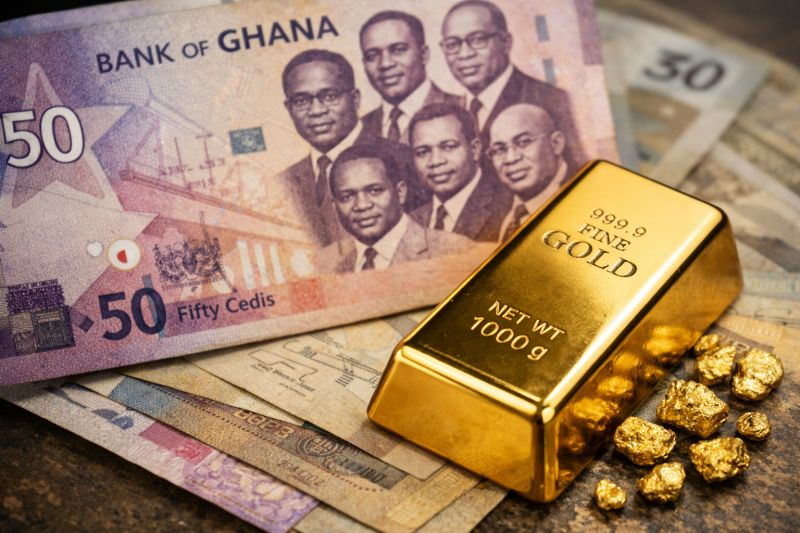
Gold is both the hero and the hostage of Ghana’s recovery story. Record production of 6 million ounces in 2025 driven by a dramatic expansion of artisanal output to 3.1 million ounces propelled total export earnings to US6.8 billion.
The government now targets 6.5 million ounces for the full year, which would consolidate Ghana’s position as Africa’s top gold producer.
But the mechanics of turning that gold into reserves have proven costly. The Bank of Ghana’s Domestic Gold Purchase Programme (DGPP) which allowed the central bank to buy directly from small-scale miners generated cumulative losses exceeding GH¢7 billion between 2022 and 2024, according to IMF disclosures.
The central bank has now handed operational control to the Ghana Gold Board (GoldBod), stepping back from day-to-day trading to strip quasi-fiscal risk from the programme.
Finance Minister Cassiel Ato Forson remains bullish. Speaking at the Ghana-UK Investment Summit in London on June 1, he announced that the government expects to buy “at least US14 billion in 2025.
“Today, the central bank has a very healthy reserve position,” he told investors. Yet those same investors have watched the cedi lose value for five consecutive months, even as the macroeconomic headlines improved.
The explanation lies in the structural mismatch between Ghana’s import-dependent economy and its narrow export base.
According to Bank of Ghana data, the oil import bill rose from US2 billion in April 2026, driven by elevated global crude prices amid Middle East tensions.
At the same time, multinational companies are repatriating dividends, and energy sector importers are competing for scarce dollars. The central bank has responded by increasing its June market support to US1 billion in May.
“The cedi is neither propped up for appearances nor simply left to drift,” one Accra-based economist told The New Republic.
“But the Bank of Ghana cannot on its own close a structural gap between steady dollar demand and uneven dollar supply.”
That gap is reflected in the country’s trade surplus: despite a healthy US$5.28 billion surplus by April, the timing of export receipts does not always align with importers’ dollar needs, leaving the market periodically short.
President John Dramani Mahama’s administration has made reserve accumulation a centrepiece of its economic legacy. In February, the government launched the Ghana Accelerated National Reserve Accumulation Policy (GANRAP), a three-year framework targeting 15 months of import cover by 2028 an ambitious goal that would place Ghana among the most resilient economies on the continent.
The policy is anchored on weekly gold purchases of approximately 3.02 tonnes, derived from both artisanal and large-scale mining.
But the politics of gold are never straightforward. The Ghana Chamber of Mines has warned that the government’s planned royalty increase from a range of 3-5 per cent to up to 12 per cent could deter new investment and jeopardise the 2026 production target.
“Our production remained almost stable in 2025, but 2026 is concerning,” Chamber CEO Kenneth Ashigbey told Reuters. “The royalty increase will immediately affect new projects, those expected to drive output next year”.
For President Mahama, who has told NDC elders he will not seek a constitutionally impossible third term, the economic narrative matters as much as the numbers.
A successful exit from the IMF programme and a credible reserves-building strategy burnish his legacy and provide political cover for his party’s succession battle.
But if the cedi continues to slide even as reserves grow, voters may begin to question what the record import cover is actually protecting.
The IMF has praised Ghana’s progress, noting that “inflation has declined rapidly, international reserves have been rebuilt, and confidence in the cedi has improved”.
Yet the Fund also struck a cautious note, warning that “the volatile external environment underscores the importance of preserving prudent policies and strengthening resilience”. The PCI framework, while a useful signalling device, provides no financial backstop.
Forecasts for the rest of 2026 vary widely. Fitch Solutions projects a further 8 per cent depreciation by year-end, while Databank Research offers a slightly more optimistic 7.2 per cent.
What is clear is that Ghana’s currency is no longer the crisis-level disaster of 2022, when the cedi traded at nearly 15 to the dollar. But nor has it fully escaped the gravitational pull of an economy that remains too dependent on one commodity, too exposed to global price shocks, and too slow to diversify.
As one veteran central banker put it, speaking on condition of anonymity: “The cedi’s fate is not written in gold. It is written in the decisions Accra makes about everything else.”