

By Gifty Boateng
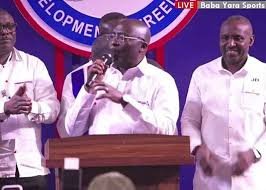
That is the paradox at the heart of the New Patriotic Party’s just-ended National Delegates Conference at the Baba Yara Sports Stadium, where the party amended its constitution to make its presidential flagbearer the leader of the party in both opposition and government effectively reducing the newly elected National Chairman to a ceremonial custodian of a house whose keys have been handed to another man.
The amendment, the 10th of 14 motions tabled, was adopted on Saturday, October 3, after delegates said they shouted an overwhelming “No” from the floor.
The party insisted all 14 motions stood. Delegates fumed. Lawyers threatened court action. And John Boadu, the man elected to chair the party, was left staring at a crown without a throne.
For years, the NPP’s national chairman has been the party’s top officer. The new arrangement changes that. If the party is in opposition, the flagbearer leads. If in government, the president by virtue of the same amendment leads.
The chairman, in effect, becomes a caretaker, a logistics chief, a custodian of structures but not the commander of the political ship. The flagbearer, Dr Mahamudu Bawumia, now occupies the commanding heights. John Boadu, the elected chairman, is rendered powerless in the very office he won.
Delegate Joseph Prempeh Antwi, constituency secretary for Manso Adubia in the Ashanti Region, told the conference the motion piled unnecessary responsibility on the flagbearer and stripped the chairman of the authority needed to run the party.
“My simplest reason is that when our party is elected to power, the president automatically occupies the highest office of the land, and anything concerning the party should be left to the party people even though he is not left out as a party man,” Antwi said. “Combining the two roles will be a burden.
The chairman must be entrusted with the party so he can bring policies, machinery and other support, so that the president gets more time to concentrate on real governance.”
Antwi claimed the motion was rejected by close to 80 percent of delegates. “People were surprised after we all said no. But the party turned around and confirmed that it has been captured, and that all 14 motions will stand which, in fact, wasn’t the best.”
He accused the party of failing to practise the principles it preaches. “If we are saying yes, it is yes. If we are saying no, it is no. Once it is captured, it doesn’t mean that even if we say no, we will still insist that it should be yes.”
Another constituency member, Eric Kyei Baffour, said the new arrangement would be too heavy for any flagbearer or president.
“Honestly, I want the party chairman to be the leader of the party. Imagine winning power in 2028 and the First Gentleman, Dr Mahamudu Bawumia, has to run the day-to-day administration of the whole country and then add party issues to it. It will be a very herculean task,” he said.
He confirmed he shouted a very big no. “Leadership should be left in the hands of the party chairman.”
The discontent did not stay in the NPP family. In its solidarity message, the People’s National Convention warned that concentrating both roles in one person risks weakening internal democracy.
“A flagbearer carries the party’s banner in elections; a party leader must build structures, reconcile factions and hold the party accountable between elections,” the PNC said.
Supporters of the amendment argued it would ensure unity of command, align responsibility with accountability and avoid the kind of rift that once tore the party between then-flagbearer Nana Akufo-Addo and national chairman Paul Afoko. They pointed to advanced democracies where the flagbearer is the recognised face and leader of the party.
Political analyst Dr Samuel Afriyie, a senior lecturer at Kumasi Technical University, backed the change. “For stronger party cohesion, especially going into elections, the flagbearer should lead the party. If you look at the NDC, that system is working for them,” he said. He added that the national chairman could hold the fort only when there is no flagbearer.
But that caveat is precisely John Boadu’s predicament. There is a flagbearer. And under the new constitution, that flagbearer is the leader. The chairman is not.
Delegates said lawyers in the party were overheard discussing a possible court challenge. “I cannot directly tell you the lawyer, but I heard some people with legal brains saying that if this thing is pushed, they can push harder so that it reaches the law court,” Antwi said.
For Boadu, the irony is brutal. He has the chair. He has the title. He has the seat at the high table. But the amendment has moved the levers of power to the flagbearer both in opposition and in government.
The chairman may still run the secretariat, but the flagbearer will run the party. And if Boadu is unavailable, it is First National Vice Chairman Kojo Fosu Boadu, alias Kojo Bamba, who acts.
In the NPP’s new architecture, the chairman is a caretaker in his own house.