

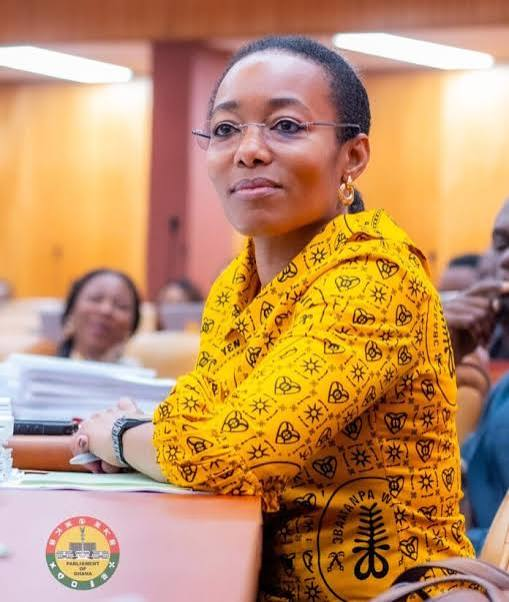
Zanetor Warns Illegal Gold Cash Could Finance Sahel Extremists As Toxic Rivers Flow Into Côte d’Ivoire
By Prince Ahenkorah
Galamsey has always been framed as an environmental crisis, a public health emergency, and a law enforcement failure. On Thursday, Ghana’s Environment Minister added a new frame: national security and regional diplomacy.
Speaking at a national conference for Metropolitan, Municipal and District Chief Executives in Accra, Dr. Zanetor Agyeman-Rawlings warned that pollution from illegal mining in the Tano and Bia rivers both of which flow into Côte d’Ivoire could trigger cross-border tensions. The rivers do not respect borders. Neither does mercury.
“Mining-induced pollution of rivers such as the Tano and Bia could travel across national borders into Côte d’Ivoire,” the minister said, according to a transcript of her remarks. The consequences, she warned, could include “regional tensions” and threats to “public health and national security.”
It is a striking escalation in the rhetoric around galamsey, which has traditionally been treated as a domestic environmental problem a source of outrage, certainly, but not a matter of foreign policy. Agyeman-Rawlings’s framing suggests that Ghana’s failure to control illegal mining is no longer just a national embarrassment. It is a regional liability.
The minister went further. She alleged that proceeds from illegal mining were helping to finance violent extremism and terrorism in parts of the Sahel.
This is not a claim that can be verified from the podium. But it is consistent with a growing body of research on the intersection between illicit gold mining and armed groups in West Africa. Gold is easily smuggled, easily monetized, and difficult to trace. In the Sahel, where state authority is thin and armed groups operate with impunity, illegal mining has become a source of revenue for actors who wish to destabilize the region.
Agyeman-Rawlings argued that Ghana must not allow “inaction and silence” to make the country “complicit in activities that could undermine security across the sub-region.”
The implication is uncomfortable. If Ghanaian gold is financing terrorism, then Ghana is not merely a victim of galamsey. It is part of the problem. The minister’s warning is a call for the country to confront that reality before it becomes a diplomatic crisis.
Agyeman-Rawlings is a medical doctor, and she brought a clinician’s precision to the health consequences of galamsey. She cited studies on the Odaw River, which she said had revealed severe pollution associated with mining activities.
She referenced assessments by the Environmental Protection Authority and its partners that identified dangerous levels of heavy metals mercury, lead, arsenic, cadmium in mining-affected environments.
The implications for children, pregnant women, and newborns are severe. Polluted water sources can expose communities far beyond mining sites. Boreholes several kilometers away from mining areas can serve as drinking water sources for schoolchildren. The minister noted that the consequences of such exposure could be “devastating for future generations.”
She also warned that the destruction of forests and pollution of water bodies were undermining food security. Ghana, she argued, cannot prioritize gold production at the expense of agriculture, water security, and other critical sectors of the economy.
The anticipated El Niño weather phenomenon, coupled with climate change, could worsen the country’s environmental challenges through changing rainfall patterns and rising temperatures. Trees regulate temperatures, sustain local climates, and support biodiversity. Their indiscriminate destruction through illegal mining intensifies environmental degradation.
Agyeman-Rawlings directed a significant portion of her remarks at the MMDCEs in the room. The fight against galamsey, she said, cannot be won through decisions taken in Accra alone.
She reminded the district executives of their responsibilities under the Local Governance Act, 2016 (Act 936), which requires prior written approval from the relevant assemblies before physical development takes place within their jurisdictions. District assemblies are strategically positioned to identify illegal mining activities, monitor the movement of excavators, detect changes in river conditions, and report the destruction of farmlands and forests.
She urged the MMDCEs to utilize their positions on Regional Security Councils, Municipal Security Councils, and District Security Councils to strengthen surveillance and enforcement. Traditional authorities, she added, must also support government efforts. Their roles as custodians of lands and natural resources are indispensable.
It is a familiar appeal. Local officials have heard it before. The question is whether this time will be different.
The minister provided an update on measures the EPA has taken. In 2025, the authority monitored 19,079 undertakings, including mining operations, with approximately one-third found to be non-compliant. The authority responded through enforcement notices, closures, and prosecutions.
The EPA has banned the importation, assembly, and use of changfan machines in mining, particularly in water bodies. Customs and security agencies are expected to enforce the directive.
The authority has piloted water treatment interventions in the Birim, Tano, and Bia rivers before introducing a water restoration framework to guide dredging and reclamation activities within a 100-meter buffer zone on both banks of affected rivers.
Under the PlanetGOLD programme, approximately 370 small-scale miners, including more than 100 women, have received training in mercury-free gold processing. A clean mining demonstration center has been completed at Tinga in the Savannah Region. Through the Ghana Landscape Restoration and Small-Scale Mining Project, more than 1,000 hectares of degraded land have been restored, and 1,604 hectares of riparian vegetation re-established.
These are real interventions. They are also, by the minister’s own admission, insufficient. Restoration efforts will remain ineffective if illegal mining activities continue to pollute rivers and destroy the environment. The problem is not a lack of programs. It is a lack of enforcement.
Agyeman-Rawlings saved her sharpest words for the politics of galamsey.
“No individual, regardless of status or political affiliation, should be shielded from prosecution,” she said, according to the transcript. She argued that illegal mining cannot thrive without some level of protection or complicity. She urged politicians, public officials, traditional leaders, and security personnel to desist from interfering in the arrest and prosecution of suspected offenders.
This is the uncomfortable truth at the heart of Ghana’s galamsey crisis. The machines do not operate in secret. The excavators do not move without roads. The gold does not leave the country without networks. Galamsey thrives because powerful people protect it.
The minister’s call for accountability is welcome. But it is also a test. Will the government prosecute the connected, or only the small-scale miners at the bottom of the chain? Will the security agencies that are supposed to enforce the ban be held to account when they fail? Will the politicians who protect illegal miners face consequences?
Agyeman-Rawlings did not name names. She did not need to. The audience knew what she was talking about.
The minister’s warning about Côte d’Ivoire is a reminder that galamsey is not just a Ghanaian problem. The Tano and Bia rivers flow across borders. The pollution they carry does not stop at checkpoints. The mercury that contaminates Ghanaian water eventually reaches Ivorian water.
If Ghana does not act, its neighbors will notice. They may demand compensation. They may restrict trade. They may take the matter to regional bodies. The longer the pollution continues, the harder it will be to undo the damage and the harder it will be to convince Côte d’Ivoire that Ghana is a reliable partner.
Agyeman-Rawlings’s speech was a warning. It was also an admission. The government knows what is happening. It knows the consequences. The question is whether it is willing to pay the political price of stopping it.