

By Philip Antoh
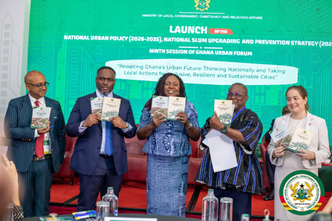
The government has introduced two major 10-year frameworks, the National Urban Policy and the National Slum Upgrading and Prevention Strategy both spanning 2026–2035 to tackle the country’s growing urban crisis.
Unveiled at the Ninth Ghana Urban Forum in Accra, the policies aim to address severe challenges such as a widening housing deficit, persistent flooding, congestion, and the uncontrolled spread of informal settlements.
The forum was themed “Resetting Ghana’s Urban Future: Thinking Nationally and Taking Local Actions for Inclusive, Resilient and Sustainable Cities.”
Speaking on behalf of President John Dramani Mahama, Dr. Nii Moi Thompson, Board Chairman of the National Development Planning Commission, highlighted the urgent need for the policies.
He noted that Ghana’s urban population has surged from roughly four million in the 1980s to 14 million in 2020, with projections hitting 20.4 million by 2026.
While acknowledging that this growth brings economic opportunities, Dr. Thompson warned that it has overwhelmed existing infrastructure. “Across our cities, we are confronted with persistent challenges… housing deficits continue to grow, along with congestion, flooding, sanitation challenges, and weak development controls,” he said.
To counter this, the new policy focuses on better land-use planning, affordable housing, digital innovation, climate resilience, and improved urban financing.
However, Dr. Thompson issued a stern warning to local authorities: “This policy must not remain a document on the shelf. It must be translated into concrete plans, budgets, and measurable actions.”
Representing the Minister for Local Government, Chieftaincy and Religious Affairs, the Ministry’s Chief Director, Alhaji Amin Abdul-Rahman, echoed this sentiment.
He explained that the Slum Upgrading Strategy will rely on improved service delivery, housing management, and community participation to uplift informal settlements while preserving human dignity.
The government plans to collaborate closely with local assemblies, traditional leaders, the private sector, and development partners to ensure these blueprints translate into tangible improvements for Ghanaian cities.
Alongside the Urban Policy, we are also launching the National Slum Upgrading and Prevention Strategy to respond to the realities faced by many residents of informal settlements who continue to lack adequate housing and access to basic services.
The strategy he said provides a framework for integrated slum upgrading, improved service delivery, strengthened land and housing management systems, enhanced community participation and preventive measures to reduce the emergence of new informal settlements.
“It reflects government’s commitment to promoting social inclusion, human dignity and sustainable urban development as we also solicit support from our development partners, investment from the private sector and active participation by citizens in building cleaner, safer and more resilient communities.”