

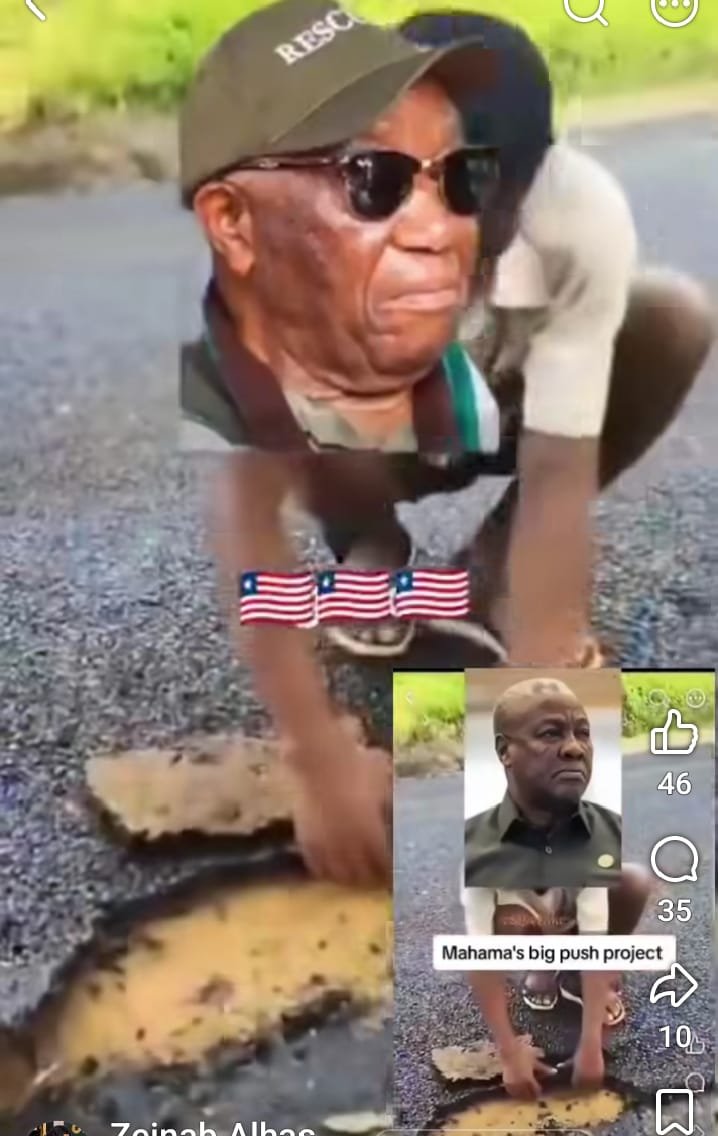
A plot to misrepresent a poorly constructed road in Liberia as part of President John Mahama’s flagship “Big Push” infrastructure project has been exposed, with the opposition New Patriotic Party (NPP) fingered as the likely architect of the propaganda piece.
The scheme unraveled after a video emerged online posted on October 5, showing a newly constructed road that appeared impressive on the surface but was shoddy underneath.
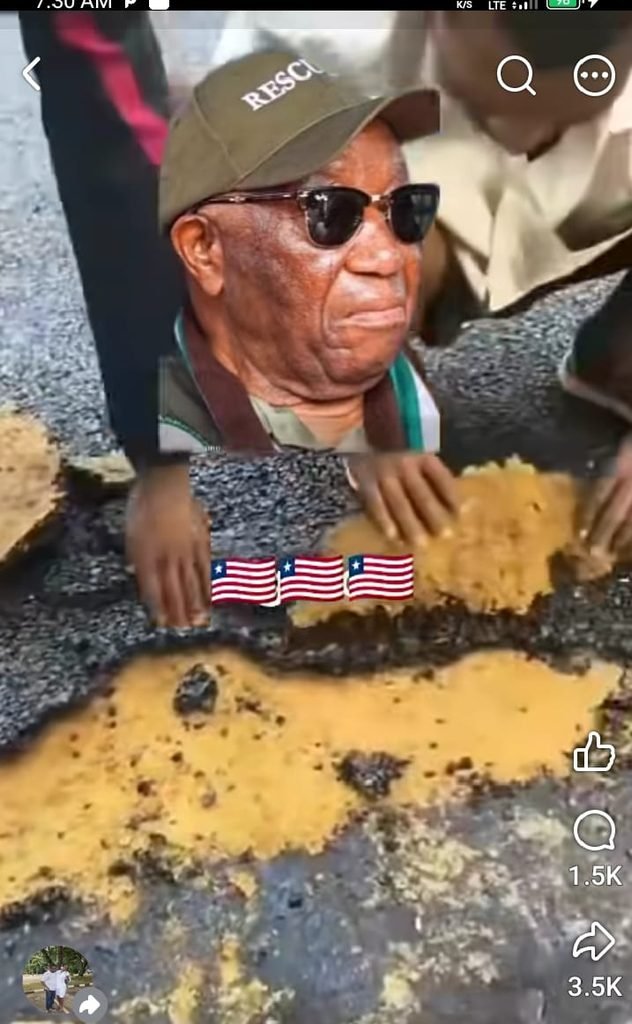
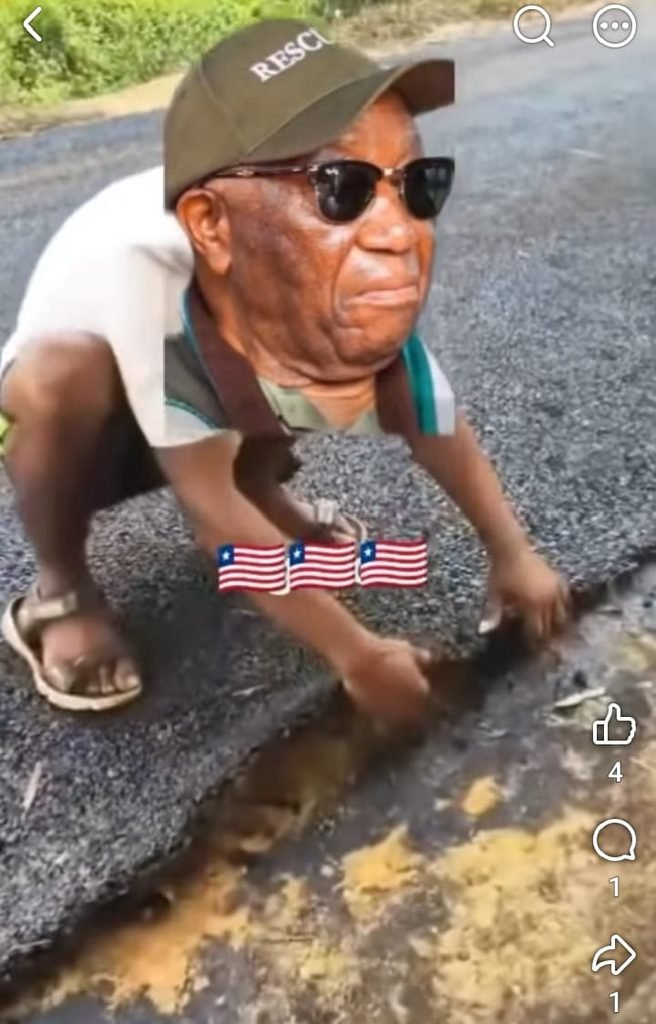
In the footage, a young Liberian man expressed disappointment at the contractor’s work and called on Liberian authorities to take action. At one point, he pulled off a section of the asphalt to prove how poorly the road had been built. The video carried a photograph of Liberia’s President, Joseph Nyuma Boakai — clearly situating the project in that country.
Days after the video began attracting attention, however, a doctored version surfaced online. This time, it was set to a campaign song of President Mahama and accompanied by his portrait, insinuating that the road was located in Ghana and formed part of the Big Push project.
Although no one has claimed the altered video, some social media users have accused the NPP of being behind it. There is speculation that the video was doctored within the party’s communications department, led by its Director, Dennis Edward Miracles Aboagye.
Aboagye has not laid claim to the video, but suspicion has fallen on his outfit. But former Member of Parliament for the Ablekuma Central constituency Ebenezer Gilbert Nii Narh Nartey, has said that it is up to the NDC government to come and deny that the video did not originate from Ghana.
During a panel discussion on Neat FM, the rejected a question by the host asking why the NPP will run with such an image when they know it is false.
“That thing is not from Ghana and no one should involve the name of the Agbodza in this. On NPP platforms it is there. There are somethings these days if use them for politics they do not hold. To sit down for someone to lie that something that is not from Ghana it will be used as coming from Ghana…..”
When the host pointed out that the video was not from Ghana, he rebutted asking him if he was the Public Relations Officer (PRO) for the Roads Minister Kwame Agbodza?
“Are you Agbodza PRO? Let the ministry come and debunk it. Do you now work at Ministry? The ministry has a PRO, if somebody is tarnishing the image of the minister, it is the responsibility of the PRO to come and say it is untrue”, he told the host. I will not take yours as sole substance than the ministry coming out”, he told the host of the programme Kwabena Owusu Agyemang.
According to Nartey, everything that did not go well under former President Akufo-Addo was blamed on him.
“Kwabena, give me one thing in Nana Addo’s administration that was notattributed to Nana Addo. Give me one thing. If it is not Ghana, the minister or the PRO should come and deny it that it is not Ghana”, he added.
Critics point to a recent admission by NPP a failed general secretary aspirant Sylvester Tetteh as evidence of a deliberate strategy built on propaganda rather than facts.
In a video circulating on social media, Tetteh told party members that the governing National Democratic Congress (NDC) was creating fear among NPP communicators through the arrest of TikTokers and other social media activists.
His solution: a communication strategy designed to put the government on the defensive by setting the political agenda and forcing the NDC to respond.
“We are in opposition, we don’t need facts, we need to propagate. We need to propagate,” Tetteh declared.
He added: “One and a half years in opposition, the party is in Parliament; there is no problem. But Parliament is a house of records. At Asylum Down, it is not a place of records, it is a place of propaganda.”
This is not the first time the NPP has been accused of using foreign material to score political points.
In 2021, the now Minority Leader, Alexander Afenyo-Markin, was caught using a foreign image to support his claim of massive sand winning at Keta in the Volta Region. The photos were said to have originated from Sierra Leone.
At a news conference on Friday, November 12, 2021, on sea erosion affecting the Ketu South, Keta, Anlo and South Tongu constituencies, the then Deputy Majority Leader and MP for Effutu suggested that residents of Keta were themselves to blame for the erosion due to sand winning.
He displayed a picture of several tipper trucks lined up along a coastline loading sand, using it to demonstrate that the people of Keta were engaged in serious sand winning at the beach.
When his attention was drawn to the false information, however, he withdrew the remarks and apologised.
“Upon further due diligence, the very website, Cover Ghana, that published the article and accompanied the picture with it and dated it, has since pulled it down. It is only fair and proper to sincerely withdraw that picture and apologise for adding that as part of our findings,” he said.
“I mean, we all make mistakes sometimes. I couldn’t have reasonably taken that step to mislead. If it were so, I would not have handed over the entire research findings to the press,” Afenyo-Markin added, insisting his intention was to present documents for stakeholders to interrogate and proffer solutions.
The incident followed his remarks at the November 12, 2021, press conference, during which he discussed the causes of coastal erosion and alleged that residents of Keta were contributing to the problem through sand winning.
The use of the photograph subsequently became a point of contention in the broader debate over the accuracy of political claims and the verification of evidence presented to the public.
The controversy surrounding the Liberian road video has once again highlighted the risks associated with circulating photographs and videos without verifying their origin and context.
With social media serving as a major platform for political communication, edited footage and misleading captions can quickly influence public discussions before the underlying facts are established.
The Big Push programme is a flagship infrastructure initiative of the Mahama administration, making claims about the quality and execution of projects under the programme a politically sensitive issue.
For now, the origin of the modified video and the identity of those responsible for circulating it remain unconfirmed.
By Gifty Baoteng