

By Philip Antoh
The Ghana Chamber of Mines has underscored the resilience of the country’s mining industry, revealing a contribution of over GH¢22.22 billion to the economy in 2025.
This impressive revenue generation was announced during the Chamber’s 98th Annual General Meeting in Accra, where stakeholders gathered to review the sector’s performance amidst global economic headwinds.
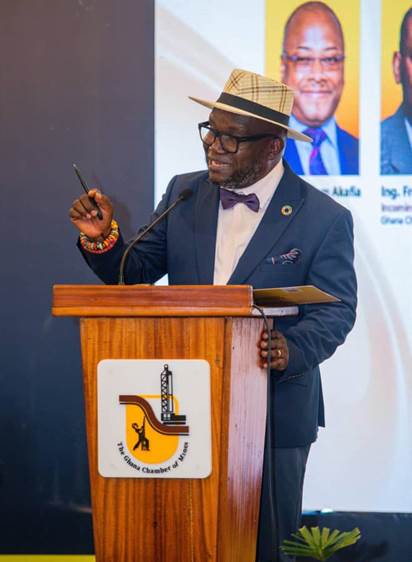
Delivering his address, the Chief Executive Officer of the Chamber, Ing. Dr. Kenneth Ashigbey, noted that despite 2025 being plagued by geopolitical tensions, inflation, supply chain disruptions, and climate obligations, the large-scale mining sector remained robust.
Dr. Ashigbey highlighted the industry’s multifaceted impact, which includes supporting over 13,800 direct jobs, spending approximately US$4.2 billion on local procurement, and investing US$88.6 million in community development projects within host communities.
Dr. Ashigbey disclosed that the Chamber’s persistent engagement with the government regarding fiscal policies has yielded results, specifically concerning the Growth and Sustainability Levy (GSL).
Following these discussions, the government agreed to reduce the levy from three percent to one percent in 2026, with a commitment to phase it out entirely by 2028. However, the Chamber continues to push for the immediate and total removal of the levy to boost competitiveness.
Furthermore, the Chamber has been active in the review of the Minerals and Mining Act.
Dr. Ashigbey expressed support for a medium-scale mining category, improvements in lease administration, and the conditional reinstatement of international arbitration mechanisms to bolster investor confidence.
On the environmental front, the Chamber strengthened its collaboration with the Environmental Protection Authority (EPA) to enforce standards regarding environmental permitting, reclamation bonds, and ESG compliance.
Dr. Ashigbey also addressed the menace of illegal mining (galamsey), stating that the Chamber has ramped up collaboration with government agencies, traditional authorities, and international bodies to combat environmental degradation.
In terms of security, the industry partnered with the Ghana Armed Forces and Police Service to provide specialized training for about 200 officers deployed to mining enclaves.
Highlighting strides in human capital, Dr. Ashigbey mentioned the Chamber’s partnership with the University of Mines and Technology (UMaT).
Through the Tertiary Education Fund, an additional US$2 million has been committed to student bursaries, research, internships, and the establishment of an Artificial Intelligence and Robotics Laboratory.
Outgoing President of the Chamber, Mr. Michael Edem Akafia, provided a broader economic perspective, describing 2025 as a year of strong performance.
He revealed that Ghana’s economy grew by 5.95% its highest rate in five years driven significantly by the gold mining subsector, which expanded by 19.6%.
Consequently, gold has become Ghana’s largest economic subsector by contribution to GDP.
As the Chamber gears up for its 100th anniversary, Dr. Ashigbey outlined a vision that extends beyond celebration.
He stated that the centenary activities will focus on shaping a sustainable and innovative future.
The CEO set five key priorities for 2026, advocating for stable and competitive policies, strengthening collaboration with stakeholders, promoting responsible mining practices, enhancing public understanding of the sector’s value and pursuing digital transformation to improve service delivery.
The meeting also saw successful organization of the 18th West African Mining and Power Expo (WAMPEX 2025) and the Mining Industry Marketing Expo (MIME 2025), both aimed at boosting local content.
Dr. Ashigbey concluded by expressing gratitude to the government, regulatory bodies, traditional authorities, development partners, and member companies for their continued support in advancing the industry.