

By Lawrence Odoom/Phalonzy
The Gomoa East District Assembly in the Central Region is courting investors to back the creation of a dedicated “Gomoa White Salt Board” to regulate and optimize the district’s vast, underutilized salt deposits.
Despite an abundance of indigenous salt, the district lacks a formal regulatory body akin to the Gold Board, a gap District Chief Executive Margaret Naana Ackom says must be closed to unlock economic and industrial value.
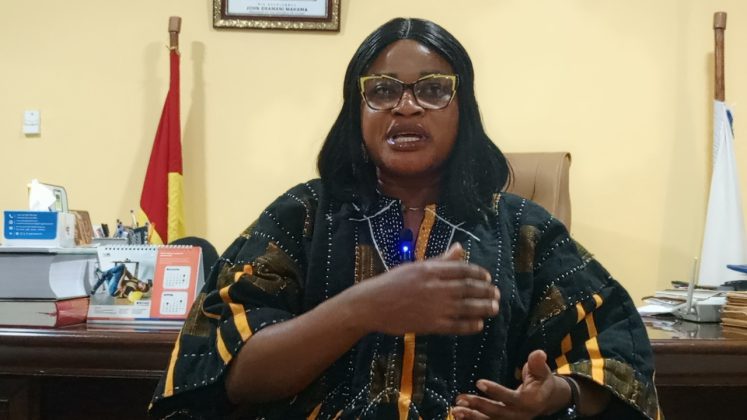
In an exclusive interview with Onua News marking her first year in office, Madam Ackom made a compelling case for institutionalizing the sector.
“We have GoldBod in Ghana, but we don’t have a salt board. I am talking about the local salt in Ghana. Now we are in the dry season, so it is available and cheaper, but during the rainy season, one cannot get salt to buy; it becomes expensive,” she explained.
The proposed board, she noted, would anchor storage infrastructure to guarantee year-round supply across Ghana and position the commodity for export.
“When the board is created, we will get a place for storage so salt will be available in either the rainy season or the dry season, and we can also export it because in places where snow is massive, they use salt to wipe or clear the snow.”
Madam Ackom emphasized that formalization would catalyze youth employment, since many young people already engage in small-scale salt mining. A structured board would scale operations, standardize quality, and integrate miners into a viable value chain.
Industrial Prospects: Cement Factory Pitch
The DCE further appealed to Engineers and Planners CEO Ibrahim Mahama to consider siting a cement factory in the district, citing five active quarry sites that could furnish raw materials for production.
Banking and Judicial Infrastructure Deficit
Despite being the most populous district in the Central Region, Gomoa East has no commercial bank. Residents and businesses must travel to Kasoa, Winneba, or Agona Swedru for basic financial services.
Madam Ackom urged banks to establish branches urgently, noting the rollout of the district’s 24-hour market will intensify demand for banking services.
“We have given Point Hope a 3-unit classroom block because the land was a challenge. Duawonfo, we have built a 6-unit classroom block with teachers’ bungalows, and here, they do not have school at all, so the children walk all the way to Fetteh, so Fetteh is really choked.”
The judicial gap is equally stark. With no district court, litigants and police officers must seek adjudication in neighboring jurisdictions, overburdening those courts and delaying justice.
“She explained that some of these district courts are already congested, and as such, adding up cases from Gomoa East delays the justice system.”
Strides in Education and Health
Outlining her stewardship, the DCE said the Assembly, with the area’s MP, distributed books, pens, pencils, and other learning materials to BECE and WASSCE candidates over the past year.
“We have given Point Hope a 3-unit classroom block because the land was a challenge. Duawonfo, we have built a 6-unit classroom block with teachers’ bungalows, and here, they do not have school at all, so the children walk all the way to Fetteh, so Fetteh is really choked.”
She added that 10% of the District Assembly’s Common Fund is being channeled into education, with new schools under construction in underserved communities.
On health, a new CHPS compound has been provided at Nkwantanan to deliver primary care, while 20% of the Common Fund is earmarked for legacy projects.
“We have a DCE bungalow on the premises of the assembly, and we have converted that into eight offices, such as those of the Ghana Immigration Service, National Identification Authority, and Signal Bureau, among others, because we realised that apart from this one, the past government was constructing another bungalow at Dominase, so we decided to convert this one into offices,” she said.
Regarding support for persons with disabilities, “Madam Naana Ackom explained that some of them were given something depending on the individual needs of the person.”
Sanitation and Fisheries
To tackle sanitation, the Assembly has constituted a task force and procured refuse containers for distribution across communities to streamline waste disposal.
On premix fuel, the DCE highlighted a critical shortfall in coastal coverage.
“We have three coastal towns, but we had two committees. We had one at Fetteh and Nyanyaano, but Dampase did not. Fisher folks had to travel all the way to Winneba or Apam before they get premix fuel, but we have been able to establish one at Dampase because we are talking about over 360 canoes in my district,” she explained.
The year-one account paints a district pursuing aggressive infrastructure and social investment while lobbying for structural interventions, chief among them, a Salt Board to convert natural endowments into sustainable prosperity.