

Says Fund Too Small to Curb Accra’s Flooding Crisis
By Philip Antoh
A decade after the June 3, 2015, flood disaster that killed more than 150 people and submerged much of the capital, Accra remains dangerously exposed. A new policy brief from the IMANI Centre for Policy and Education, released on Monday, delivers a sobering verdict: the remaining funds for the Greater Accra Resilient and Integrated Development (GARID) project are unlikely to be enough.
The think tank’s analysis, titled “GARID and Urban Governance as Adaptation and Strategic Measures to Address Perennial Floods,” cuts through the official optimism that has surrounded the World Bank-backed initiative. The core message is simple but unsettling: the money is running out, the timeline is slipping, and the city’s vulnerability is not being fixed.
GARID was originally designed as a $350 million intervention to tackle chronic flooding, waste management, and drainage infrastructure in the Odaw River Basin – the city’s main drainage artery. But the financial picture has deteriorated. The World Bank reallocated $65 million to emergency COVID-19 response, leaving roughly $285 million for core infrastructure.
Worse still, the spending trajectory is alarming. As of June 2025, more than $118 million had already been spent from the $127 million drawn down. With the project’s completion deadline extended to 2027, IMANI notes that the “margin for error is shrinking rapidly.”
When that remaining $285 million must be spread across 17 metropolitan, municipal, and district assemblies each with its own engineering challenges the arithmetic becomes stark. The Odaw Basin alone requires expensive, technically demanding works.
But IMANI’s brief argues that money is only part of the problem. The bigger threat, it suggests, lies in institutional weakness and contractor performance.
A November 2025 study cited by the think tank reveals stark disparities among project implementation units. Some possess strong technical capacity; others struggle with chronic staffing shortages and obsolete tools. The result is a patchwork of progress – incremental gains in some areas, outright failure in others.
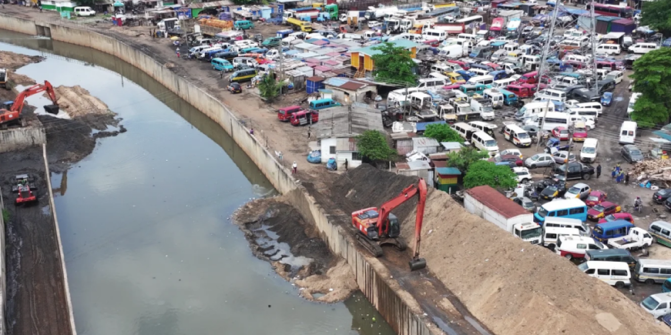
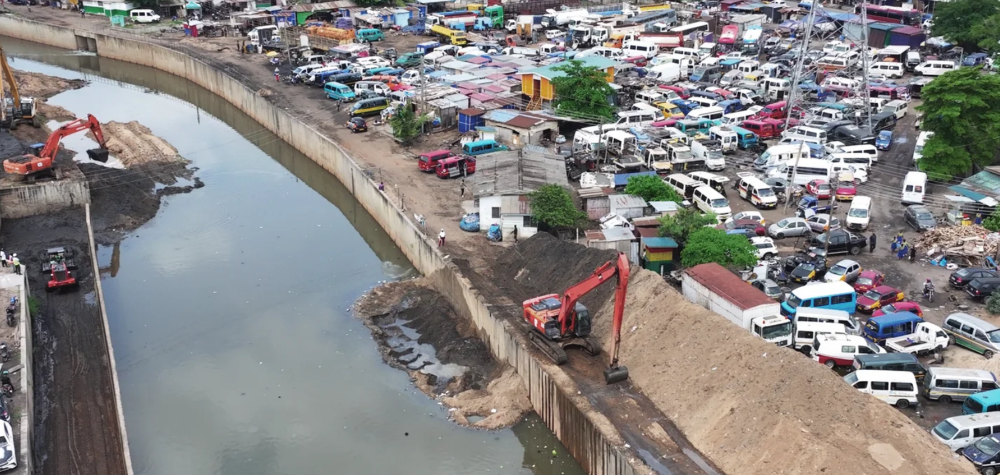
Agbogbloshie, the informal trading hub and one of Accra’s most flood-prone communities, is cited as a glaring example. Despite the extended timeline, critical sections of the Odaw River remain unfinished. Residents continue to endure flooding with no end in sight.
“If the money is available but the execution is stalled by poor contractor oversight and limited local capacity, then the funding amount becomes secondary to the management of these human and institutional failures,” the brief argues.
The IMANI analysis points to a deeper structural issue: the government’s tendency to treat GARID as a routine infrastructure project rather than a strategic climate adaptation imperative. This, the think tank warns, is a dangerous miscalculation.
“We cannot afford to view GARID as a project that will fix itself,” the brief states. “If the government continues to treat it as a routine infrastructure program, the city will remain vulnerable to the next disaster.”
The warning is not academic. Accra’s flood risk is intensifying as climate change exacerbates rainfall patterns. The 2015 disaster was a wake-up call; nearly a decade later, the city’s defences remain far from adequate.
IMANI is calling for urgent strategic oversight: strengthened project governance, improved coordination among the 17 assemblies, and a ruthless focus on using remaining funds for long-term resilience, not short-term optics.
But the think tank’s underlying question is one the government has yet to answer: if $285 million already reduced from $350 million is insufficient, how much more will it take? And who will pay for it?
For now, the Odaw River continues to flow. The excavators dig. The contractors come and go. But as IMANI’s brief makes clear, until Accra’s political and administrative systems match the scale of the threat, the next June 3 is only a matter of time.