

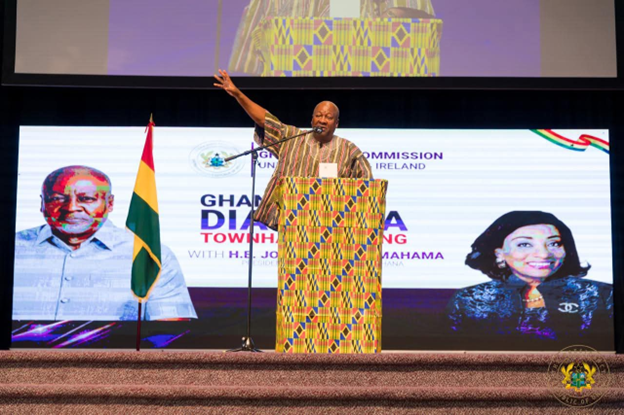
as President Mahama unveils shipbuilding plans for western enclave as inflation falls to 3.4%
President John Dramani Mahama used Monday morning’s Ghana-UK Investment Summit in London to announce a strategic shift in the country’s industrial geography, revealing plans for a shipbuilding industry that would transform what he called the “western enclave” of the West African nation.
Speaking at the one-day summit hosted at a central London venue, Mahama told an audience of institutional investors, business leaders and policymakers that the time had come to “move westwards”, breaking with six decades of industrial concentration around the port city of Tema in the east.
“Since our first President established the industrial town of Tema and the Port at Tema, a lot of our investment in terms of industry has gone towards the east,” Mahama said. “It is time to move westwards and that shipbuilding industry would be a jewel in the west.”
The announcement followed a surprise opening address by UK’s High Commissioner to the Ghana, Christian Rogg, who reportedly unveiled an undisclosed investment package for the western region. Mahama thanked his “brother” for what he described as a move that would “change the dynamics” of the area.
The President used the platform to showcase a dramatic improvement in Ghana’s economic fundamentals since his administration took office. Inflation, which stood at 23.8 per cent in December 2024, has fallen to 3.4 per cent as of April 2026, he told delegates. International reserves have climbed from approximately US13.8 billion, while GDP has crossed US$114 billion following estimated 6 per cent growth in 2025.
“These improvements are not abstract macroeconomic indicators,” Mahama said. “They translate into a more predictable investment environment, lower operating uncertainty, greater currency stability, and improved planning conditions.”
The sovereign credit outlook has improved following recent upgrades by international rating agencies, he added, though he did not name which agencies or provide specific ratings.
Mahama positioned his flagship “24-Hour Economy” policy as the centrepiece of Ghana’s investment proposition, describing it as “a deliberate national productivity strategy” rather than a slogan. The programme aims to maximise utilisation of infrastructure, logistics, ports and energy systems around the clock, with investors in logistics, industrial parks, cold-chain systems and manufacturing identified as primary targets.
The summit, organised by the Ghana High Commission, Invest Africa and the UK-Ghana Chamber of Commerce, is intended to move “from conversations to commitments”, Mahama said. Bilateral trade currently exceeds £1.5 billion annually, a figure the President described as “only scratching the surface”.
With Ghana’s population of 34 million, Mahama repeatedly stressed the country’s role as a strategic entry point to the ECOWAS market of 425 million people and the African Continental Free Trade Area’s 1.4 billion consumers. He cited recent legislation including the Ghana Investment Promotion Authority Act, which removes minimum capital requirements across many sectors and guarantees profit repatriation.
The government is also pursuing establishment of a new national airline to improve connectivity with major international markets, including the UK, while a US$10 billion “Big Push Infrastructure Programme” is accelerating investments in roads, railways and ports.
Several ministers and senior officials were present at the summit for what organisers hope will translate into binding commitments before delegates depart London later this week.
By Our Correspondent