

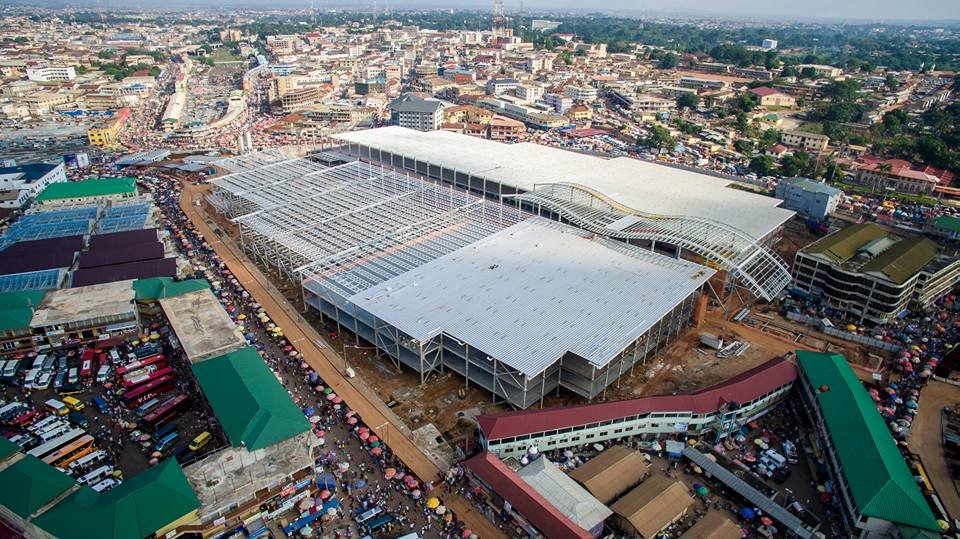
Market Racketeers Resold Gh¢25k Shops For Gh¢120k
By Prince Ahenkorah
What was designed as an affordable pathway for traders into the redeveloped Kumasi Central Market is fast evolving into a lucrative secondary market for a privileged few.
Officials at the Ministry of Local Government have uncovered what appears to be a growing trade in market stalls at Phase One of the Kejetia redevelopment project, where shops allocated at heavily subsidised rates are allegedly being resold or sublet at prices up to five times their original value.
At the centre of the controversy is a glaring disparity between the GH¢25,000 premium paid to the Kumasi Metropolitan Assembly (KMA) for a five-year tenancy and the GH¢100,000 to GH¢120,000 that some beneficiaries are reportedly charging third parties to acquire the same spaces.
The discovery is raising uncomfortable questions about whether the market allocation exercise has become less about supporting traders and more about creating opportunities for speculative gains.
Speaking at a stakeholder engagement in Kumasi, Local Government Minister Mahama Ayariga suggested that some beneficiaries had effectively turned publicly subsidised stalls into private assets.
According to him, preliminary assessments indicate that certain individuals acquired multiple shops under the official arrangement before transferring them to others at prevailing market rates.
The practice, officials argue, undermines the social objective of the project while simultaneously depriving government of revenue earmarked to finance subsequent phases of the redevelopment programme.
The arithmetic is difficult to ignore.
If traders are willing to pay between GH¢100,000 and GH¢120,000 for access to a stall, government officials question why public authorities should continue allocating the same spaces at GH¢25,000 and allow middlemen to pocket the difference.
For Ayariga, the issue is not merely one of fairness but of project financing.
Revenue generated from the Kejetia market was intended to support the construction of future phases of the redevelopment project without resorting to additional borrowing. Yet a substantial share of the potential value appears to have migrated into private hands.
The emerging concerns come against the backdrop of a widening revenue gap.
When Phase One was commissioned, authorities projected premium collections of approximately GH¢165.3 million over the five-year tenancy period. So far, however, only GH¢89 million has been realised, according to Kumasi Mayor Richard Agyeman-Boadi.
The shortfall has heightened scrutiny of the market’s occupancy structure.
Assembly officials believe part of the problem lies not only in tenants defaulting on payment obligations but also in allegations that some individuals secured multiple allocations despite having little or no trading activity within the market itself.
The mayor cited cases in which beneficiaries allegedly accumulated large numbers of stalls before selling them on for substantial profits. In one instance, he claimed, a non-trader was linked to as many as 20 shops.
Such claims, if verified, would reinforce long-held suspicions among market traders that scarce commercial spaces have become instruments of accumulation rather than centres of productive business activity.
The revelations are likely to influence how future allocations are handled.
Government officials are now signalling a shift away from heavily discounted premiums toward a pricing structure that reflects actual market demand. The intention, they argue, is to ensure that the value generated by the redevelopment remains within the project rather than being captured by individual beneficiaries.
Under the proposed arrangement, premiums for Phase Two stalls would more closely mirror prevailing market rates, generating the resources required to fund Phase Three and support long-term management of the facility.
Consultants involved in the project argue that adequate premium collection is critical not only for construction but also for operational sustainability. Modern market infrastructure requires professional management, maintenance and security, all of which come with recurring costs.
Beyond the debate over allocations and premiums, construction progress remains mixed.
Phase Two of the redevelopment is reported to be about 68% complete, with procurement substantially advanced but physical construction lagging behind. The project, valued at the equivalent of GH¢248 million and initiated in 2018, has already exceeded its original completion schedule.
Against that backdrop, city authorities are also battling misinformation surrounding future allocations. The KMA insists no official allocation process has begun for Phase Two and has warned traders against individuals purporting to sell or reserve stalls on behalf of the assembly.
For now, officials have issued an ultimatum to Phase One occupants with outstanding premium obligations: settle debts by December 2026 or face forfeiture of their shops.
The wider challenge facing government is whether it can close the loopholes that have transformed subsidised public assets into instruments of private enrichment.
Kejetia was conceived as a flagship urban renewal project. The latest revelations suggest that the next battle may not be over construction, but over who ultimately benefits from the market’s rapidly appreciating value.