

as Mahama Seeks Unity
By Philip Antoh
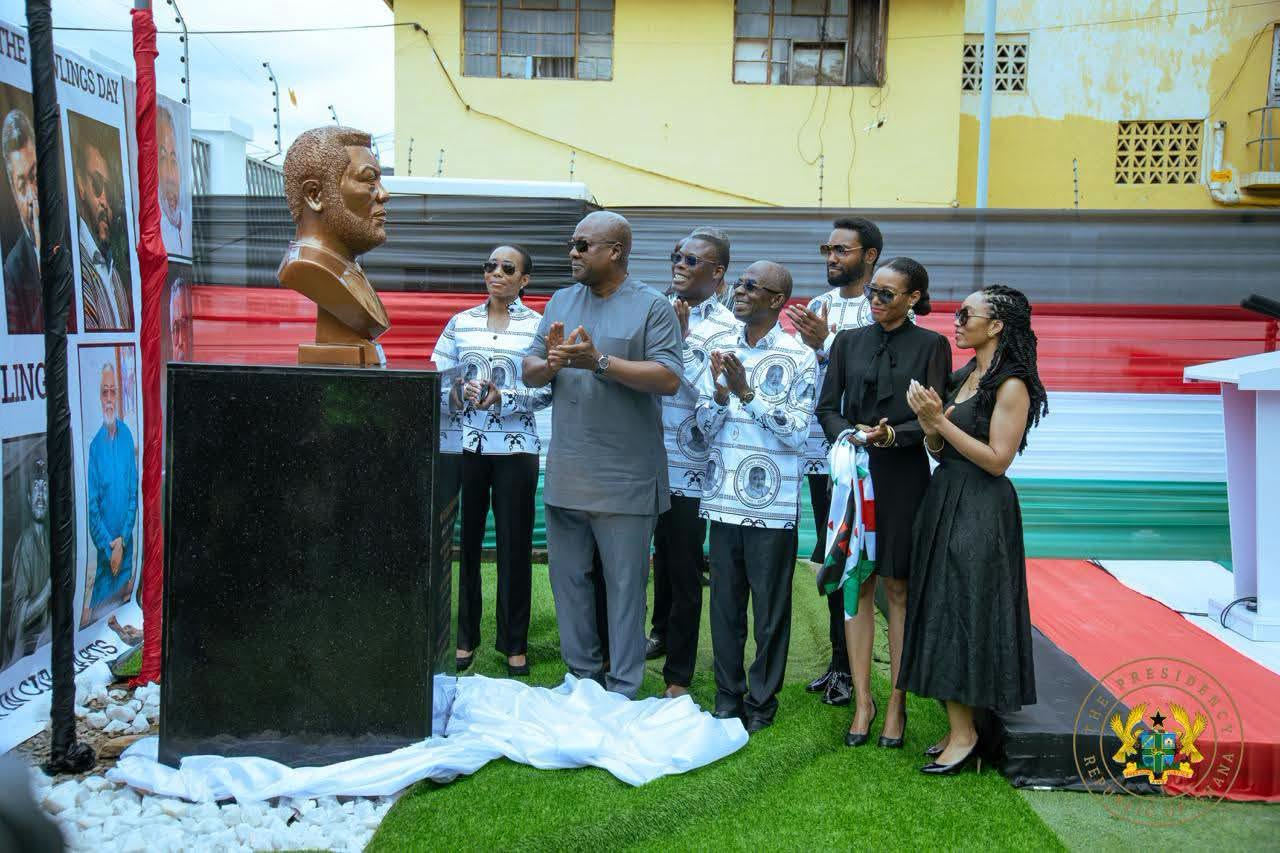
The National Democratic Congress (NDC) has taken a decisive step to cement the legacy of its founder, Flight Lieutenant Jerry John Rawlings, renaming its Adabraka headquarters to ‘Rawlings House’ and unveiling a bust in his honour. But beneath the pomp and pageantry of yesterday’s ceremony lay a more urgent political message from President John Dramani Mahama: the party must remain united.
Speaking at the historic event, Mahama described the renaming as “more than a symbolic gesture,” calling it an opportunity to “preserve history, honour sacrifice and recommit the party to the ideals” that have sustained its political tradition. The ceremony, which also featured a cake-cutting to mark Rawlings’ birthday, drew top party officials, government appointees, and NDC faithful.
Mahama paid glowing tribute to Rawlings, describing him as a transformative leader whose “courage, commitment to accountability, social justice and national service laid the foundation for Ghana’s democratic stability and political freedoms.” He said the naming of the headquarters after Rawlings serves as a constant reminder that “leadership is about service” and that political power “must always be exercised in the interest of the people.”
“This headquarters is more than an administrative facility,” Mahama declared. “It is the operational heart of our party where ideas are debated, policies are formulated and strategies are developed to serve the people of Ghana.”
But the President’s remarks carried a sharper edge. He used the occasion to rally party members around his government’s development agenda, warning against internal divisions. “The best tribute we can pay to those who built this tradition is to preserve its unity and strengthen its institutions,” he stressed.
In a revealing anecdote, Mahama disclosed that Rawlings had consistently rejected attempts to have major national institutions named after him during his lifetime.
The late former President declined a proposal to name the University for Development Studies after him, despite donating his World Food Prize money as seed funding for the institution. He also rejected a proposal to name the FPSO for the ENI Sankofa oil field after him, insisting that he preferred “to have my name inscribed in the minds and hearts of men than on statues and monuments.”
Mahama observed that Rawlings, known for his philosophical reflections, “was neither vain nor ostentatious” and would likely have been uncomfortable with the ceremony held in his honour.
Kimathi Rawlings, son of the late former President, delivered an emotional address on behalf of the family and the Rawlings Foundation. He described the renaming as “far more than a symbolic gesture” and a fitting tribute to his father’s “enduring legacy, values, and sacrifices” that continue to influence Ghana’s politics.
For the Rawlings family, the gesture represents a long-awaited recognition of a man who, despite his towering influence, remained a polarising figure even within his own party. The renaming signals a deliberate effort to reclaim and institutionalise his legacy as the NDC charts its future.
Rawlings, who died in November 2020, remains one of the most consequential figures in Ghana’s modern history. He first seized power as a young military officer in 1979, executing a bloody coup that saw the summary execution of three former heads of state. He handed over power to a civilian government later that year, only to return in a second coup in 1981, ruling as the chairman of the Provisional National Defence Council (PNDC) for over a decade.
Under his leadership, Ghana transitioned to constitutional rule in 1992, and Rawlings served as the first President of the Fourth Republic from 1993 to 2001. His tenure was marked by a mix of populist policies, human rights abuses, and economic reforms that laid the groundwork for Ghana’s democratic stability.
Mahama’s call for unity is not incidental. The NDC has faced internal tensions in recent years, with factions jostling for influence ahead of the 2028 elections. The President’s message was clear: the party cannot afford to be divided if it hopes to retain power.
He assured the nation that his government remains committed to implementing policies that expand opportunities for young people, support businesses, reduce poverty, and improve the quality of life of all Ghanaians. But his primary audience was the party faithful, whom he urged to place “the collective interest above personal ambitions.”
The renaming of the headquarters to ‘Rawlings House’ and the unveiling of the bust are intended to ensure that Rawlings’ legacy endures. The President expressed hope that the renamed headquarters would remain “a lasting symbol of unity, service and dedication to the Ghanaian people.”
For the NDC, the ceremony was as much about the future as it was about the past. By enshrining Rawlings’ legacy in stone, the party is sending a message: its foundation is solid, and its commitment to the principles he stood for remains unwavering.
The decision to rename the NDC headquarters after Rawlings is a calculated political move. It seeks to anchor the party’s identity in the legacy of its founder, even as it navigates the challenges of governance and internal politics. Mahama’s unity message underscores the party’s awareness of its vulnerabilities.
Rawlings’ relationship with the NDC was complex. After leaving office, he became a vocal critic of the party’s direction, often accusing its leadership of abandoning the principles of probity and accountability he championed. His death in 2020 left a void that the party has struggled to fill.
By naming its headquarters after him, the NDC is attempting to reclaim his legacy and harness it for its current political objectives. But the move also carries risks. It could alienate those who view Rawlings’ rule as authoritarian and his legacy as tarnished by human rights abuses.
Nevertheless, the ceremony was a moment of unity for the NDC, bringing together party faithfuls to honour a man who shaped Ghana’s political landscape. For better or worse, Rawlings’ legacy is now permanently etched into the party’s physical and symbolic architecture.