

By Leo Nelson
President John Dramani Mahama has announced a major shift in government policy on tax exemptions, declaring an end to blanket tax waivers for imported medical equipment and other specialized investments, as his administration moves toward what he described as a more targeted and accountable exemption regime.
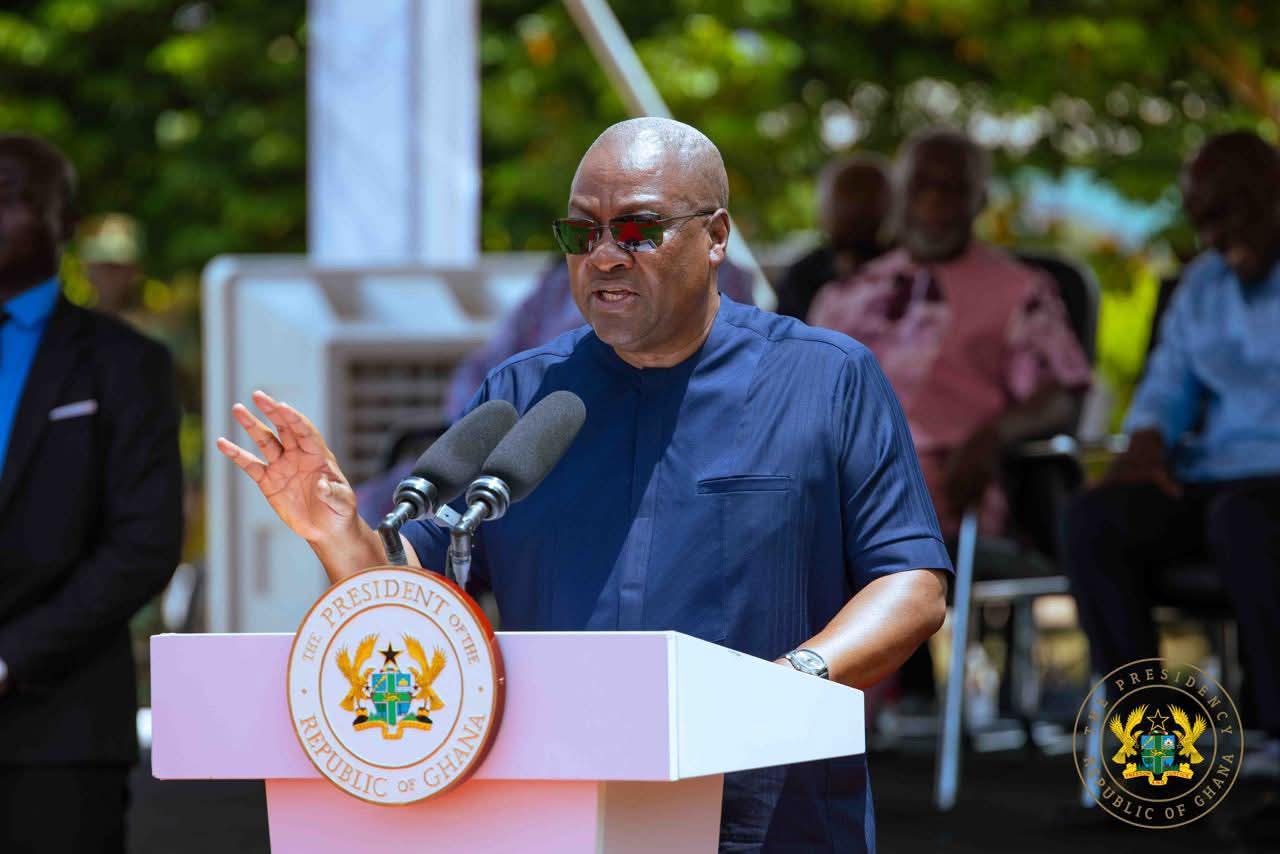
Speaking at the commissioning of a new PET Scan facility at the Swedish Ghana Medical Centre, President Mahama stated that government would no longer approve automatic tax exemptions across entire sectors, insisting that future requests would be assessed individually based on merit, strategic value, and national impact.
“With regards to tax exemptions, blanket tax exemptions are no longer given. It is on a case by case basis,” the President said during his address. He however assured investors in critical sectors such as healthcare that the government remains open to supporting genuine investment initiatives.
“So for instance, if you order any medical equipment, you can apply for exemption on that equipment, and I can assure you that we will look at it very favorably.”
The announcement marks one of the clearest signals yet from the Mahama administration on its intention to tighten fiscal discipline while still supporting high impact investments in sectors that directly improve public welfare.
President Mahama made the remarks as he commissioned the advanced PET Scan technology at the Swedish Ghana Medical Centre, describing the expansion of the facility as a significant step in strengthening Ghana’s diagnostic and specialist healthcare capacity.
Returning to the center for the second time since its original commissioning over a decade ago, the President reflected on the transformation of the facility and the broader development of the surrounding enclave.
“This will be the second time I have come here. I remember many years ago, in 2013 or thereabouts, I was here with President John Agyekum Kufuor at the time this center was established.
“After the commissioning, when we entered and inspected it, it was a very isolated facility because there were no buildings anywhere. All the way from School Junction to this place was completely bush.”
President Mahama said the transformation of the facility since its acquisition by the Ghana National Association of Teachers demonstrates what strategic institutional investment can achieve in the health sector.
“I am told GNAT acquired it around 2020, and since then you have set out to expand it and add more facilities to the center. I want to congratulate you for that.”
Beyond healthcare, President Mahama used the occasion to praise GNAT for what he described as an impressive track record in strategic business investments and institutional growth.
He noted that the teachers’ association has evolved far beyond its traditional advocacy role, establishing itself as a serious player in sectors ranging from insurance to aviation services and banking.
“This is not the first achievement of GNAT. I remember when we were looking for a partner to take over AAN, which is a ground handling company at the airport. It was GNAT that stepped forward and bought the shares, and today owns AAN Ghana Limited.”
He further highlighted GNAT’s investments in insurance, finance, and shareholding positions in some of Ghana’s leading financial institutions, describing the association as a model of institutional entrepreneurship.
While the commissioning of the PET Scan facility formed the core of the event, President Mahama also used the platform to clarify government’s emerging housing agenda, particularly as it relates to teachers and public sector professionals.
According to him, there has been public confusion over two separate housing initiatives currently being developed by government. The first, he explained, is the Teacher Dabre housing project, which is specifically designed to provide accommodation for teachers directly on school campuses.
President Mahama explained that the goal is to reduce the burden of daily commuting and improve teacher retention, especially in underserved areas.
“We want to make sure that when teachers are posted to a school, they are able to get accommodation and live on campus rather than commute from town to school every day.”
The second initiative, he revealed, is a broader mortgage driven housing project targeted at professionals including teachers.
President Mahama disclosed that government is collaborating with institutions including Republic Bank, GNAT, the State Housing Company, and the Tema Development Company to establish a GH¢3 billion housing fund.
The fund, he said, will support the construction of affordable homes denominated in Ghana cedis rather than foreign currencies. “We are going to set up a three billion cedi fund. Republic Bank will contribute. The Government of Ghana will contribute. GNAT will contribute.”
He stressed that homes built under the initiative would be accessible through long-term mortgage arrangements tailored to Ghanaian professionals. “The houses will be designated in cedis, not in dollars, and members can take mortgages over a number of years until retirement.”
In a light-hearted moment, the President said the policy would ensure that professionals retire with dignity and independent housing security. “When you reach retirement age, you do not go to your family house and quarrel over your grandmother’s room or your grandfather’s room. You have a place to lay your head.”
President Mahama’s remarks at the Swedish Ghana Medical Centre offered a broader glimpse into the economic philosophy shaping his administration, one that seeks tighter fiscal controls while expanding strategic investments in healthcare, housing, and public welfare.
By ending blanket tax exemptions while preserving targeted support for sectors such as medical technology, the administration appears to be signaling a move toward more disciplined public finance management without undermining critical national development priorities.
For healthcare investors, educational institutions, and professional associations, the message was clear. Government remains open to partnership, but future incentives will be earned through impact, accountability, and national value creation.