

Finance Minister’s zero-appeal budget leaves opposition with nothing to fight
By Political Desk | The New Republic
The New Patriotic Party sharpened their knives ahead of Thursday’s mid-year budget review. Their communicators had been primed. Their talking points were polished. They were ready to resist to fight tooth and nail against any request for additional appropriation.
They got nothing to fight.
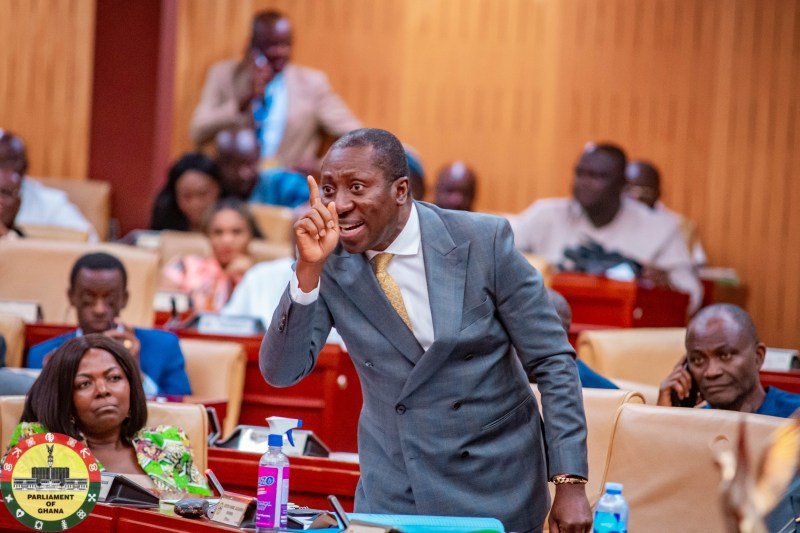
Finance Minister Dr. Cassiel Ato Forson walked into Parliament, looked the opposition squarely in the eye, and told them: Not a pesewa.
“Mr. Speaker, today, I am NOT here to seek a supplementary estimate. The 2026 appropriation remains unchanged,” he declared.
The rag was pulled from under the NPP’s feet. Their grand strategy collapsed before it could even begin.
For weeks, NPP communicators had been laying the groundwork. Their narrative was simple: the Mahama government had mismanaged the GH¢357.1 billion budget approved for 2026 and was coming back to Parliament with its hands out for more.
They had rehearsed their objections. They had planned their resistance. They had even drafted statements accusing the government of fiscal recklessness.
Then Dr. Ato Forson stood up and announced something far more strategic: the government would not ask for a single pesewa in additional funds. Instead, it would realign existing expenditures a surgical approach that left the NPP’s entire game plan in ruins.
The opposition sat in stunned silence. Their carefully constructed arguments evaporated.
Having neutralised the NPP’s anticipated attack, the Minister proceeded to lay out a compelling case that the government is squarely on track to achieve all its 2026 targets:
· Overall real GDP growth: at least 4.8%
· Non-oil real GDP growth: at least 4.9%
· End-year inflation: 8±2%
· Primary surplus: 1.5% of GDP on a commitment basis
· Gross International Reserves: sufficient to cover not less than three months of imports
These are not aspirational numbers. They are verifiable targets that the government has, according to the Minister, already hit or is on course to achieve.
The realignment strategy, rather than asking for more, focused on redirecting funds to priority areas:
Transport Infrastructure Expansion:
GH¢400 million allocated toward a new fleet of operational buses for Metro Mass Transit and STC a direct intervention aimed at easing the burden on commuters and reducing transport costs.
Debt Servicing Readiness:
Resources shifted heavily into the Sinking Fund, now accumulating GH¢15.6 billion specifically to handle upcoming domestic and external debt pressures. This is fiscal responsibility in action preparing for obligations rather than scrambling when they fall due.
Agro-Industrial Support:
Capital allocations refocused to support agro-industrial value chains, including food processing and the Oil Palm Industrialisation Programme. A deliberate effort to move beyond raw commodity exports and create value-added industries.
Flood Mitigation Planning:
Funding reprioritised to immediately enhance emergency desilting and drainage framework designs a direct response to the catastrophic June floods—ahead of the major permanent infrastructure overhaul budgeted for 2027.
To free up these resources without expanding the deficit, the Ministry relied on stringent internal controls that have delivered dramatic savings:
Payroll Cleanup:
A strict audit successfully removed over 53,000 “ghost names” from the public sector payroll, permanently eliminating wasteful spending line items. That is not a minor administrative adjustment it is a fundamental clean-up of a system long exploited by the unscrupulous.
Discretionary Spending Ceilings:
Tight controls were placed on ministerial operations, keeping overall non-essential public expenditure 14.3% below planned targets for the first half of the year.
This is not just accounting it is a philosophical shift. The Mahama government is demonstrating that fiscal discipline is not about cutting essential services but about eliminating waste and ensuring that every pesewa serves the public interest.
The NPP’s humiliation was complete. They had arrived at Parliament ready for a fight. They left with nothing but questions about their own strategy.
The opposition had banked on being able to paint the government as profligate and irresponsible. Instead, they were confronted with a Finance Minister who had not only balanced the books but had done so without asking for a single additional cedi.
For the NPP, the mid-year budget was supposed to be an opportunity to regain political momentum. Instead, it became a demonstration of the competence they had claimed the government lacked.
The mid-year budget review was never just about numbers. It was about political credibility and on that front, Dr. Ato Forson delivered a masterclass.
By not seeking additional appropriation, the Minister achieved several objectives simultaneously:
· He demonstrated fiscal discipline and responsible governance
· He neutralised the NPP’s anticipated attack
· He showed that the government can deliver results without expanding the deficit
· He restored confidence in the management of the economy
For the NPP, the challenge now is to find a new line of attack. The old narrative that the government is fiscally reckless has been rendered obsolete.
What Dr. Ato Forson demonstrated on Thursday was not just financial acumen it was strategic brilliance.
Rather than coming to Parliament with his hands out, he came with a plan. Rather than asking for more, he showed how to do more with what he already had.
The realignment strategy is a testament to the government’s commitment to fiscal discipline. It sends a clear message to international investors, rating agencies, and the Ghanaian people: this government does not spend what it does not have.
In an era of economic uncertainty, that is a message worth more than any supplementary budget.
With the mid-year budget now a matter of record, the focus shifts to implementation. The realignment of expenditures will only deliver results if the ministries and agencies involved execute their mandates effectively.
The government must now deliver on its promises: buses on the streets, value-added industries, debt servicing capacity, and flood mitigation.
For the NPP, the political calculus has changed. They can no longer campaign on the government’s fiscal irresponsibility the numbers simply do not support that narrative.
The opposition must now find new ground on which to contest the government’s record. And on Thursday’s evidence, that may be a more difficult task than they anticipated.