

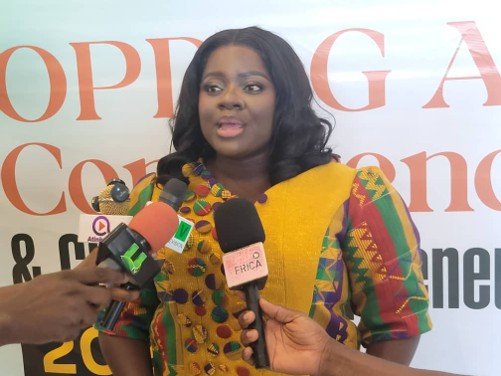
Aims to close a 150,000-hectare gap
By Philip Antoh
For decades, Ghana has leaned heavily on its traditional gold reserves to prop up the economy. But the President of the Oil Palm Development Association of Ghana (OPDAG), Paul Amaning, believes the country is sitting on a different kind of treasure one that could rival, and perhaps surpass, the yellow metal.
Mr. Amaning argues that oil palm holds the transformative power to rewrite the country’s economic fortunes, pointing to Malaysia as a glaring example. Once a student of Ghana in palm oil production, Malaysia commercialised the crop and now rakes in billions. Mr. Amaning insists Ghana can walk that exact same path.
He made these remarks during OPDAG’s 2026 Annual General Meeting, a gathering that brought together key regulators including the FDA, GRA, and TCD alongside development partners to review the past year and chart an ambitious course for 2027.
Speaking to journalists on the sidelines of the event, Mr. Amaning welcomed the government’s recent $500 million investment pledge for the sector, revealing that OPDAG itself was the architect of the policy.
“We do acknowledge the step government has taken. I can confidently say that the document as accepted by government came from the association. We really know what we want,” he said.
According to the Association’s internal analysis, Ghana urgently needs about 100,000 hectares of new farms to shore up the sector’s deficit. Additionally, many OPDAG members are seeking investment to expand their operations and create an estimated 250,000 jobs.
“We know every sector, how we need to deploy certain resources to solve the challenge of the 150,000-hectare deficit. Within the next five years, if that fund is available, Ghana will be able to become a net exporter,” Mr. Amaning stated confidently.
The term “Red Gold” isn’t just a catchy slogan; it stems from a desire to diversify the country’s foreign exchange earnings.
“The red gold concept is that almost every time we rely on gold for our foreign exchange. I’m telling government that red gold can be another venture one that is more environmentally friendly to earn the same dollars we are earning,” he explained.
He pointed to the staggering figures from Asia to drive his point home. “Malaysia and Indonesia are making almost about 85 billion dollars of revenue every year. Compare that to gold, which is about 15 billion dollars. These two countries are making 85 billion dollars.”
“So the red gold programme is just to let the public know that Ghana can rely on oil palm to become self-sufficient and we won’t have to borrow,” he added.
On the industry’s current worth, Mr. Amaning noted that the entire value chain, including imports, handles about 400,000 metric tonnes.
“400,000 by 1,000 dollars means we are doing almost 4 billion dollars that’s the value,” he noted.
However, the actual local industry currently earns only around $260 million, a figure he describes as far too low. With strategic government intervention, he projects this could rise to about $500 million within five years, and hit the $1 billion mark within a decade.
For this vision to materialise, Mr. Amaning stressed that the $500 million must be carefully channelled to empower independent farmers, turning them into bankable entities capable of accessing loans to expand.
“Most of our farmers don’t have the best technology, and we are not practising the best management on our farms we take it as normal business, but it shouldn’t be like that,” he said.
“With that, we’ll be able to increase our production from maybe 250,000 to 500,000 if the 500 million dollars is properly used. If it’s not, forget it we just talk. As president, we won’t sit by for resources to be deployed outside the proper channel,” he warned.
Bridging the Yield Gap: 6 Tons vs. 20 Tons
Mr. Amaning also highlighted a stark disparity in productivity. The average Ghanaian farmer harvests about 6 tons per hectare, while their Malaysian counterparts achieve more than 20 tons on the same land size.
“There are issues that we know, and we’ve tabled them for government to look at the right seedlings, the right technology. Those things can increase yields from 6 metric tons per hectare per year to maybe even 12 metric tons. If you do that, you have solved the problem without expanding farm size,” he explained.
To secure the future of the sector, OPDAG is turning its attention to the youth. The Association has partnered with Accra Technical University (ATU) to develop a curriculum tailored to the needs of the oil palm industry.
“As president, I noticed that the youth need employment, and an oil palm farm can offer that, but you need to train them,” he said.
“We engaged ATU to develop a curriculum that can solve some of the problems we’ve identified in the industry. The training will educate the youth on what they need to do to access funding as entrepreneurs, the steps in setting up a business, and more. All of that training and education will happen at ATU.”
With a unified voice, a clear policy document, and a government willing to listen, OPDAG is betting big that Ghana’s “Red Gold” is the key to unlocking a prosperous, self-sufficient future.