

TNR||ANA
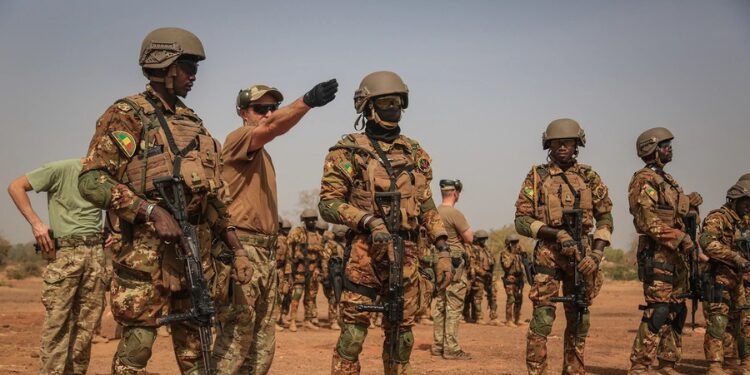
Parts of Mali, including the strategic Gao Region, have been placed under curfew following a wave of coordinated attacks by insurgent groups that struck key locations across the country, in what analysts describe as one of the most significant escalations of violence in recent years.
The government imposed overnight restrictions in Gao and the capital, Bamako, after large scale attacks targeted military and transport infrastructure, raising fresh concerns about the government’s ability to maintain control in both northern and central regions.
Residents in Gao reported explosions and exchanges of gunfire even after officials declared the situation stabilised, with an uneasy calm settling over the city by evening.
The Malian army indicated that it had repelled the attacks and killed “several hundred” assailants, describing the operations as large-scale strikes carried out by unidentified “terrorist” groups.
The attacks hit multiple sites, including areas near Bamako, the nearby garrison town of Kati, and northern cities such as Gao, Mopti and Sevare, indicating a high level of coordination and operational reach.
The exact number of casualties is unknown; however, Issa Ousmane Coulibaly, a government spokeswoman, confirmed that at least 16 people were hurt but insisted that the situation was “completely under control” in all impacted locations. In Bamako, officials imposed a three-day midnight curfew as part of emergency security measures to restore order and avoid further disruptions.
Meanwhile, the attacks were claimed by Jama’at Nusrat al-Islam wal-Muslimin, an al-Qaeda-linked organization operating in the Sahel. The organization claimed to have carried out strikes against Bamako’s airport, the Kati military installation, and other places in the north. It also claimed cooperation with the Azawad Liberation Front, which announced progress in Gao and the capture of a military post in Kidal.
The attacks caused widespread disruption, including the closure of Bamako’s airport, where flights were cancelled or diverted as a precaution. Witnesses described heavy gunfire and explosions near military installations, especially in Kati, where fighting reportedly lasted for several hours. There were also unconfirmed reports that the residence of Defence Minister Sadio Camara was destroyed during the assault.
As a result, foreign missions issued urgent advisories as the situation developed. The US embassy advised its people to stay in place, while British authorities warned against all travel to Mali. Civilians attempting to reach the airport reported witnessing active conflict zones, with helicopters overhead and ongoing gunfire in the surrounding villages, emphasising the ferocity of the clashes.
Renewed Pressure on Government Amid Escalating Insurgency
The recent bloodshed underlines Mali’s precarious security environment, where armed groups have managed to operate despite years of military operations and foreign assistance. The coordinated nature of the attacks signals a possible shift in tactics, mixing jihadist activities with long-standing separatist movements in the north to exert pressure on numerous fronts at once.
The involvement of Tuareg rebels alongside Islamist forces illustrates the conflict’s complex dynamics, which began with an uprising in 2012 that saw armed factions control significant sections of northern Mali. Although government forces have reclaimed territory, instability endures, especially in rural and contested areas where official presence is restricted.
The current administration, led by Assimi Goïta following military coups in 2020 and 2021, has focused restoring security but faces rising obstacles. While officials claim that the situation is under control, recent reports of intermittent violence in affected areas indicate that the threat is still present and changing.
Residents in Gao, a major military hub in the north, reported hearing more explosions and gunshots, despite official claims indicating that stability had been restored. Local authorities acted immediately to impose curfews in order to prevent further escalation, restrict movement, and allow security forces to perform operations without interruption.
The attacks have broader regional ramifications. Mali remains a key battleground in the Sahel, with armed groups tied to global Islamist networks expanding their influence beyond borders. The scope of the coordinated assaults has generated concerns that these groups would maintain significant operational capacity despite continuous counterinsurgency attempts by national and international forces.
Adding to the complexity, the government’s security strategy has shifted in recent years, with Western partners playing a less role and relying more on alternative partnerships. This transformation has coincided with ongoing instability, raising questions about the efficiency of current measures to suppressing insurgency and restoring territorial authority.
The focus is now on whether the government can stop more attacks and regain control while security personnel carry out sweep operations in Bamako, Kati, and other impacted districts.