

Minority MPs Blocked From Unfinished Military Hospital
By Prince Ahenkorah
Ghana’s parliamentary minority has escalated its political campaign against the ruling National Democratic Congress (NDC) over a derelict military hospital in the Ashanti Region.
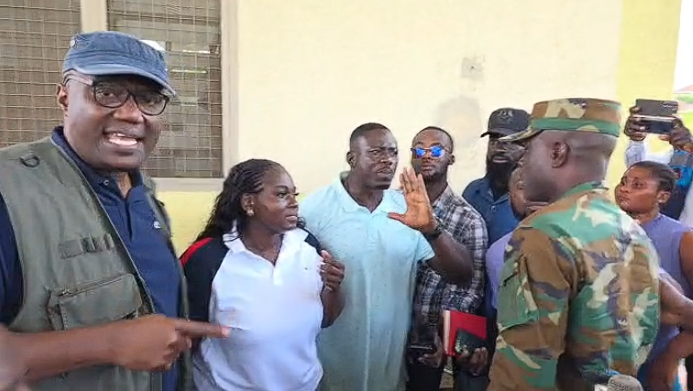
But the real drama unfolded on Wednesday, 10 June, when military personnel physically blocked the delegation from accessing the premises a move the MPs immediately branded as obstruction of parliamentary oversight.
The Afari Military Hospital in Atwima Nwabiagya District was supposed to be a signature health infrastructure project. Conceived as a 500-bed facility bequeathed by the first John Mahama government in 2016 to relieve pressure on the region’s overwhelmed Komfo Anokye Teaching Hospital (KATH), it remained uncompleted after eight years of NPP governance.
The oversight visit by the Minority Health Committee turned confrontational when soldiers stationed at the facility refused entry, insisting the lawmakers lacked prior clearance. The tense standoff briefly halted proceedings, with the military holding the line while MPs demanded access in the name of parliamentary accountability.
Ranking Member Dr Nana Ayew Afriyie led the charge, arguing that the visit was part of routine oversight responsibilities. “We are not here for political grandstanding,” he told journalists after the confrontation. “We are here to inspect assets the state has abandoned.”
The facility is in an advanced state of decay. Weeds have overgrown parts of the hospital, and the structures show signs of neglect despite substantial prior investment. Dr Afriyie estimated that GH¢200 million would be required to complete and commission the hospital. He proposed an initial release of GH¢50 million to allow contractors to resume work, with the remainder paid over time.
The timing is deliberate. The 2028 elections are approaching, and the NDC is building its legacy on infrastructure and healthcare. The NPP minority is pouncing on every abandoned project it can find. The Afari hospital, a white elephant in one of the NPP’s traditional strongholds, offers rich political ammunition.
Dr Afriyie insisted the Minority’s concerns were not politically motivated. But the choice of location, the timing of the visit, and the framing of the issue all follow a well-worn opposition playbook: highlight government failure, embarrass the ruling party which is belief to be making strong incursions into the NPP’s stronghold, and force the executive onto the defensive.
The military blockade only added to the optics. For the Minority, it was proof that the government has something to hide. For the NDC, it was a minor security protocol blown out of proportion.
The Afari hospital remains unfinished. The government has offered no timeline for its completion. The military has offered no apology for the blockade. And the Minority has promised to return this time, perhaps, with formal clearance.
For an opposition party seeking retain to power, the NPP is desperate to win the hearts and minds of its stronghold. But will the fight for Afariwa be convincing when in fact the party throughout its eight year in power neglected such a flagship hospital in the heart of its own electoral base?.