

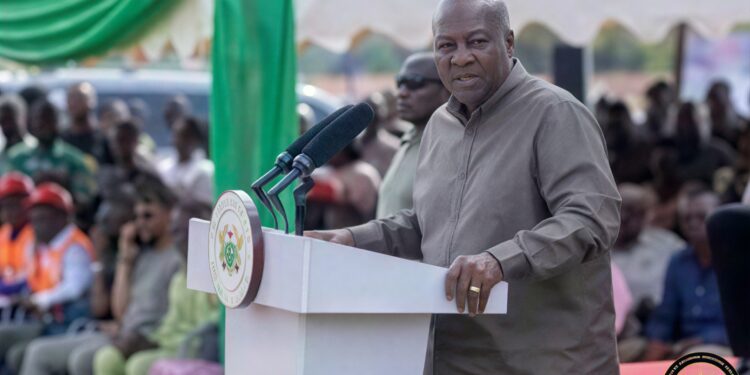
President John Dramani Mahama has addressed a gathering of traditional rulers and citizens at the University for Development Studies Auditorium as part of his “Resetting Ghana” tour in the Northern Region. He began by expressing gratitude to the revered traditional rulers, chiefs, Imams and religious leaders including the christian clergy, senior government officials, members of the council of states and all citizens.
He also noted that his administration has achieved significant fiscal discipline, resulting in inflation dropping from 24 percent to under 4 percent. He added that the stability of the local currency and petroleum prices has provided a necessary stability for Ghanaians.
“In many countries, there are shortages of petroleum products. Even in the United States of America, a litre of fuel was $2.98 just before the war. Today, that same fuel is about $4, which means it is almost doubling. In Ghana, because of the resilience of the economy, our currency is stable and inflation is stable. We have been able to manage petroleum prices to cushion our citizens and prevent inflation from rising to the levels we came to meet.”
The President explained that international credit markets remain inaccessible to the country due to previous debt default situations, forcing the government to rely on internally generated revenue to fund major capital projects across the regions.
According to him, the state is currently funding 2,000 kilometres of active road construction under the Ministry of Roads. These projects are aimed at linking regional capitals to districts and enhancing national trade.
Over 50 billion cedis has been allocated from last year to the present period for these reconstruction efforts. The President assured residents that communities without ongoing projects will eventually see construction begin on their roads.
In the Northern Region, key projects include corridors in North East areas such as Cheriponi and the road to Bintile. Engineers are also working on the Saboba to Cheriponi and Yendi to Saboba stretches to improve connectivity to the capitals and boost accesibility.
A new bridge at Tsitsile is expected to create a shorter route between Bimbilla and Zabzugu. Additional plans cover the Salaga to Bimbilla and Kpandai to Salaga roads to address long-standing infrastructure gaps within the region.
Addressing water challenges, the President announced a strategic change in supply sourcing for the Tamale metropolis. He said ongoing repairs on worn-out motors at existing stations have already increased daily supply by millions of gallons.
He added that a long-term solution involves constructing a new pumping station south of the city near Yapei, which will draw water from the White Volta River and transport it 21 miles to Tamale.
This system will combine supply from Dalor in the north and Yapei in the south, ensuring a sustainable surplus for the growing population.
The President outlined a three-layer health strategy aimed at reaching underserved populations through free primary healthcare. He said the initiative complements the National Health Insurance Scheme by strengthening polyclinics and community health services.
Health volunteers will visit households to conduct screenings for blood pressure and glucose levels, while also promoting healthy lifestyles and serving as an early warning system for disease outbreaks. He clarified that the tricycles are not ambulances. They are intended to support health professionals in carrying out their duties. However, he noted they may be used in emergencies when no other vehicles are available.
During a visit to the Tamale Teaching Hospital, the President inspected the ongoing construction of a cardiothoracic centre, the first specialised heart facility in the five northern regions.
He noted that patients with cardiac conditions or stroke cases previously required emergency referrals to Kumasi or Accra, adding that the new centre will provide timely, life-saving care within the region. The Government also plans to establish similar centres of excellence in the Volta and Western regions, along with a future oncology centre in Tamale to address rising cancer cases.
On agriculture, the President also pointed out a surplus in products such as eggs and poultry, proposing that the National School Feeding Programme absorb the excess to support farmers and improve the nutrition of children. He said the creation of the Ministry of Trade and Agribusiness is intended to boost agro-processing, enabling businesses to convert raw produce into goods that can be stored and even exported.
Mechanisation efforts include the establishment of farmer service centres equipped with modern tractors and irrigation systems. He also highlighted the training of 300 female tractor operators as a milestone in promoting gender inclusion.
The President announced that the Government had processed teacher trainee allowances, with payments expected soon following the resolution of administrative challenges.
The President concluded by inviting questions from traditional leaders and the public, reiterating his commitment to resetting the nation through transparent governance and direct engagement.