

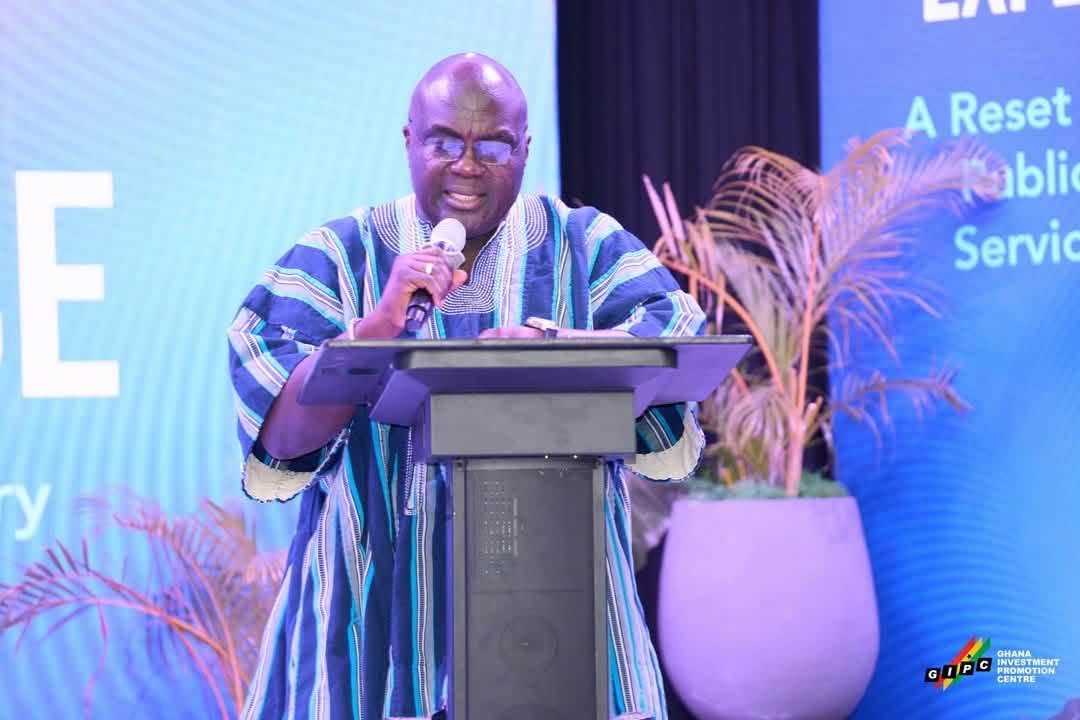
Mahama’s right-hand man delivers a devastating verdict on Ghana’s public service.
By David Tamakloe
It was supposed to be a harmless parade of platitudes. A routine book launch to stroke the egos of the governing elite.
Instead, the event at Alisa Hotel yesterday, 8 July turned into a brutal, unflinching confessional that laid bare the rotting carcass of Ghana’s public service and the man holding the scalpel was none other than President Mahama’s own political enforcer, Julius Debrah.
Debrah, the Chief of Staff and the ultimate insider in the Mahama machine, used the podium to deliver what is now being whispered in corridors as a declaration of war against the very bureaucracy his own government commands.
“A citizen wakes up before dawn to join a queue,” Debrah thundered, his words cutting through the ceremonial fog. “The citizen is asking one quiet question: does this country see me?”
It was a rare moment of bloodletting in Ghana’s political jungle and the silence in the room was deafening.
President Mahama’s vaunted “Reset Agenda” is on life support, and Debrah just pulled the plug on the pretense. Critics have long dismissed the Reset as another well-packaged reform destined for the graveyard of Ghanaian policy documents. But Debrah’s intervention far from defending the administration confirmed their worst fears.
In a stunning rebuke to the status quo, Debrah insisted that legitimacy is not won at the ballot box alone. It is earned in the grim, grinding ordinary encounters between the citizen and the state. His message was sharp enough to draw blood: if the state’s daily behavior does not change, the Reset is dead on arrival.
Ghana’s bureaucracy has historically been a cemetery where reforms go to die. And Debrah just handed the mourners a roadmap of the disaster.
The most explosive revelation of the evening was the introduction of the Citizen Experience Failure Cycle a damning framework that does not blame the tired clerk at the window, but the criminal system that traps them.
Debrah was explicit, refusing to mince words: “Good people are trapped inside bad systems.”
The diagnosis is a chilling indictment of the state’s machinery:
· Broken processes that lead nowhere;
· Unreliable technology that crashes on demand;
· Weak supervision that lets incompetence flourish;
· Perverse incentives that reward delay over delivery;
· Institutional cultures where doing nothing is the safest bet.
This is not a bug in the system. According to Debrah, it is the feature. It is the quiet machinery of dysfunction that has held Ghanaian citizens hostage for decades.
Debrah reserved his sharpest knives for the leadership. In a moment that sent shockwaves through the senior bureaucracy, he declared: “Institutions deliver what leaders prioritise.”
Two agencies can swallow the exact same budget and produce wildly opposite results. Why? Because one director measures response times, while the other measures nothing at all. Ghana’s public service, Debrah warned, rises or collapses on the temperament of a single director.
His unmistakable warning to the powerful: Leadership is not a speech delivered from a plush office. It is what the institution learns to expect. If the director expects lethargy, the institution delivers lethargy.
In a subtle but savage rebuke to the big men at the top, Debrah flipped the hierarchy on its head. “The frontline officer is not at the bottom of the hierarchy. In the eyes of the citizen, the frontline officer is the state.”
This is politically explosive. Ghana’s service culture has long privileged title over tangible delivery. By elevating the clerk, the nurse, and the teacher as the true custodians of state legitimacy, Debrah has effectively declared war on the entrenched directors who have outlasted governments.
The presence of Vice President Naana Jane Opoku-Agyemang was no accident. Debrah’s tribute to her casting her as a beacon for “little girls across Ghana” was a strategic masterstroke to cloak this brutal bureaucratic exposé in the garb of generational and gendered renewal.
But make no mistake: her presence was a calculated shield. The administration is terrified that the Reset Agenda is hemorrhaging credibility, and they needed a symbolic figure to absorb the shock of Debrah’s bluntness.
In one of the speech’s most somber turns, Debrah recalled the chilling moment he had to announce the deaths of colleagues in a helicopter crash. “They were not statistics,” he said, his voice heavy. “They were serving this country, and in the course of that service, they gave everything.”
It was more than sentiment. It was a bloody reminder that public service failures carry mortal consequences. The state’s dysfunction is not abstract paperwork it is the destruction of lives and legacies.
Debrah dropped the hammer in his closing argument: “A reset that the citizen cannot feel will remain incomplete.”
This is the line that will haunt the corridors of Jubilee House. Ghana’s public service has chewed up and spat out countless reform cycles. The question now burning on the lips of every analyst and citizen alike is whether Mahama’s administration has the stomach to break the pattern.
Or will the bureaucracy simply sit back, wait, and eat another reform for lunch?