

As insufficient for ‘Mass Murderers’
By Philip Antoh
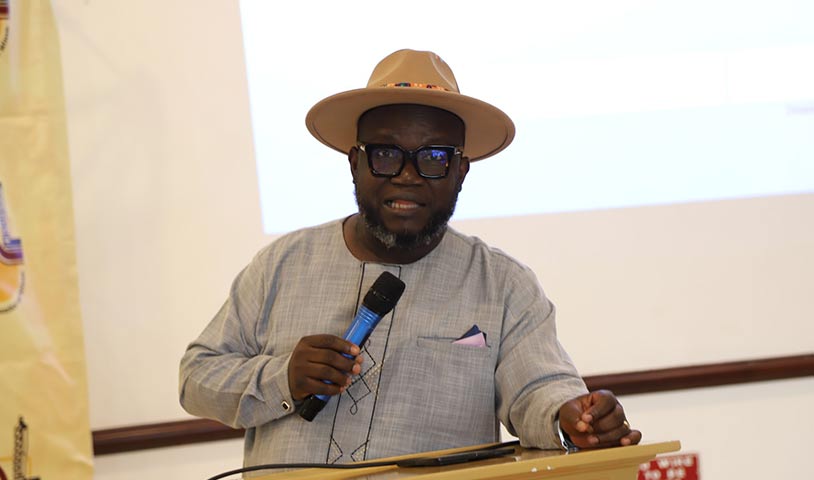
Minutes after the Accra High Court sentenced Bernard Antwi-Boasiako, the Ashanti Regional Chairman of the opposition New Patriotic Party, to 20 years in prison for illegal mining, Dr. Kenneth Ashigbey, convener of the Media Coalition Against Illegal Mining, delivered a striking verdict of his own: the punishment was far too lenient.
Speaking on JoyNews, Ashigbey argued that Justice Audrey Kocuvie-Tay should have imposed the statutory maximum of 25 years, coupled with the highest possible fine, to send an unmistakable message to the influential financiers who bankroll Ghana’s galamsey scourge.
“The law talks about either the fine or the custodial sentence or both,” he said. “I would have wished that the judge would have given the maximum sentence of 25 years and also added the maximum fine.”
But Ashigbey’s criticism was not merely legalistic. He drew a stark and provocative parallel between illegal mining and lethal violence, arguing that the environmental and health devastation caused by galamsey financiers amounts to nothing less than mass murder.
“If anybody had taken a gun and shot somebody, we would all be asking for the maximum sentence,” he asserted. “These people are causing deaths through environmental destruction.”
He catalogued the cascade of crises linked to illegal mining: recent flooding in Samreboi caused by degraded forest reserves, kidney disease and renal complications from toxic water pollution, stillbirths resulting from contaminated water sources, and heavy metal contamination of cocoa farms that threatens Ghana’s food security and export economy.
He labeled the financiers “economic saboteurs” and “nation wreckers.”
Ashigbey revealed that the Samreboi prosecution was the direct result of persistent advocacy by civil society. He recounted how he, private legal practitioner Martin Kpebu, and two other activists formally petitioned the then-Attorney-General and the Inspector General of Police to act on illegal mining at the Tano Nimiri Forest Reserve.
He commended the current Minister for Lands and Natural Resources for acting during the Easter holidays in 2025, as well as former minister and former Minerals Commission CEO Martin Ayisi for publicly confirming that Akonta Mining Company Limited had engaged in illegal mining. However, he lamented that previous police prosecutors and Attorneys-General had stalled the criminal process.
“We kept pushing,” he said. “It just tells you that if the media continue pushing these issues, we can get somewhere.”
He extended specific praise to the current Attorney-General for seeing the case to its conclusion, and to Justice Kocuvie-Tay for her courage in delivering a conviction against a politically powerful figure.
‘This is just the beginning’
Despite celebrating the conviction, Ashigbey warned that Wontumi’s case must not be the end of the crackdown. He challenged authorities to pursue other high-profile figures implicated in the galamsey menace, regardless of their political affiliations or social standing.
“It is great that we are dealing with one campaigner, but what has happened to the other politically exposed persons who were named?” he asked. “There are several politically exposed persons involved in galamsey. There are MMDCEs demonstrating either complicity or incompetence. There are chiefs who have publicly been accused of involvement. This is just the beginning.”
He emphasized that until the big financiers face the full, uncompromising weight of the law, Ghana’s existential galamsey threat will persist.
The conviction of Wontumi marks a significant milestone in Ghana’s long-running battle against illegal mining, a crisis that has devastated forest reserves, polluted water bodies, and fueled public anger across the country.
Yet Ashigbey’s comments underscore a deeper anxiety: that one conviction even of a powerful political figure may be insufficient to dismantle a system in which galamsey is bankrolled by influential elites who have for years operated with impunity.
Justice Kocuvie-Tay’s sentence of 20 years, while historic, falls short of the maximum permitted by law. For activists like Ashigbey, the question now is whether this represents a turning point or merely a symbolic gesture in a fight that has only just begun.