

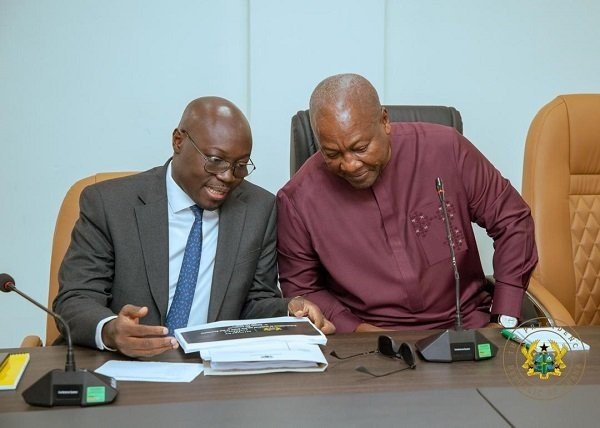
IMF Hails Mahama’s Tough Reforms as Ghana Reaps the Rewards
By Prince Ahenkorah
President John Dramani Mahama’s economic reset is beginning to yield positive
results, with the International Monetary Fund (IMF) acknowledging that Ghana is
reaping the benefits of difficult economic reforms undertaken to restore stability
and strengthen the economy.
The Fund says the country has recorded stronger-than-expected economic growth,
a reduction in inflation to single digits and an improvement in its fiscal position,
suggesting that the difficult policy decisions taken by the authorities are beginning
to bear fruit.
However, while acknowledging the progress made, the IMF has cautioned that
Ghana must not become complacent, stressing the need to consolidate the gains
and build resilience against future economic shocks.
Speaking at a news conference in Washington, DC, IMF Director of
Communications Julie Kozack said the Ghanaian authorities had demonstrated a
willingness to implement difficult policy measures under challenging economic
conditions.
According to her, those decisions are now contributing to improved economic
stability and strengthening the country’s overall economic position.
“We’ve also seen a willingness by the authorities to undertake some very difficult
policy decisions,” she said.
“Those are now bearing fruit, as I said, in terms of stability and the strength of the
economy,” she added.
Highlighting Ghana’s economic performance, Kozack disclosed that the country’s
economy expanded by 6 per cent in 2025, with the IMF projecting growth of 5.7
per cent in 2026.
She also pointed to improvements in Ghana’s external position, a decline in
inflation to single digits and a reduction in the public debt-to-GDP ratio to
approximately 50 per cent.
The Fund further described Ghana’s fiscal position as strong, noting that the
Country’s primary surplus was on track to meet its year-end target.
These developments represent important indicators of progress in Ghana’s efforts
to restore macroeconomic stability following the economic difficulties experienced
in recent years.
The IMF also acknowledged the role of stakeholder engagement, social dialogue
and public consultations in supporting the reform process.
Kozack explained that consultations beyond government had helped communicate
difficult policy decisions, gather feedback and identify broader national priorities.
Beyond the immediate economic gains, the IMF says its engagement with Ghana is
entering a new phase, moving from crisis management towards consolidating
reforms and strengthening the foundations of the economy.
The shift follows Ghana’s decision to pursue a Policy Coordination Instrument
(PCI) after completing its three-year, US$3 billion Extended Credit Facility
programme.
While the previous programme focused largely on addressing the country’s
economic crisis and restoring stability, the new arrangement is expected to provide
a framework for monitoring economic policies, consolidating reforms and
strengthening long-term resilience.
Unlike the Extended Credit Facility, the PCI does not provide direct financial
assistance. Rather, it offers a structured platform for policy engagement between
Ghana and the IMF.
Despite the positive economic indicators, the Fund insists that sustaining the
recovery will require continued discipline, commitment to reforms and stronger
economic safeguards.
Kozack warned that Ghana must strengthen its capacity to withstand both domestic
and external shocks to avoid reversing the progress achieved.
Reflecting on the country’s recent economic difficulties, she noted that the
economic environment had been considerably more challenging just a few years
ago.
“Even a few years ago, I think the mood in Ghana was more difficult. It was a hard
time for the country; it was a hard time for the people,” she said.
She stressed that the priority going forward must be to protect the gains made and
strengthen the economy’s ability to withstand future disruptions.
“The focus is really on strengthening and bolstering that resilience that comes next
for the country,” she added.