

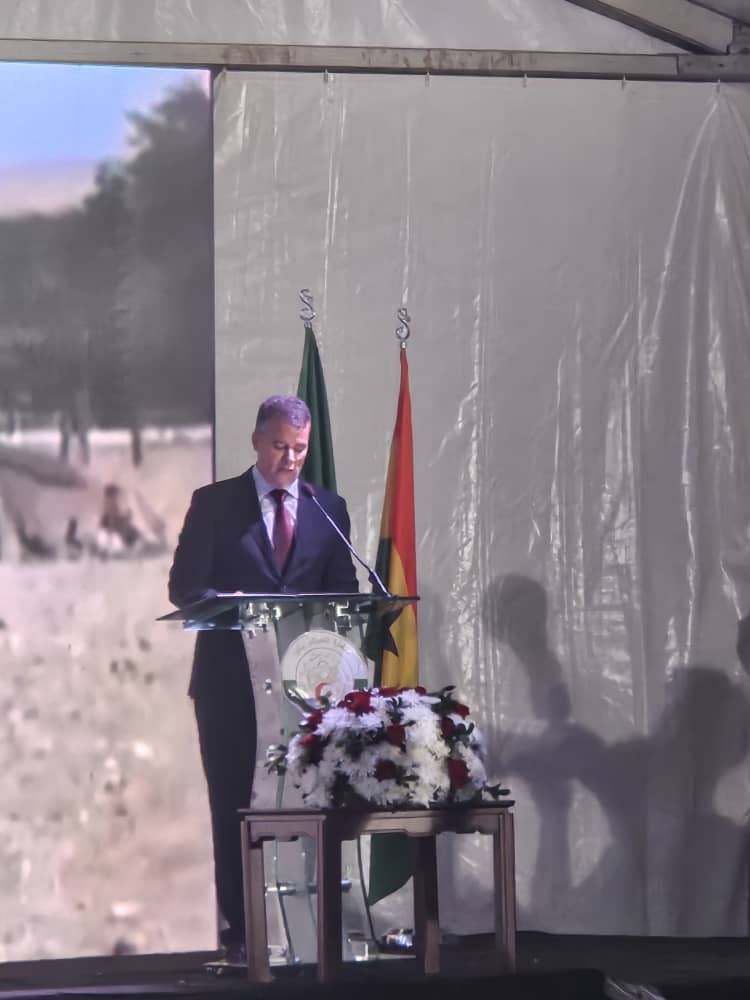
At a diplomatic gathering marked by historical reflection and forward-looking ambition, Ghana reaffirmed its longstanding solidarity with Algeria during the 71st anniversary of the Algerian Revolution, hosted at the residence of Ambassador Mourad Louhaidia in Accra on 12 November.
The event, attended by members of the diplomatic corps, media, and dignitaries from across Ghana’s political and civil society landscape, served as both a commemoration of Algeria’s anti-colonial struggle and a platform to deepen bilateral ties between the two nations.
In a speech delivered on behalf of President John Dramani Mahama, Ghana paid tribute to the National Liberation Front’s (FLN) eight-year war against French colonial rule, describing it as “one of the most defining and inspiring chapters in Africa’s liberation history.” The remarks underscored the ideological and material support Ghana, under Kwame Nkrumah, extended to the FLN, including hosting its representatives in Accra and advocating for its recognition at the 1958 All-African Peoples’ Conference.
The historical solidarity between the two countries, forged in the crucible of decolonisation, has since evolved into a pragmatic partnership. Ghana’s Foreign Minister, Samuel Okudzeto Ablakwa’s visit to Algiers in April was cited as a milestone in expanding cooperation in trade, education, and defence. The two countries are also working to revive the long-dormant Ghana–Algeria Permanent Joint Commission for Cooperation, with a view to finalising draft agreements and identifying new areas of engagement.
Algeria’s recent hosting of the Intra-African Trade Fair in September, where Ghanaian businesses were prominently represented, was highlighted as a tangible example of the countries’ shared commitment to the African Continental Free Trade Area (AfCFTA). Algeria’s allocation of 40 scholarships to Ghanaian students this year was also praised as a gesture of goodwill and investment in pan-African human capital.
Beyond bilateral ties, the speech emphasised Ghana and Algeria’s alignment in multilateral forums such as the African Union, the Non-Aligned Movement, and the United Nations, particularly in the areas of peace, security, and sustainable development.
The tone of the evening was one of cautious optimism. While the rhetoric of pan-African unity remains strong, both countries face domestic and regional challenges that could complicate deeper integration. Nonetheless, the event served as a reminder that the bonds forged in the era of liberation continue to shape Africa’s diplomatic landscape and that Ghana and Algeria remain key players in that legacy.