

By Prince Ahenkorah
A grassroots revolt is brewing in Ghana’s cocoa heartlands. Farmers in the Eastern Region have thrown down a gauntlet to the government, demanding the immediate prosecution of former executives of the Ghana Cocoa Board (COCOBOD) if allegations of massive financial mismanagement under the previous administration are to be believed.
The challenge, issued during a high-level engagement at Jejeti in the Atiwa East District, exposes a deep credibility gap between government rhetoric and the lived reality of the farmers who form the backbone of the economy.
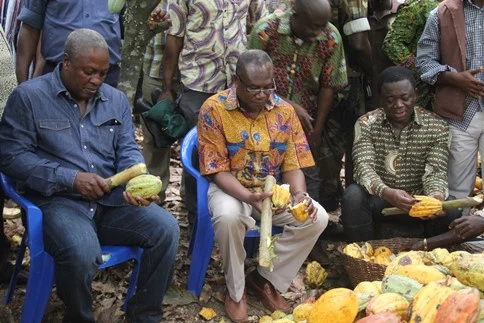
The meeting, led by Dr. Peter Boamah Otokunor, Director of the Presidential Initiative on Agriculture and Agribusiness, was intended to brief farmers on the precarious state of the sector. Otokunor dropped a bombshell: the state, he claimed, incurred losses totalling $1.7 billion on cocoa purchases between October and February.
This financial hemorrhage, he explained, was tied to the procurement of some 580,000 metric tonnes of cocoa within that period a purchasing spree that he argued has plunged COCOBOD into debt and necessitated painful price adjustments. The implication was clear: the previous administration’s profligacy is to blame for the current squeeze on farmers’ incomes.
But the message did not land as intended. Nana Kojo Asante, the Odikoro of “Woman No Good,” speaking on behalf of his community, thanked the delegation for its visit but swiftly pivoted to the crux of the matter: accountability.
He voiced a deep-seated scepticism among farmers, who feel they are being saddled with a debt they did not authorise. “Now the debt someone has incurred is what has been transferred to cocoa farmers,” Asante lamented, capturing a sentiment that the alleged mismanagement of a few is being paid for by the labour of millions.
His demand was unequivocal and politically charged. If the government possesses evidence of wrongdoing, he argued, it must trigger the appropriate legal processes immediately.
“Before we will believe that the previous government incurred debt, there should be arrest and prosecution,” he stated firmly. “Unless they are put before the court, that is when we will believe the previous administration duped the country.” The statement directly challenges the government to move from political narrative to judicial action.
This confrontation transcends a simple briefing session; it strikes at the heart of a high-stakes political blame game. Cocoa is not merely a crop in Ghana; it is a political currency. By linking the current financial strain at COCOBOD directly to the actions of the previous administration, the government is attempting to inoculate itself against farmer discontent over pricing and delayed payments.
However, as the Jejeti meeting demonstrates, this strategy carries risk. Farmers are signalling that they will not simply accept the official narrative without concrete proof proof they believe can only be provided by a court of law.
For the former COCOBOD executives, the farmers’ call for prosecution adds a volatile new dimension to what has, until now, been a political and administrative controversy. While the government has made public claims of a $1.7 billion hole in COCOBOD’s accounts, it has yet to translate these allegations into formal charges.
The farmers’ demand effectively calls the government’s bluff: either put up the evidence and prosecute, or risk having the debt narrative dismissed as partisan politicking.
The episode underscores a wider crisis of confidence in the management of Ghana’s most strategic agricultural asset. With producer prices a constant source of tension and the financial sustainability of COCOBOD under scrutiny, the trust of the farmer is paramount.
If the government cannot convince the very people who harvest the beans that it is fighting for their interests and against those who allegedly bled the system dry it risks not only political backlash but also the stability of the cocoa value chain itself. For now, the ball is firmly in the court of the Attorney-General.
The farmers of Atiwa East are watching, and they are not in a mood to be placated by words alone.