

By Lawrence Odoom
The Majority in Parliament has launched a scathing critique of the Akufo-Addo administration, accusing it of failing to attain macroeconomic stability even as the Bank of Ghana incurred cumulative losses exceeding GH₵80 billion between 2022 and 2024.
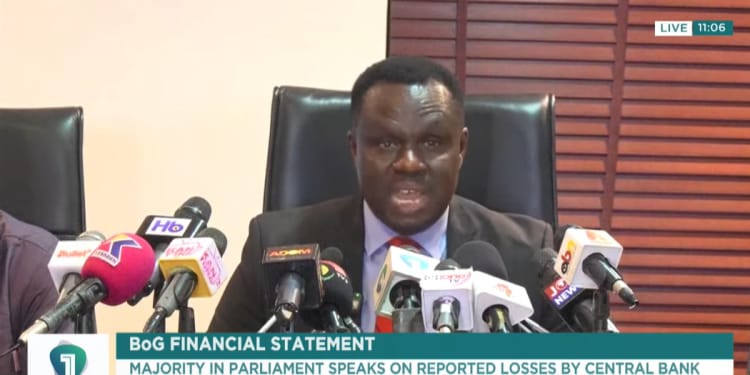
Speaking to journalists, Chairman of Parliament’s Economy and Development Committee and Member of Parliament for Amenfi West, Eric Afful, dissected the economic conditions underlying the Bank of Ghana’s GH₵15.6 billion loss for 2025.
He argued that the institution’s substantial operational deficits did not yield corresponding improvements in the country’s economic fundamentals. Inflation remained persistently elevated, the cedi sustained its downward trajectory, and gross international reserves provided only four months of import cover.
“Inflation surged at the peak of 54.13 % in 2022 before declining to 23.84 % by the end of 2024. The Ghana cedi experienced significant depreciation, reaching approximately GH₵14 to a dollar by December 2024, representing a depreciation of about 19.7%.
“Gross international reserves stood at about $9.3 billion in 2024, covering four months of import cover of goods and services. At the same time, the bank’s equity position weakened. We recorded a negative GH₵64.34 billion in 2023, improved slightly to a negative GH₵61 billion in 2024,” he explained.
In light of these figures, Afful maintained that the 2025 financial outcome must be viewed within the broader context of ongoing policy interventions rather than as an isolated fiscal anomaly.
“Given these considerations, the 2025 outcomes must be understood as the continuation of a deliberate and necessary policy intervention,” he added.
The Majority contends that despite the scale of losses absorbed by the central bank, the administration’s economic management failed to translate into price stability, currency resilience, or strengthened external buffers.