

Aimed at restoring integrity to Public Land Management
By Phillip Antoh
The government has unveiled a comprehensive set of reforms aimed at restoring transparency, accountability and efficiency in the administration of public lands, introducing measures that include a mandatory 70 per cent upfront payment of market value for land leases and the immediate resumption of services under tightened controls.
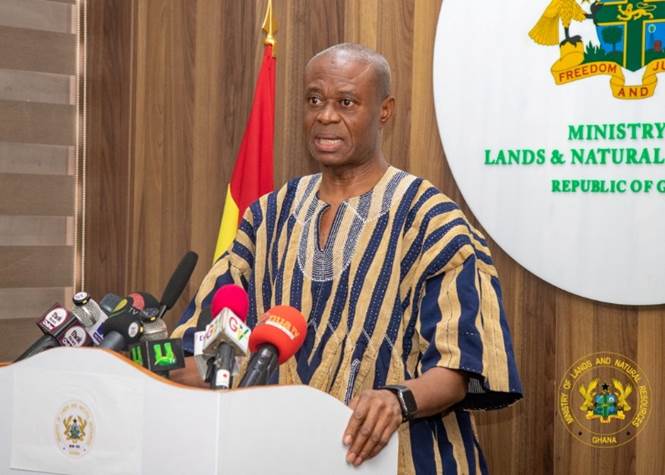
Addressing a press conference on Wednesday March 11, 2026, Deputy Minister for Lands and Natural Resources, Alhaji Dr. Yusif Sulemana (MP), revealed that the reforms are part of Cabinet directives currently being implemented by the Ministry in collaboration with the Lands Commission.
The announcement follows a year-long suspension of public land transactions ordered by President John Dramani Mahama on January 10, 2025, aimed at safeguarding state lands and restoring discipline in land administration .
One of the most significant changes announced relates to the pricing of public lands. The Ministry introduced a new premium framework for public land leases, which requires that at least 70 per cent of the assigned market value be paid upfront, with the remaining 30 per cent spread over the tenure of the lease as ground rent
Dr. Sulemana explained that the reform is designed to enhance revenue generation for the state and prevent situations where individuals paid widely varying premiums for similar lands in the past.
The move follows findings that premiums previously ranged from as low as one per cent to 30 per cent of market value a system that significantly undervalued public lands and failed to deliver value for money to the state .
Another key reform is the revision of the Public Land Application Form, popularly known as Form 5, which will now serve as the single mandatory application instrument for all public land transactions nationwide.
The revised form will be used for both new applications and reapplications by individuals whose earlier applications were cancelled during the recent review exercise.
The review uncovered significant procedural breaches in several applications, including non-compliance with the Lands Commission’s internal guidelines. A total of 8,160 lease applications executed or initiated between 2017 and 2024 across all sixteen regions were examined, comprising 4,176 direct allocations, 2,799 regularisations, and 795 subsequent transactions, among others .
To enhance accessibility and efficiency, the Lands Commission has also been directed to publish the form on its official website to allow applicants download, complete and submit their applications electronically.
The Deputy Minister further disclosed that the Ministry has undertaken a comprehensive review of the Lands Commission’s internal processes for allocating public lands Under the new framework, the stages involved in processing applications have been clearly defined, with stronger internal checks and verification mechanisms introduced to ensure transparency and traceability in decision-making.
Significantly, no public land will be allocated without the prior approval of the Minister – a measure expected to strengthen ministerial oversight and ensure that allocations align with national policy objectives
This provision reinforces policy coherence and provides an additional safeguard against unauthorised or irregular allocations.
Another major reform announced is the standardisation of land market values for estates across the country. According to Dr. Sulemana, the Ministry and the Lands Commission have compiled reliable market values for several prime estates, including over 30 estates within the Greater Accra Region.
These values will be published on the Lands Commission’s website to guide the assessment of land premiums and eliminate discretionary pricing, ensuring fairness and value for money in all public land allocations.
The move addresses longstanding concerns that politically exposed persons have in the past acquired public lands at prices far below market value.
Additionally, a Public Land Protection Taskforce will soon be inaugurated to prevent encroachment on state lands, halt unauthorised developments and prosecute offenders where necessary].
The Task Force will comprise personnel from the Ministry of Lands and Natural Resources, the Ministry of Works, Housing and Water Resources, the Lands Commission, the Ghana Police Service and allied security services, and a selected private sector stakeholder with relevant technical expertise .
Its mandate includes preventing encroachment, halting unauthorised developments, and ensuring that public lands under review are protected from illegal occupation and development during the reform transition .
As part of the transparency drive, the Deputy Minister announced that the list of all public land applications reviewed covering more than 8,000 cases will soon be published on the websites of the Ministry and the Lands Commission, beginning with the Greater Accra Region.
Completed transactions will undergo case-by-case review, and any allocation found to have been processed without full compliance with due process will be cancelled .
Dr. Sulemana added that the temporary suspension on public land transactions has now been lifted, although all services will operate strictly under the new reforms.
The Minister for Lands and Natural Resources, Emmanuel Armah-Kofi Buah, had earlier clarified that all activities may resume immediately, but strictly in accordance with the new reforms and procedures announced .
The Deputy Minister also disclosed that the Ministry has initiated the procurement process for the national digitalisation of Ghana’s land administration system, funded largely through the Lands Commission’s internally generated funds a move expected to significantly modernise land services and reduce human interference in land transactions.
The Ministry has secured 100 per cent retention of the Lands Commission’s Internally Generated Funds, out of which 67 per cent will be used for the funding of the Land Bank and Digitalisation Project.
To ensure sustainability and prevent a reversion to past practices, government has taken steps to provide legislative backing for these reforms.
The revised Public Land Application Form and the restructured internal allocation processes will be incorporated into the draft Land Regulation, which is currently undergoing review.
As the Minister emphasised in his February address, “Public lands are vested in the President in trust for the people of Ghana to be administered in the public interest.
They are meant to serve national development objectives, support public infrastructure, and promote equitable access to land”.
With these sweeping reforms, the Mahama administration is betting that transparency, technology and tougher oversight can finally deliver on that promise.