

By Nelson Ayivor
Grief is one of life’s most profound and universal experiences. It arrives uninvited, often without warning, and settles deep within the human heart. Whether it is the loss of a loved one, the end of a relationship, the collapse of a dream, or a life-altering setback, grief reshapes our world in ways that words often struggle to capture.
Yet, within its heaviness lies an unexpected possibility—the capacity for growth.
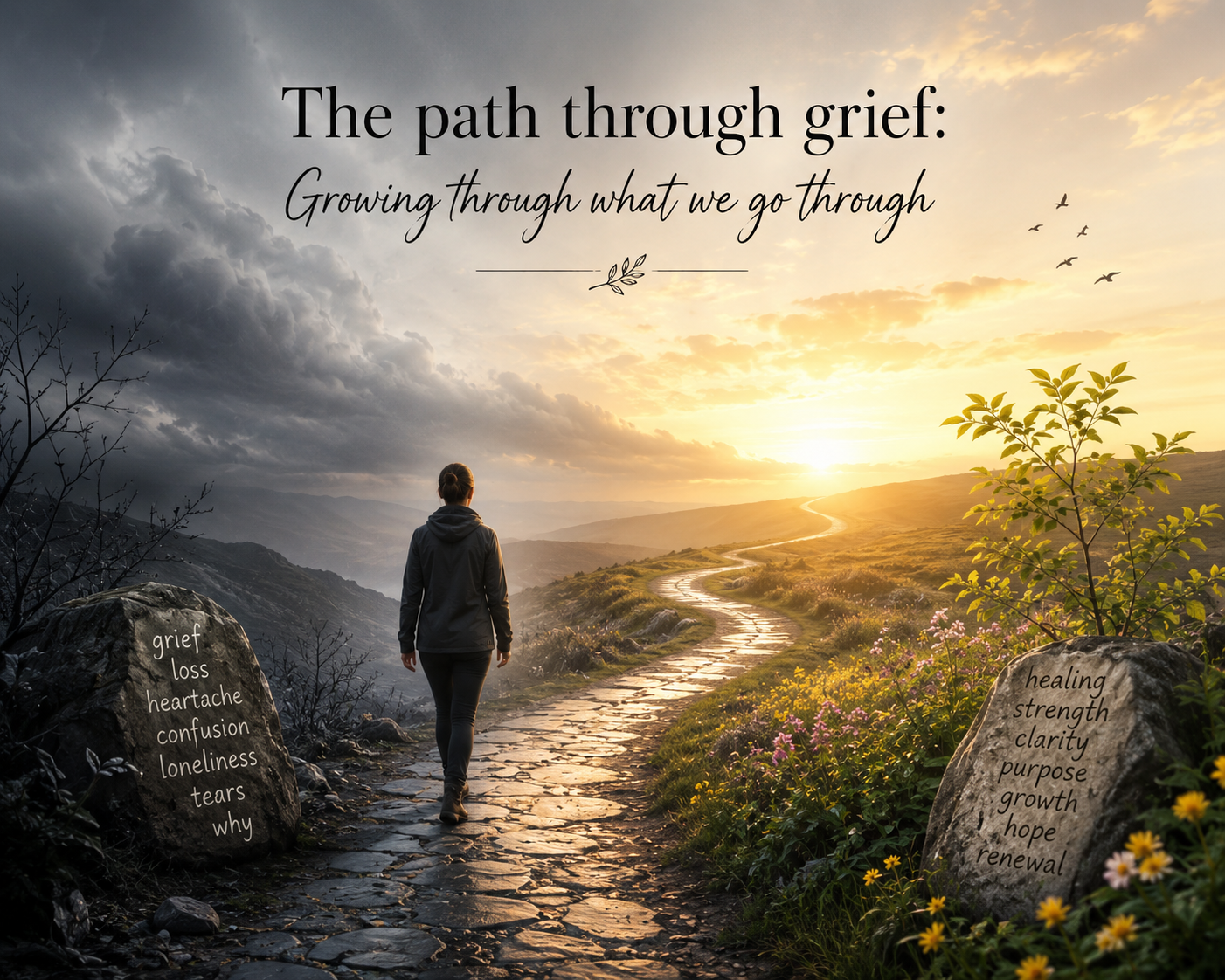
To grow through grief is not to deny pain or rush healing. It is to walk through sorrow with courage, allowing it to refine, deepen, and ultimately transform us.
Understanding Grief Beyond Loss
Grief is not a linear process. It is complex, deeply personal, and often unpredictable. The groundbreaking work of Elisabeth Kübler-Ross introduced the widely recognized stages of grief—denial, anger, bargaining, depression, and acceptance.
While these stages provide a framework, they are not a rigid sequence. People move back and forth between them, sometimes revisiting the same emotions repeatedly.
Later, scholars such as George A. Bonanno expanded our understanding by showing that resilience is more common than previously thought. Many individuals, even after profound loss, are able to maintain or regain emotional stability, not because they are unaffected, but because humans possess an innate capacity to adapt.
Grief, therefore, is not merely something to “get over.” It is something to move through—an evolving journey rather than a destination.
The Weight We Carry—and What It Teaches Us
In the early stages, grief can feel overwhelming. It disrupts routines, alters identity, and challenges one’s sense of meaning. The absence of what once was creates a void that seems impossible to fill.
Yet, grief also forces reflection. It compels individuals to confront life’s fragility and reassess what truly matters. In this way, grief becomes a teacher—harsh, unyielding, but profoundly transformative.
As Viktor Frankl observed in Man’s Search for Meaning, even in suffering, humans can find purpose. According to Frankl, meaning is not something we are given; it is something we create through our responses, even in the face of loss.
Growth Does Not Mean Forgetting
One of the most common misconceptions about grief is that healing requires letting go completely. In reality, growth often involves finding new ways to stay connected.
Psychologists describe this as “continuing bonds”—the idea that relationships do not end with loss but evolve. Memories, values, and lessons become part of who we are. The love we shared does not disappear; it changes form.
Growing through grief, then, is not about erasing the past. It is about integrating it into our present in a way that allows us to keep living.
The Role of Vulnerability in Healing
Grief has a way of breaking down emotional barriers. It exposes vulnerability in its rawest form. While this can feel uncomfortable, it also opens the door to deeper human connection.
Research by Brené Brown emphasizes that vulnerability is not weakness but strength. It is through vulnerability that people experience genuine connection, empathy, and healing.
Sharing one’s grief—whether through conversation, writing, or community—can transform isolation into solidarity. It reminds us that we are not alone in our pain.
Finding Strength in the Process
Growth through grief does not happen overnight. It is a gradual process marked by small, often unnoticed steps—getting out of bed on a difficult morning, finding moments of laughter amid sorrow, or rediscovering purpose after loss.
Resilience is built in these moments. It is not the absence of pain, but the willingness to continue despite it. In many cases, individuals emerge from grief with a renewed sense of clarity.
Priorities shift. Relationships deepen. Life is no longer taken for granted. What once seemed ordinary becomes meaningful.
Practical Pathways to Growth
While grief is deeply personal, certain approaches can support the journey: Allow the pain: Suppressing grief often prolongs it. Acknowledging emotions is the first step toward healing.
Seek connection: Support from family, friends, or community can provide strength during difficult times.
Create meaning: Engage in activities that honor what was lost—whether through service, creativity, or reflection. Be patient with yourself: Healing does not follow a timetable. Growth unfolds at its own pace.
These steps do not eliminate grief, but they create space for transformation.
Hope Beyond the Hurt
Perhaps the most powerful truth about grief is that it does not last forever in its most intense form. While the loss may remain, the pain evolves. It softens, making room for new experiences, relationships, and possibilities.
Growth through grief is not about becoming someone entirely different. It is about becoming a deeper, more compassionate version of oneself.
As time passes, many come to realize that grief has given them something unexpected—a greater capacity for empathy, a clearer sense of purpose, and a stronger appreciation for life.
Conclusion
Grief is not a path anyone chooses, yet it is one many must walk. It is filled with uncertainty, pain, and moments of profound vulnerability. But it is also a path that can lead to growth.
To grow through what we go through is to embrace the full spectrum of the human experience—to acknowledge pain without being defined by it, to carry loss without losing oneself, and to find meaning even in the midst of sorrow.
In the end, grief does not diminish the human spirit. It reveals its depth. And within that depth lies the quiet, enduring strength to rise, to heal, and to live again.
The writer is Associate Editor at The New Republic. He enjoys writing on compelling topics in religion and spirituality and draws inspiration from his faith and life’s experiences.