

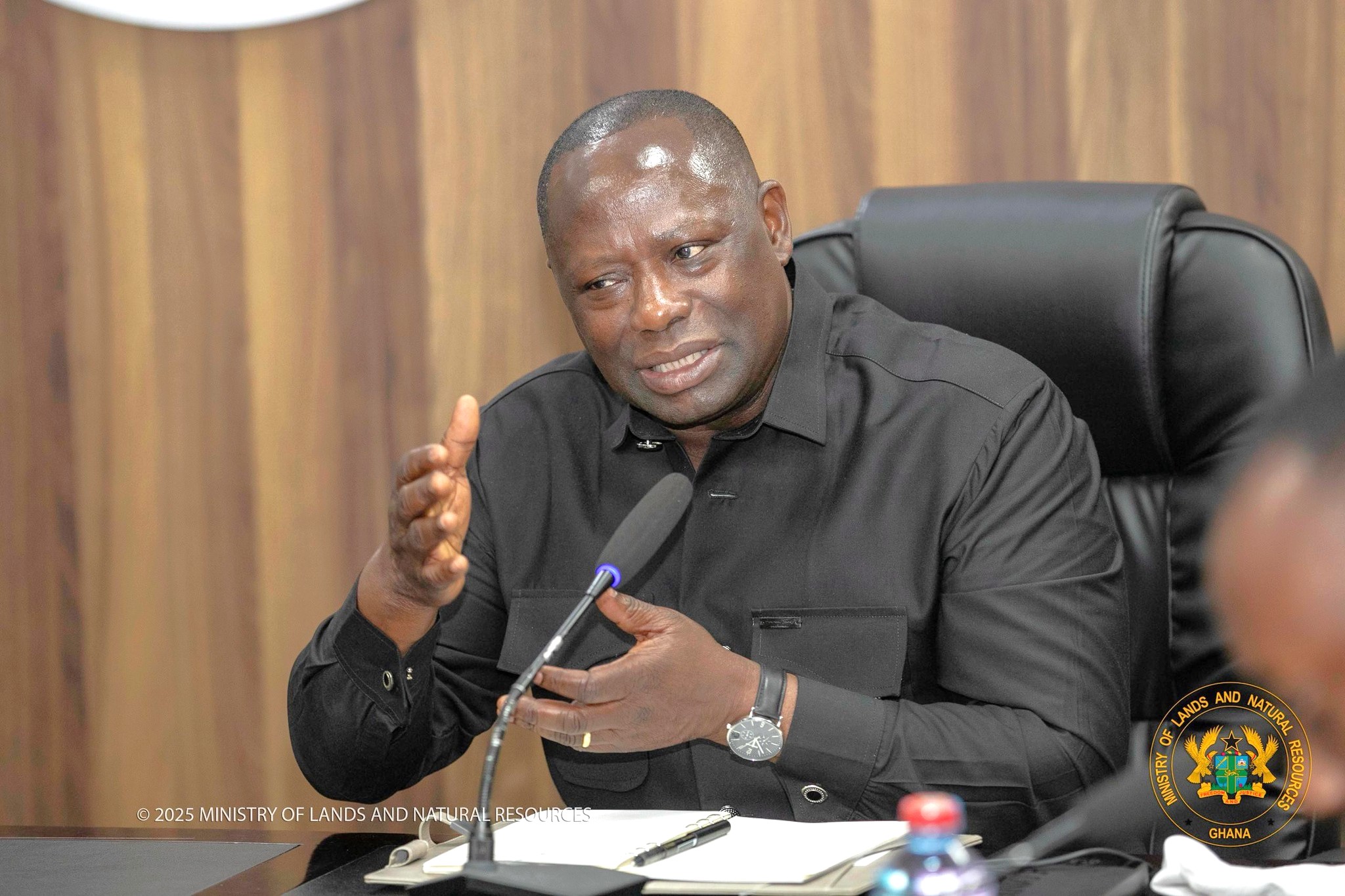
‘No Allocation Without My Nod’
By Philip Antoh
The era of backroom land deals may be facing its toughest reckoning yet. Lands Minister Emmanuel Armah-Kofi Buah announced yesterday that henceforth no public land allocation will be valid without his written approval – a direct response to a presidential audit that uncovered widespread procedural breaches across thousands of transactions.
Speaking in the Ministry’s conference room, Buah revealed that a review of 8,160 public land lease applications processed between 2017 and 2024 had exposed “significant” failures in transparency and accountability. The result: all incomplete transactions have been cancelled. Completed ones will be examined individually, and any found to violate due process will be revoked.
The numbers tell a story. Of the 8,160 applications reviewed, 4,176 were direct allocations the most opaque category. Another 2,799 involved “regularisations,” a euphemism often used to legalise prior encroachments. There were also 108 land swap or public-private partnership deals, 795 subsequent transactions, and 263 new allocations. Only 19 related to state bungalows.
The review was triggered by President John Dramani Mahama’s directive on January 10, 2025, ordering the Lands Commission to halt all public land transactions. That freeze has now been lifted, but the new rules are draconian by comparison.
The political subtext is impossible to ignore. Public land has long been a currency of patronage in Ghana allocated to party faithful, traditional authorities, or well-connected developers with little scrutiny.
Mahama’s own previous administration was not immune to such criticisms. By empowering Buah to personally sign off on every allocation, the President is centralizing control and political risk.
The new architecture includes a revised public land application form, stricter internal procedures at the Lands Commission, and the creation of a Public Land Protection Task Force to combat encroachment. But the real power shift is the minister’s veto.
The review committee tasked with scrutinizing leases across all sixteen regions was chaired by Deputy Lands Minister Yusif Sulemana. Its members read like a roll call of loyalists: Collins Dauda, MP for Asutifi South and Chairman of Parliament’s Lands Committee; Professor Bruce Kofi Banoeng-Yakubu; Professor Kwame John; and Rev. Dr Lawrence Tetteh. Notably absent are any civil society representatives.
The bottom line: Mahama is sending a signal public lands are no longer a free-for-all. But the proof will be in enforcement. Will the task force dare to evict encroachers with powerful backers? And will the minister’s approval be a genuine gatekeeping mechanism or simply a new bottleneck for rent-seekers to navigate?
For now, applicants have been put on notice. As Buah put it: “Public lands are held in trust for the people of Ghana.” Whether that trust is honoured depends on who gets approved and who gets revoked.