

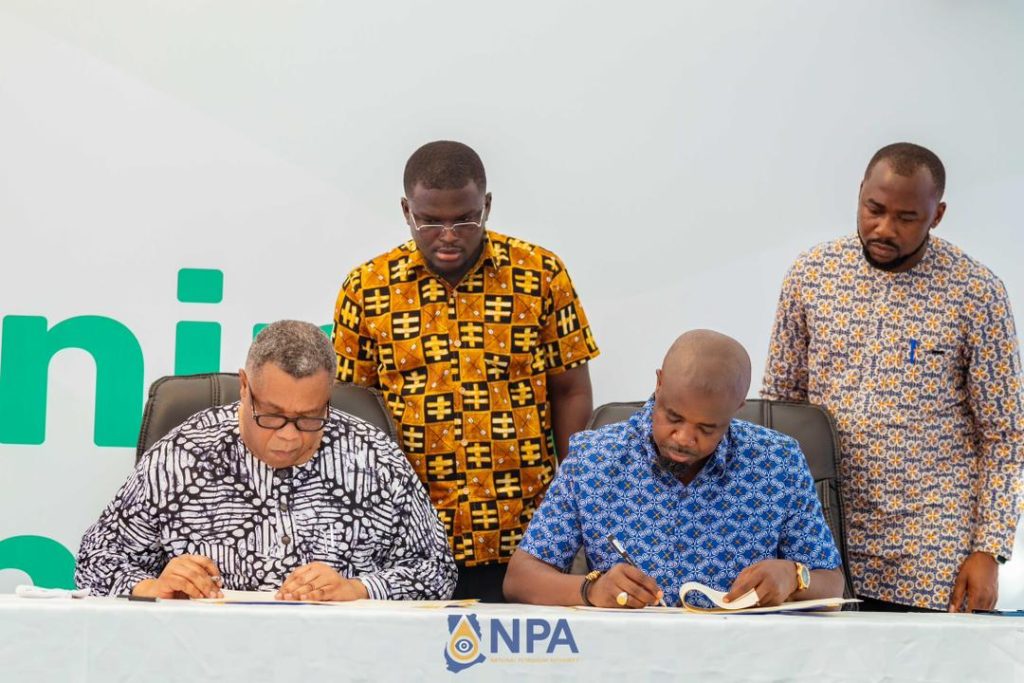
A new pact between the state’s petroleum regulator and the nascent 24-Hour Economy Authority signals a push to secure the logistical backbone of President John Dramani Mahama’s flagship industrial programme.
An Memorandum of Understanding signed on 31 March between the National Petroleum Authority (NPA) and the 24-Hour Economy Authority aims to force the downstream petroleum sector into round-the-clock operation.
The deal, which brings together security services, private distributors, and state-owned BOST Energies, marks the first major institutional test for the government’s economic transformation agenda.
Under the agreement, the NPA will impose new operational standards covering lighting, security, staffing, and digital fuel monitoring on filling stations, depots, and tanker fleets.
In parallel, the 24-Hour Economy Authority, led by presidential adviser Augustus Goosie Tanoh, will coordinate security deployments and cross-government support for certified operators.
A nationwide pilot covering 10% of the sector is slated to begin imminently, with security provision named as the immediate priority.
The MoU brings together an uneasy coalition of stakeholders: the Chamber of Oil Marketing Companies (COMAC), the Chamber of Bulk Oil Distributors (CBOD), the Ghana National Tanker Drivers Union (GNTDU), the Tanker Owners Union (TOU), and security agencies including the Ghana Police Service and the National Security Secretariat.
The inclusion of the Ghana Revenue Authority (GRA) also hints at efforts to formalise and tax operations that have historically operated with significant informality.
For the government, the initiative is less about extended trading hours than about creating the conditions for industrial expansion.
Tanoh framed the programme as a supply-side intervention, arguing that new manufacturing and agro-processing capacity would generate the demand to sustain 24-hour operations.
NPA Chief Executive Godwin Kudzo Tameklo described the MoU as aligning his agency’s regulatory mandate with the national agenda, though industry insiders note that enforcing new standards will test the NPA’s capacity for oversight.
The move comes as the government seeks to avoid the bottlenecks that have hampered previous industrialisation drives. By integrating petroleum supply with security and logistics, the administration is betting that consistent fuel availability can underpin the expansion of manufacturing corridors and export processing.
Yet the real test will be whether the state can coordinate the sprawling network of private distributors, state agencies, and often fractious transport unions without the kind of friction that has derailed such efforts in the past.