

How Akufo‑Addo’s In‑Law Allegedly Dismantled a State‑Owned Factory and Walked Away With a $100,000 SUV for $900
By Gifty Boateng
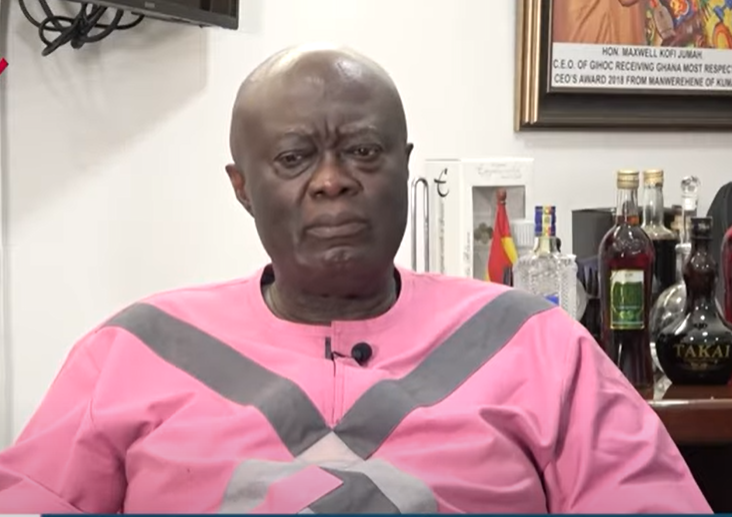
The Economic and Organised Crime Office has finally detailed why it arrested Maxwell Kofi Jumah, the 75‑year‑old former managing director of GIHOC Distilleries and an in‑law of ex‑President Akufo‑Addo.
The charges, pieced together from investigation documents and monitoring by The New Republic, paint a picture of systematic asset stripping, unauthorised self‑enrichment, and the controversial dismantling of a historic state factory.
Jumah was arrested on April 28 after a raid on his Kumasi residence. He spent days in EOCO cells before being granted a record GH¢55 million bail conditions he has yet to meet. On Monday, he was admitted to the Intensive Care Unit of Korle Bu Teaching Hospital, a development his spokesman says has further stalled compliance.
Below are the seven core allegations EOCO is examining, with financial and business implications laid out.
Jumah is accused of illegally acquiring a high‑end company vehicle originally valued at nearly $100,000 shortly after his tenure ended in January 2025.
According to investigation documents, he purchased it for just GH¢4,943 roughly 5% of its market value a transaction EOCO describes as a sweetheart deal executed without proper board or ministerial approval.
He also allegedly kept additional luxurious vehicles, including an Audi valued at $60,000, that should have been returned to the state. Jumah is under scrutiny for disposing of GIHOC properties in Tema said to be worth $70,000. The sales reportedly occurred without the mandatory authorisation of the company’s board or the sector minister. Proceeds and buyer details have not been disclosed.
Perhaps the most brazen allegation: Jumah is accused of authorising an unauthorised weekly allowance of GH¢40,000 for himself. Over a multi‑year period, this would translate into millions of cedis in self‑approved compensation outside any formal employment contract or board resolution.
Investigators allege Jumah expanded GIHOC’s workforce without approval, adding roles that were neither budgeted for nor operationally necessary. The result: a severe strain on the company’s already fragile operational budget. EOCO has not yet released the exact number of unauthorised hires or the cumulative financial impact.
The most politically and emotionally charged allegation concerns the Aboso Glass Factory in the Western Region. Established by Kwame Nkrumah on February 5, 1966 just weeks before his overthrow the factory was the first of its kind in West Africa. Built at a cost of GH¢9 million (1966 value), it once employed 500 workers and produced 18 million bottles annually, plus tableware and sheet glass.
Jumah, through his direct access to his in‑law the former president, secured permission to take control of the long‑abandoned facility in 2019. He promised a full revival, claiming he had lined up over $100 million in private investment. When European backers pulled out he blamed COVID‑19 the revival never happened.
Instead, broadcaster Blakk Rasta, who has closely followed the case, told The New Republic: “He gave obnoxious plans, ambitions that were inordinate. He made sure that he brought lofty ambitions into this thing… We will do this. We will do that. And he called it the revival plan from 2019.”
By late 2024, rather than restoring the plant, Jumah authorised a private company to enter the premises and begin dismantling. Machines that had never been used were pulled out and sold as scrap. The local chief, Nana Kwesi Appiah, was so enraged he ordered the youth to salvage whatever remained. The community woke up to find a historic factory “brought on its knees.”
Blakk Rasta’s core question: “When you went in there and realised you couldn’t do it, why did you still break it down? And when you maybe realised the machines were obsolete, why didn’t you get another piece of land to start a fresh factory?”
Ironically, Jumah was awarded Best Chief Executive Officer by the State Interest and Governance Authority (SIGA) in 2019 the very year he took over Aboso for allegedly transforming GIHOC. The award now stands as a point of contention for civil society groups who question SIGA’s due diligence.
Jumah was granted police enquiry bail of GH¢55 million on April 29. As of press time, he remains in legal custody because the conditions have not been met. His NPP spokesman, Paul Yandoh, confirmed his ICU admission on Monday, saying the deteriorating health has “slowed down attempts to fulfil the bail requirements.”
The EOCO investigation is still pending. No charges have been filed in court. But the dossier combining alleged vehicle theft, unauthorised property sales, self‑awarded allowances, and the physical dismantling of a Nkrumah‑era factory represents one of the most detailed financial misconduct cases against a politically connected state executive in recent Ghanaian history.
For investors and governance watchers, the case raises two urgent questions: how did a single managing director operate with so little oversight for nearly eight years, and what will it take to recover the assets and the factory that remain?