

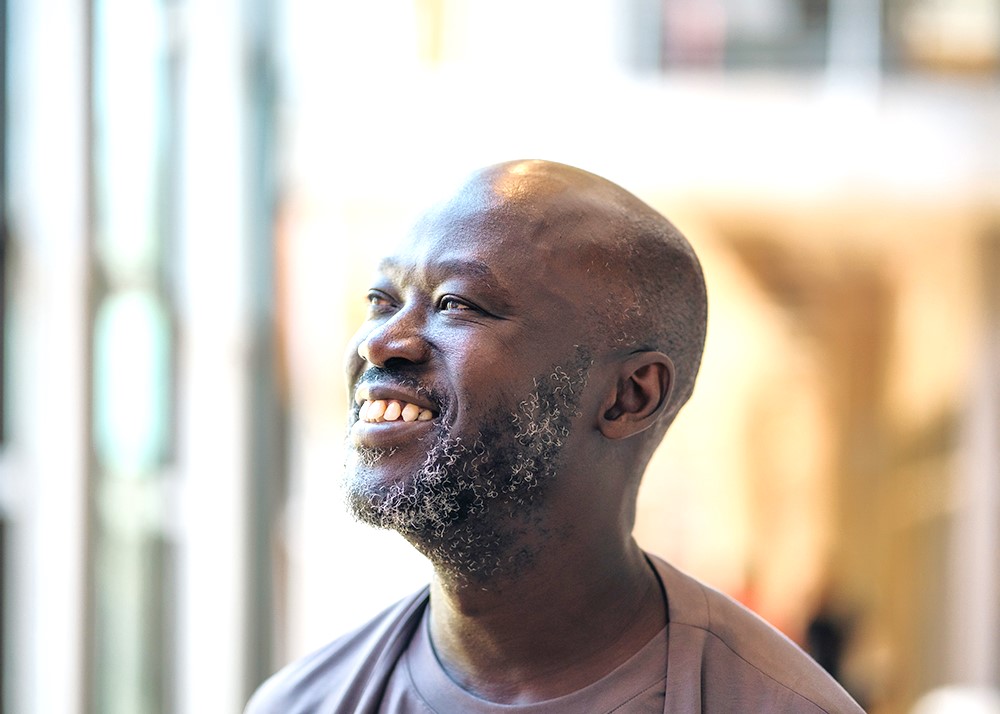
– But Avoids The $97m Question
Renowned architect defends ‘vision’ at KNUST lecture, yet critics demand answers on contract, payments, and why he waited until government changed
For the first time in years, Sir David Adjaye has spoken publicly about the abandoned National Cathedral project. But instead of providing the detailed accounting that many Ghanaians have demanded, the Ghanaian‑British architect offered an unsolicited explanation and carefully sidestepped the most painful questions about fees, procurement, and his political connections.
Speaking at a public lecture at the Kwame Nkrumah University of Science and Technology (KNUST) on Monday, Adjaye insisted that the stalled edifice was never intended to be merely a place of worship. “It was conceived as a cultural, economic and civic asset,” he told the gathering.
“I know that this project has caused a lot of heartache with lots of people,” Adjaye acknowledged. “But let me just tell you how we thought about it because I don’t think anybody has given us a chance to explain what this project is for us as architects.”
Yet the timing of his address has raised eyebrows across the capital. Adjaye remained conspicuously silent throughout the years of heated controversy under the previous Akufo‑Addo administration when the cathedral was still being promoted, funds were being released, and his selection as the preferred architect sparked fury among local professionals.
Now, with the government changed and President John Dramani Mahama having ordered the scrapping of the National Cathedral Board in July 2025, critics are asking a simple question: why speak now?
“Given his international repute, it would have served a better purpose if he had cleared his name in the heat of the moment, instead of waiting all these years until his political friends are no longer in charge,” one Accra-based architect told The New Republic, speaking on condition of anonymity.
Others wonder what pushed Adjaye to suddenly break his silence. Questions he carefully avoided at KNUST include:
· How much was he paid? Public records show that total payments, commitments, and outstanding liabilities for the project have reached at least US$97 million – a figure confirmed by Minister for Communications and presidential spokesperson Felix Kwakye Ofosu in July 2025. “Contrary to the widely held view that total payments and commitments amount to $58 million so far, there is actually an additional outstanding payment of $39 million due to the contractor,” Ofosu stated at the time.
. How did he get the contract? Critics have long alleged that Adjaye’s closeness to Gabby Asare‑Otchere a cousin of former President Nana Akufo‑Addo and influential figure in the New Patriotic Party played a role. Others point to his association with the Ofori Panyin family. Adjaye mentioned none of this at KNUST.
· Why was a local architect not chosen? At the height of the controversy, the Ghana Institute of Architects complained that its members were sidelined. Many argued that local professionals could have produced similar designs for a fraction of the cost.
In his lecture, Adjaye instead focused on the project’s potential economic benefits. “One of the most enduring and most productive injections of GDP into a country is religious tourism,” he said.
According to the architect, the cathedral complex would have included a music school, a Bible museum, social support facilities, conference facilities, a library, educational centres, and multiple wedding chapels. A large biophilic park and garden was also planned to provide much‑needed green public space in Accra.
The design also featured a crypt for national heroes, architectural elements inspired by traditional Akan symbolism, and a height that would make it “the tallest building in Accra”. Capacity was set at 25,000 people for major events.
“There is nothing like it,” Adjaye said. “It would make a unique destination in Ghana, in Accra.”
The National Cathedral was a flagship promise of former President Akufo‑Addo. Construction stalled in 2023. In July 2025, President Mahama ordered the dissolution of the National Cathedral Board, effectively freezing the project. A comprehensive forensic audit was authorised around the same time, but nearly one year later, no report has been released.
Former Finance Minister Ken Ofori‑Atta, who oversaw the expenditure of cathedral funds, has been summoned from the United States to account for his stewardship. He has so far refused to return.
Adjaye, who has been visiting Ghana frequently and recently opened an ultra‑modern studio in Accra, has not yet been called by the government to answer questions about the project. It remains unclear what will become of the site, with public opinion sharply divided.
For now, the celebrated architect has offered his vision but not his accounting. And many Ghanaians are left wondering whether the silence was broken to inform the public, or to repair a reputation.
By Gifty Boateng