

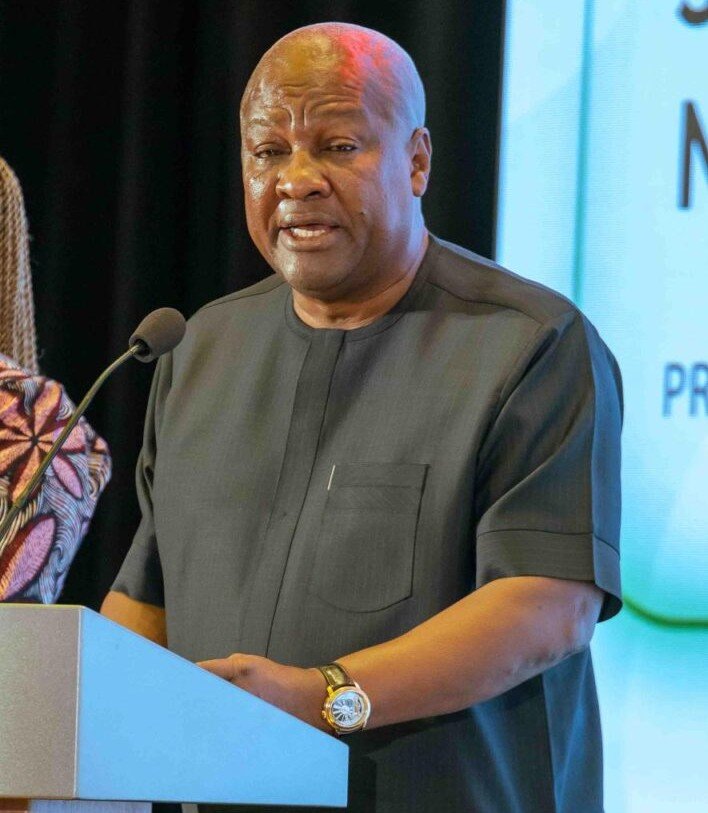
New Economy initiative targets agriculture, manufacturing, tourism and textiles as government prepares 2027 Budget.
By Prince Ahenkorah
President John Dramani Mahama has announced plans to invest more than $9 billion in job-rich sectors of Ghana’s economy between 2027 and 2030 under a new policy initiative dubbed the New Economy.
The initiative, expected to feature prominently in the 2027 Budget Statement and Economic Policy, is aimed at stimulating economic activity, expanding employment opportunities and improving the livelihoods of Ghanaians.
The announcement comes as the government prepares to present the 2027 Budget to Parliament on Thursday, November 12, with the Finance Ministry indicating that no new taxes will be introduced.
Deputy Finance Minister and Member of Parliament for Asuogyaman, Thomas Nyarko Ampem, disclosed the government’s decision during a closed-door engagement with members of the Parliamentary Press Corps ahead of the budget presentation.
According to him, the government intends to finance its flagship programmes and priority development projects through savings generated from expenditure rationalisation and cuts in public spending rather than introducing additional tax measures.
He explained that Finance Minister Dr Cassiel Ato Forson would outline the measures through which the government intends to mobilise and allocate resources to implement its development agenda.
Nyarko Ampem also indicated that the budget would provide further details on the utilisation of petroleum revenue, particularly following the government’s decision to use oil inflows to fully fund the proposed Accra-Kumasi Expressway.
The expressway is among the major infrastructure projects expected to improve transportation between Ghana’s two largest economic centres.
President Mahama announced the New Economy initiative at the 2026 Hogbetsotso Festival on Saturday, November 7, describing it as a major component of his administration’s next phase of economic transformation.
He said the policy would channel more than $9 billion into sectors with significant potential to generate employment and expand economic opportunities.
“In this presentation, we will outline our plan for what we call the New Economy. This is a bold initiative that will seek to invest over $9 billion in job-rich sectors of the economy between 2027 and 2030,” he stated.
The President identified textiles, garments, commercial agriculture, hospitality and tourism as some of the sectors expected to benefit, particularly in the Volta Region.
He said the investments were intended to create sustainable employment and ensure that Ghanaians had access to decent and dignified livelihoods.
President Mahama also highlighted ongoing development projects across various districts, including health facilities, classroom blocks and feeder roads, which he said were being supported by increased allocations from the District Assemblies Common Fund.
He attributed the increased resources available to district assemblies to his directive requiring at least 80 per cent of the Common Fund to be transferred to district administrations for local development.
However, as the government prepares to present its economic blueprint, economists and industry stakeholders are urging the administration to ensure that the proposed investments translate into tangible improvements in the lives of ordinary Ghanaians.
With unemployment, high business operating costs, infrastructure deficits and limited opportunities for young people remaining major concerns, stakeholders want the 2027 Budget to prioritise productive investment rather than focus exclusively on macroeconomic stability.
Economist Professor Godfred Bokpin has called on the government to strike a balance between fiscal discipline and strategic public expenditure to address infrastructure challenges, stimulate businesses and create decent jobs.
He cautioned that excessive expenditure controls could undermine the benefits of economic recovery if they were not accompanied by investments that strengthen the productive capacity of the economy.
Although Ghana has made progress in restoring macroeconomic stability and reducing inflation, Prof. Bokpin argued that the gains had yet to translate into meaningful improvements in the living conditions of ordinary citizens.
“You cannot be celebrating stability when all these things are going on,” he said, referencing labour unrest in the health, education and judicial sectors over conditions of service and other concerns.
He questioned the practical significance of declining inflation for people still struggling with unemployment, poor roads and inadequate access to essential services.
“What is the meaning of inflation of 5.2 per cent for someone who is selling tomatoes or spending 12 hours to go to Kumasi? It means nothing to that person,” he added.
Prof. Bokpin identified Ghana’s infrastructure deficit as a major obstacle to employment generation, warning that growth driven largely by the services sector, particularly information and communications technology, might improve economic indicators without creating sufficient jobs.
He consequently called for increased investment in agriculture, manufacturing, agribusiness and agro-processing, supported by improved infrastructure, logistics, technology and local production of inputs and equipment.
He also advocated a value-chain approach to industrialisation that connects production to processing, packaging, transportation and maintenance services to generate employment at different stages of economic activity.
Meanwhile, Director of the Institute for Fiscal Studies, Dr Said Boakye, has called on the government to undertake a comprehensive review of existing tax exemptions and incentives to ensure they provide meaningful economic benefits.
He argued that some corporate income tax exemptions across various sectors might not justify the revenue losses incurred by the state.
According to him, the government must assess the revenue forgone against the actual benefits derived, including employment opportunities for Ghanaians and foreign exchange inflows that support the cedi.
“Mere contributions to GDP by foreign-owned firms should not serve as a justification for continuous loss of government revenue through exemptions,” he stated.
Dr Boakye further cautioned against excessive reliance on tax incentives to attract foreign investment, arguing that a stable macroeconomic and political environment remained a more sustainable attraction for both local and foreign investors.
He also called for greater government participation in the extractive sector through direct investment and partnerships with private investors, citing Botswana as an example.
He suggested that production-sharing agreements could provide a better alternative to the existing concession regime in generating revenue for the country.
In the mining industry, Chief Executive Officer of the Ghana Chamber of Mines, Dr Kenneth Ashigbey, has called for incentives to support local refineries and improve their competitiveness.
He said high energy costs continued to place domestic refineries at a disadvantage and urged the government to consider allocating more hydroelectric power to the facilities to reduce their electricity expenses.