

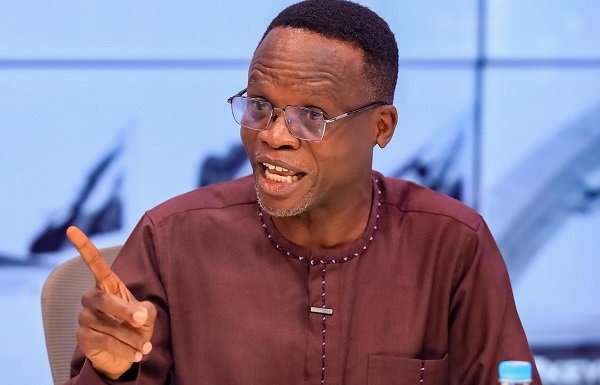
Ghana’s much-touted “New Economy” offers little that is genuinely new and stands on fragile financial foundations, development economist Dr George Domfeh of the University of Ghana has argued.
He acknowledged that the new policy centres on agriculture — agricultural transformation, agro-processing plants, including the pepper-processing facilities government has announced, and commercial farming.
“That is beautiful,” he conceded. “But if you look at it, the only key element of it is commercial farming.
And I don’t see anything new in the New Economy. There’s nothing new about it. Most of what we are being told, you already find in the 24-Hour Economy.”
In his view, the New Economy is actually less comprehensive than the 24-Hour Economy it succeeds — even as it makes agriculture the development centrepiece of the agenda.
Funding, he said, is where the Mahama administration’s 24-Hour Economy first stumbled — and where the New Economy risks stumbling harder.
Government projected to spend about US$4 billion over four years on the 24-Hour Economy. At an exchange rate of about GH¢11 to the dollar, that amounted to some GH¢44 billion. Yet successive budgets have delivered only a fraction of that — barely GH¢3.4 billion, roughly US$300 million.
“If you could not generate about GH¢4 billion out of the GH¢44 billion the 24-Hour Economy needed, how on earth are you going to generate GH¢110 billion in four years?” he asked, pointing to the US$10 billion, four-year price tag of the new agenda — some GH¢110 billion at the current rate.
He was equally sceptical of the fiscal arithmetic underneath: a plan that assumes government will hold on to a primary surplus of roughly 1% of GDP every year for the next four years and use it to bankroll the new programme.
Ghana’s own record makes that a stretch, he argued. The country recorded its first primary surplus in 2017 — after some 15 straight years of deficits — and managed surpluses in 2017, 2018 and 2019. From 2020 to 2024 it was back in deficit, with a surplus returning only in 2025, at about 1.5% of GDP. “I don’t know where that prediction is coming from,” he said.
The spending data reinforces his doubt. Last year, government planned to spend about GH¢260 billion but ended up spending about GH¢233 billion — an underspending that is partly why the 1.5% primary surplus was achieved at all.
This year, by the end of October, government was supposed to have spent about GH¢259 billion; it has so far spent only about GH¢233 billion. “So it is not that the money is there,” he said.
Dr Domfeh was also blunt about the exchange rate. The cedi’s current strength rests on a monetary regime — Bank of Ghana intervention — including the gold-for-reserves intermediation being run by the Ghana Gold Board (GoldBod), which he commended. “I like what GoldBod is currently doing. They are pumping in so much,” he said.
But that support, he warned, is hostage to gold prices. Gold sold at around $2,000 an ounce in 2024, surged to peaks above $4,000 last year — and has since pulled back. “The moment gold prices fall, we have a problem. We must not relax just because interventions are keeping the cedi strong.”
The floating exchange-rate arrangement itself is what is unsustainable, he explained, because it depends on the supply of foreign currency. If the economy is genuinely resilient — producing and exporting enough to bring in dollars on its own — the regime works.
“But when the Bank of Ghana has to go to the international market to supply dollars, all of a sudden it is not sustainable. If anything happens to that supply, it becomes a problem.” Even if the cedi settles at GH¢10 to the dollar for the next five years, that strength will not last on interventions alone.
His prescription is to attack the demand for dollars rather than defend the cedi with them.
By Gifty Boateng