

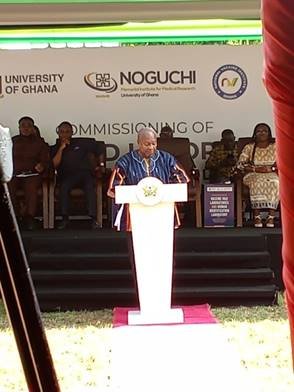
.As Mahama Inaugurates New Forensic and Vaccine Labs at Noguchi
By Philip Antoh
President John Dramani Mahama has inaugurated two landmark scientific facilities, a state-of-the-art Human Identification (DNA) Laboratory and dedicated vaccine research and development laboratories at the Noguchi Memorial Institute for Medical Research (NMIMR), in what marks a decisive shift towards health security, scientific self-reliance and homegrown vaccine production.
The facilities will allow Ghana to carry out DNA testing on its own soil, bolster forensic investigations, help identify disaster victims and missing persons, and drive the development of vaccines against both current and emerging infectious diseases.
A Painful Reminder from Adansi Akrofuom
Commissioning the projects, President Mahama framed the DNA laboratory as a direct response to a national embarrassment.
After the August 6, 2025, helicopter crash at Adansi Akrofuom that killed eight Ghanaians, tissue samples recovered from the scene had to be flown to South Africa for analysis, forcing grieving families to endure days of anxious waiting before their relatives could be identified.
The President described Ghana’s inability to perform the tests locally as ‘a day of shame’ for the nation, insisting that such dependence would now become history.”
“That will be a thing of the past. And so I’m proud now that we have a world-class facility that will strengthen our forensic and public health systems,” he said.
Beyond national tragedies, the laboratory is expected to deliver swift answers to families, allow dignified burials without delays, support police work on crimes such as rape and murder where DNA evidence is crucial, and resolve paternity, maternity and inheritance disputes requiring scientific confirmation of biological relationships.
Prez Mahama, however, emphasised the need for clear communication between the laboratory and victim-identification agencies so families receive accurate information promptly.
Breaking Vaccine Dependence
Turning to the new mRNA and protein research laboratories, the President said they represented a vital step towards Ghana’s health sovereignty.
He recalled how the COVID-19 pandemic exposed the fragility of global vaccine supply chains, with developed nations prioritising their own populations and pushing African countries to the back of the queue.
Ghana, he argued, and the continent at large must invest in local expertise, research infrastructure and pharmaceutical manufacturing to withstand future emergencies.
He listed Mpox, Lassa fever, Ebola and Marburg virus disease as threats confronting the sub-region, warning that preparedness must be built between outbreaks not during them.
Mr Mahama disclosed that Ghana is one of only five African countries deploying innovative mRNA technology for vaccine research and development.
He commended the National Vaccine Institute (NVI) for forging partnerships with the International Vaccine Institute and institutions in Europe and the United States and revealed that discussions are underway with a European institution on mRNA-based cancer vaccine research.
Homegrown Talent
Five Ghanaian scientists who received specialised training in Brussels and Accra to operate the mRNA laboratory and mentor other researchers were congratulated by the President.
They are Prof. Linda Eva Amon, Prof. Peter Kodjoe-Pachin, Prof. Augustina Angela Silvaken, Dr. Rubin Jani Ayubo and Dr. Festus Kodjoe-Akwa.
He urged universities and research institutions to deepen mentorship and collaboration, especially among young scientists, to sustain a strong pool of local expertise.
The President also appealed to citizens not to shy away from clinical trials, describing them as indispensable to vaccine development.
He recalled how misinformation and public resistance forced Ghanaian researchers to relocate Ebola vaccine trials to another African country during an earlier outbreak, stressing that Ghana cannot develop its own vaccines without citizens’ willingness to take part in properly conducted trials.
A US$1 Billion Bet on Pharma
Reaffirming government’s ambition to make Ghana a pharmaceutical and biomanufacturing hub for West Africa and beyond, Prez. Mahama announced a US$1 billion allocation to the pharmaceutical sector under the New Economies Seventh Bill, with plans for pharmaceutical and biomanufacturing hubs in the Eastern, Central and Border regions.
He called the present moment “a golden era” for Ghana’s vaccine and pharmaceutical industry, noting that the country must leverage its growing scientific capacity to improve healthcare and drive economic transformation.
He also disclosed that government will spend US$46 million this year on childhood vaccines as Ghana prepares to transition from Gavi financing by January 2030.
The President expressed gratitude to the Ministry of Health, the National Vaccine Institute, the University of Ghana, NMIMR, Africa CDC and other development partners for their roles in delivering the facilities.
A Legacy of the Fallen Eight
Health Minister Kwabena Mintah Akandoh said the Human Identification Laboratory was born from President Mahama’s directive to build local DNA-testing capacity after the helicopter crash.
He noted that although Ghana had qualified scientific personnel, it lacked the equipment, forcing the identification of the eight victims to be done in South Africa.
The Minister said the facility would speed up answers for families after disasters, aid in locating missing persons and strengthen the hands of the police and the courts.
He added that government is working with partners to secure international accreditation for the laboratory to guarantee globally recognised standards.
On vaccines, Mr Akandoh said the COVID-19 pandemic taught African countries the cost of dependence on external supplies and announced that the first vaccines bottled in Ghana are expected on the market in 2027, a milestone he described as a foundation for the country’s local vaccine development agenda.
He thanked Ghana’s Indonesian partners, the University of Ghana, the Noguchi research team, Mahama Cares, ABB Medical Limited and other stakeholders, and assured that government would invest in human resources, equipment maintenance and essential supplies to keep the facilities running effectively.
The Minister closed by paying tribute to the eight Ghanaians who perished in the August 6 crash, saying the DNA laboratory would stand as part of their enduring legacy.