

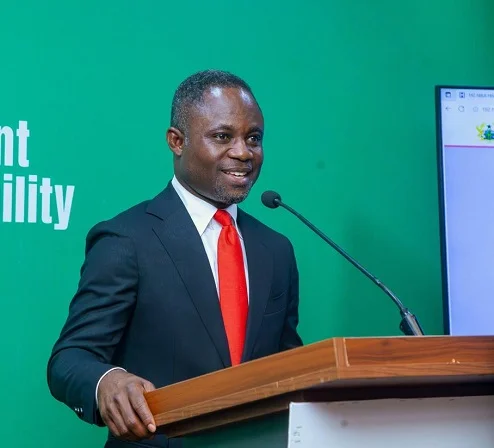
By Philip Antoh
The Minister of Health, Kwabena Mintah Akandoh, has mounted a spirited defence of the government’s increased investment in healthcare infrastructure, disclosing that capital expenditure in the sector has risen from roughly GH¢700 million in 2024 to more than GH¢9 billion in the 2027 Budget.
Speaking during Tuesday’s debate on the 2027 Budget in Parliament, Mr Akandoh said the increase of more than GH¢8.3 billion reflects the government’s commitment to expanding healthcare infrastructure and improving service delivery nationwide.
“Capital expenditure (CAPEX) in 2024 was around GH¢700 million. In the 2027 Budget, CAPEX is more than GH¢9 billion,” he told the House. “This is what we are talking about.”
He noted that the Ministry of Health has been allocated a total of GH¢40.3 billion under the proposed budget, describing the surge in capital spending as a major shift in the financing of the sector.
Under the proposed allocation, GH¢6.8 billion has been earmarked to begin the construction of two specialist hospitals, six regional hospitals, two district hospitals and a new maternal and children’s centre at the Korle Bu Teaching Hospital.
A further GH¢1 billion has been set aside to complete 35 district hospitals under the government’s Agenda 111 initiative, although the Minority has expressed doubts about the government’s ability to meet the completion target.
The Eastern and Western Regional Hospitals are also expected to receive a combined GH¢1 billion to support their development.
Beyond infrastructure, the National Health Insurance Scheme (NHIS) emerges as one of the largest beneficiaries of the ministry’s budget, with an allocation of GH¢10.2 billion.
The Ghana Medical Trust Fund, popularly known as MahamaCares, is expected to receive GH¢2.6 billion, while GH¢200 million has been allocated for ambulances and GH¢100 million for childhood and maternal vaccines.
The budget also provides GH¢60 million towards the completion of the La General Hospital and GH¢70 million to support psychiatric hospitals.
Despite the headline increase in capital allocation, Mr Akandoh conceded that the ministry remains under financial pressure, as a significant share of its resources goes into compensation and the procurement of goods and services.
These recurrent expenditures, he argued, leave little room for expanding healthcare infrastructure and implementing other development projects.
“When compensation and goods and services are taken from the allocation, very little is left for expansion of the sector,” he said.
The Minister also sought to reassure Parliament about the government’s capacity to utilise the resources allocated to health, promising to present evidence of improved budget execution when the House considers the appropriation estimates.
He said implementation of the 2026 health budget had already exceeded 80 per cent, a figure he pledged to demonstrate during the subsequent appropriation debate.
“When we get to the appropriation debate, I would demonstrate to this House that there has been more than 80 per cent execution of the 2026 budget,” he stated.
Finance Minister Dr Cassiel Ato Forson presented the 2027 Budget Statement and Economic Policy to Parliament on November 12, outlining the government’s spending priorities, including a US$10 billion New Economy programme and a commitment not to introduce new taxes.
Mr Akandoh also appeared before the House on Tuesday to announce a directive for the merger of two patient-data management systems as part of efforts to streamline health information management.