

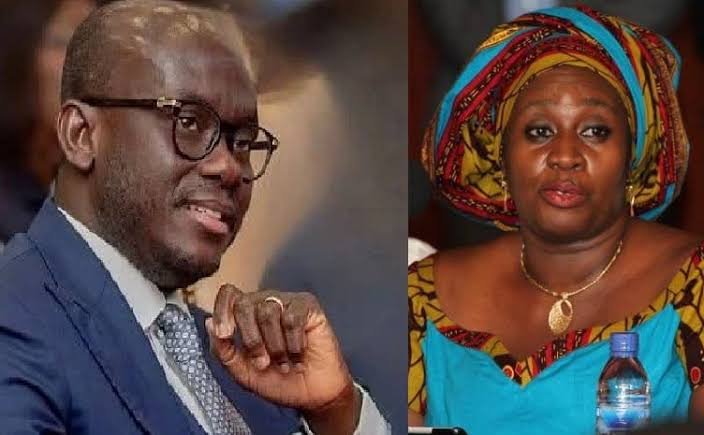
Judges Say, The State’s Case Was Built On Sand
The stage is set for former Microfinance and Small Loans Centre (MASLOC) CEO Sedina Christine Tamakloe Attionu to walk free after the Court of Appeal unanimously overturned her corruption conviction in a judgment that has reignited debate about prosecutorial competence in Ghana’s high-profile financial crime cases.
The verdict, delivered on July 30, 2026, represents a devastating blow to the state’s case against the former NDC official, with legal observers pointing to fatal strategic errors made during the initial prosecution under former Attorney General Godfred Yeboah Dame.
Attorney General Dr. Dominic Ayine, clearly caught off guard, announced at a press conference that he would appeal the decision and seek a stay of execution while admitting he had not yet read the full judgment.
“I have instructed that a stay of execution be filed, and we will proceed to the Supreme Court,” Dr. Ayine told journalists, acknowledging his announcement was based on “hunch” rather than a thorough review of the appellate ruling.
The Attorney General’s hurried response was widely interpreted as a political necessity rather than a legal one. With Tamakloe being a prominent member of the ruling National Democratic Congress (NDC), the government’s opponents were quick to exploit the timing of her acquittal for political gain.
When approached by court reporters for comment, former Attorney General Godfred Yeboah Dame offered a sardonic response that underscored the political dimensions of the case.
“Go and ask the current Attorney General. He is the same person who filed nolle prosequi in many of the other cases involving NDC people, go and ask him.”
The insinuation was unmistakable: that the loss at the Appeals Court was the outcome of deliberate poor prosecution by Dr. Ayine, who allegedly presented a lax case to free a fellow party member.
However, legal analysts point out that Tamakloe’s lawyers filed the appeal in October 2024 when Yeboah Dame was still Attorney General under the Akufo-Addo administration. Dr. Ayine only inherited the case upon becoming Attorney General in 2025.
At the heart of the state’s failure lies a strategic decision that legal experts now describe as catastrophic: Yeboah Dame’s choice to prosecute Tamakloe in absentia rather than pursuing extradition from the United States, where she had traveled for medical treatment.
The High Court trial proceeded without Tamakloe’s physical presence, meaning she was never cross-examined a procedural loophole that proved decisive.
Alfred Tuah-Yeboah, then Deputy Attorney General, had defended the approach at the time with an argument that now appears tragically flawed.
“We deliberately chose to complete the trial first and then seek extradition later because that would make the extradition request much stronger,” Tuah-Yeboah had explained. “If we had halted the trial and pursued extradition earlier, she could have argued political persecution and frustrated the process.”
That miscalculation created the technical situation that Tamakloe’s legal team exploited at the Appeals Court, successfully arguing that she was denied the fundamental presumption of innocence until proven guilty.
The decision to proceed with trial in absentia has been harshly criticized by legal observers, with one describing it in Akan parlance as akin to “seducing a corpse” an easy but ultimately hollow victory.
With Tamakloe absent from the courtroom, the prosecution faced no cross-examination that could have tested her defenses. Crucially, this meant critical issues including the fact that payments which supposedly caused financial loss to the state were actually effected by former Finance Minister Ken Ofori-Atta after the NPP government took office in 2017 were never properly ventilated.
The Appeals Court unanimously faulted the High Court for not properly applying the principle that an accused person is presumed innocent until proven guilty. The appellate judges also expressed disappointment in the prosecution’s “shoddy job,” highlighting the bogusness of charges that included allegations of causing financial loss for spending money on training programmes without evidence that the programmes were never held.
Dr. Ayine’s appeal to the Supreme Court faces exceptionally long odds, legal experts say.
As an appellate court, the Supreme Court does not exercise original jurisdiction to consider new evidence. It will only review the Appeals Court’s judgment nothing more.
This means Tamakloe will not be cross-examined before the Supreme Court. The golden opportunity that prosecutors have to pick apart an accused person’s case was squandered at the High Court level.
Under Ghana’s legal system, an accused person cannot be tried twice before the same court as it would constitute double jeopardy. The High Court is the highest court with original jurisdiction to accept witness evidence. Beyond that lie appellate courts, which only review judgments of lower courts.
The prospect of a Supreme Court reversal appears remote given the unanimity of the Appeals Court ruling. All three justices Emmanuel Ankamah J.A., Samuel Obeng-Diawuo J.A., and Emmanuel Senyo Amedahje J.A. concurred in overturning the conviction.
Yeboah Dame’s record as Attorney General now faces renewed scrutiny, with the Tamakloe case joining a growing list of high-profile prosecutorial failures.
The same former Attorney General presided over the GH¢3.3 billion corruption case against former Finance Minister Dr. Kwabena Duffuor and seven others which was ultimately discontinued. His prosecution of Democracy Hub activists for unlawful assembly and treason felony charges against lawyer Oliver Barker-Vormawor also collapsed under his successor through nolle prosequi applications citing lack of basis.
Perhaps most damning was the revelation that Yeboah Dame was caught on tape coaching a witness to lie under oath to obtain an easy conviction an incident that severely undermined his credibility.
His politically charged case against former SSNIT Director-General Dr. Ernest Thompson and former Minister Collins Dauda over the Saglemi Housing project was also discontinued through nolle prosequi applications.
With the benefit of hindsight, legal analysts conclude that Yeboah Dame’s decision to pursue trial in absentia rather than extradition effectively “rolled out the red carpet” for Tamakloe to walk free.
The state’s only remaining option is the Supreme Court appeal an exercise that many legal observers describe as largely academic, given the procedural constraints.
“Under circumstances like this, it would take a seismic shift in logic for the Supreme Court to overrule the unanimous judgment of the Appeals Court,” said a legal analyst who requested anonymity. “Such overturns usually do not happen.”
What makes the situation particularly galling for the state is that no fresh evidence exists. Dr. Ayine made clear at his press conference that he has no new evidence beyond the docket he inherited from Yeboah Dame.
“The dye looks to be already cast,” the analyst added. “The Supreme Court is more likely than not to uphold the Appeals Court judgment.”
Sedina Tamakloe, who has remained outside Ghana’s jurisdiction throughout the legal proceedings, is now poised to secure her freedom a freedom that, barring a Supreme Court intervention of unprecedented nature, appears all but guaranteed.